
Bitcoin's Strategic Position Amid Apple's iPhone Launch
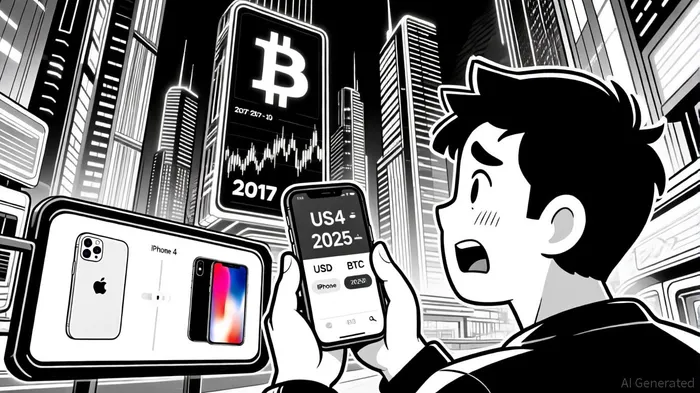
In the fall of 2025, two contrasting narratives dominate global markets: Apple's iPhone 17 launch and Bitcoin's meteoric rise to $112,000. While Apple's latest flagship faces mixed consumer sentiment due to pricing adjustments and unmet AI expectations, Bitcoin's surge has made a single iPhone 17 cost just 0.007 BTC—a far cry from the 2,842 BTC required for the iPhone 4 in 2010. This divergence underscores a fundamental tension between speculative crypto demand and consumer-driven tech adoption cycles.
Bitcoin's Strategic Position: Macro Moves and Regulatory Tailwinds
Bitcoin's recent performance has been fueled by macroeconomic shifts and regulatory clarity. The Federal Reserve's dovish pivot, highlighted by Chair Jerome Powell's Jackson Hole speech, has shifted market focus from inflation to employment data. For every 100,000 positive job surprises, BitcoinBTC-- has gained 0.9%. Meanwhile, the U.S. government's approval of the GENIUS Act has provided a framework for institutional adoption, with BlackRockBLK-- and Grayscale launching Bitcoin ETFs that now hold over $50 billion in assets.
This institutional embrace has transformed Bitcoin from a speculative asset into a quasi-safe haven. As of 2025, 28% of U.S. adults own cryptocurrencies, up from 15% in 2021. The purchasing power of Bitcoin against consumer goods has also shifted dramatically: one BTC now buys 140 iPhones, compared to just 0.35 iPhones in 2017. This inversion reflects Bitcoin's 2,700% price increase since 2017 versus the iPhone's relatively stable pricing (adjusted for inflation).
Apple's Consumer-Driven Tech Cycle: Pricing, Perception, and Plateaus
Apple's iPhone 17 launch, however, tells a different story. Despite introducing a slimmer “Air” model and a $1,999 2-terabyte Pro variant, the product line has struggled to excite investors. Analysts note that Apple's pricing strategy—raising base storage while avoiding major AI features—has left consumers and shareholders underwhelmed. The stock dropped 3% in the days following the launch, signaling skepticism about the product's value proposition.
Historically, Apple's iPhone sales have followed a predictable cycle. In 2024, the company sold 232.1 million units, capturing 18.7% of the global smartphone market. Yet, this success is increasingly challenged by stagnant innovation. The iPhone 17's lack of groundbreaking AI capabilities—a feature dominating headlines in 2025—has highlighted the limits of iterative hardware upgrades. Meanwhile, Android's 72.46% market share suggests that Apple's dominance in high-value markets (like the U.S. and China) may not translate to broader adoption.
Contrasting Forces: Speculation vs. Utility
The iPhone and Bitcoin represent two distinct economic forces. Consumer tech cycles are driven by tangible utility—users pay for devices that solve real-world problems (communication, productivity). In contrast, crypto demand is often speculative, tied to macroeconomic trends, regulatory shifts, and network effects.
This divergence is evident in adoption patterns. The iPhone's 1.56 billion active users reflect a mature, utility-driven market. Conversely, Bitcoin's 28% U.S. ownership rate is fueled by a mix of retail speculation and institutional bets on its store-of-value proposition. While Apple's growth is capped by physical constraints (production costs, supply chains), Bitcoin's value is theoretically unbounded, limited only by regulatory and technological hurdles.
The Road Ahead: Diverging Trajectories
For investors, the iPhone 17 and Bitcoin highlight two investment paradigms. Apple's stock, while resilient, faces headwinds from saturated markets and slowing innovation. Bitcoin, on the other hand, benefits from a confluence of macroeconomic tailwinds (dovish Fed policy, ETF adoption) and a narrative of digital scarcity.
Yet, risks remain. If the Fed tightens again or Trump's pro-crypto policies face legal challenges, Bitcoin could face a correction. Similarly, Apple's ability to reinvigorate its product line—perhaps through AI integration in 2026—could reignite consumer demand.
In the end, the iPhone 17 and Bitcoin are not competitors but mirrors of their respective ecosystems. One thrives on incremental innovation and brand loyalty; the other on macroeconomic shifts and speculative fervor. For investors, understanding this duality is key to navigating the next phase of both markets.
Source:
[1] What will drive crypto in Q3 2025? [https://www.blockscholes.com/research/bybit-x-block-scholes-quarterly-report-what-will-drive-crypto-in-q3-2025]
[2] 8 Years Ago You Could Buy an iPhone 17 with 1 Bitcoin [https://cryptorank.io/news/feed/d12e5-8-years-ago-you-could-buy-an-iphone-17-with-1-bitcoin-how-many-can-you-get-now-that-its-launched]
[3] What analysts had to say about Apple's iPhone 17 lineup ..., [https://www.cnbc.com/2025/09/10/increased-confidence-in-growth-what-analysts-had-to-say-about-apples-iphone-17-lineup-release.html]
[4] 2025 Cryptocurrency Adoption and Consumer Sentiment ... [https://www.security.org/digital-security/cryptocurrency-annual-consumer-report/]
[5] AI Gets Scant Mention At AppleAAPL-- iPhone 17 Launch Event, [https://www.investors.com/news/technology/apple-stock-down-after-iphone-17-launch-event/]
[6] iPhone - statistics & facts, [https://www.statista.com/topics/870/iphone/]





Comentarios
Aún no hay comentarios