
Bitcoin's Stagnation at $111K: A Pre-Fed Decision Inflection Point?
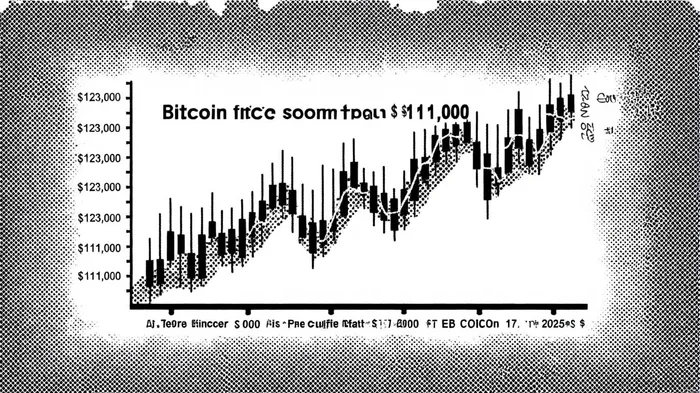
Bitcoin's price has lingered near $111,000 for weeks, caught in a tug-of-war between institutional accumulation and macroeconomic uncertainty. This stagnation, while seemingly uneventful, masks a brewing inflection pointIPCX-- tied to the Federal Reserve's September 17, 2025, policy decision. To understand whether this is a prelude to a breakout or a capitulation, we must dissect the interplay of macroeconomic catalysts, market sentiment, and historical precedent.
Macroeconomic Catalysts: The Fed's Tightrope Walk
Bitcoin's current price stagnation reflects a delicate balance between two forces: institutional demand and long-term holder (LTH) distribution. Despite spot BitcoinBTC-- ETFs and corporate treasuries absorbing hundreds of thousands of BTC, LTHs have offset this by moving over 450,000 BTC into short-term wallets—a sign of potential near-term selling pressure [1]. Meanwhile, leveraged capital in futures and options markets has further dampened spot demand, locking liquidity into speculative bets rather than direct purchases [1].
The Fed's upcoming rate cut, priced at 100% probability for a 25-basis-point reduction and 10% for a 50-basis-point cut [2], could tip this balance. Historically, Bitcoin has surged during liquidity expansions and dollar weakness. For instance, the 2020–2022 period saw Bitcoin rally amid zero interest rates and quantitative easing, with studies estimating a 13.25%–21.20% price increase per 1% rate cut [5]. A Fed pivot toward easing could replicate this dynamic, weakening the U.S. dollar and redirecting capital into risk assets like Bitcoin [4].
However, the effectiveness of a rate cut hinges on broader economic signals. If the Fed's easing is interpreted as a response to economic weakness rather than structural inflation control, risk appetite may remain constrained, capping Bitcoin's upside until stronger ETF inflows or liquidity expansion materialize [2].
Market Sentiment: Neutral Ground with Volatility Looming
Bitcoin's Fear and Greed Index currently sits at 48, a “Neutral” reading that underscores a market neither euphoric nor panicky [1]. This ambivalence aligns with the broader crypto ecosystem's cautious optimism. Prediction markets like Polymarket assign an 82% probability to a 25-basis-point cut, while VIX futures suggest traders are bracing for post-decision volatility [4].
Technical indicators add nuance. Bitcoin recently fell from a year-to-date high of $124,200 to $111,000, forming a double-top pattern at $123,002. A breakdown below the $111,000 neckline could trigger a retest of $105,000 [1]. Conversely, a sustained rebound above $123,000 would signal renewed bullish momentum, particularly if the Fed's easing is perceived as a liquidity boost rather than a crisis response.
Historical Parallels and the Inflection Point Thesis
Bitcoin's price history reveals a clear correlation with Fed policy. During the 2024 easing cycle, Bitcoin surged to all-time highs as rate cuts reduced borrowing costs and boosted risk-on sentiment [5]. Similarly, the 2020–2022 period saw Bitcoin rally amid zero rates and QE, with a 0.78 correlation to global M2 money supply growth [4]. These patterns suggest that the Fed's September decision could act as a catalyst, either breaking Bitcoin out of its consolidation phase or accelerating a pullback.
The inflection point hinges on three variables:
1. Magnitude of the rate cut: A 50-basis-point surprise could trigger a liquidity-driven rally, while a 25-basis-point cut may only provide a modest tailwind.
2. Institutional behavior: ETF inflows and MicroStrategy's treasury activity will determine whether demand outpaces distribution.
3. Geopolitical and inflation dynamics: Persistent inflation or geopolitical tensions could amplify Bitcoin's appeal as a hedge, even in a hawkish Fed environment.
Conclusion: The Clock is Ticking
Bitcoin's $111K level is more than a technical support—it's a psychological battleground. The Fed's September decision will test whether this price stagnation is a prelude to a breakout or a capitulation. For investors, the key is to monitor liquidity shifts, ETF flows, and post-decision volatility. If the Fed's easing is accompanied by dollar weakness and improved macroeconomic conditions, Bitcoin could retest $124,000 within weeks. Conversely, a hawkish surprise or profit-taking by institutions could see the price dip below $105,000.
In this high-stakes environment, patience and precision are paramount. The next two weeks will determine whether Bitcoin's stagnation is a pause in a bull run—or a warning shot in a bear market.






Comentarios
Aún no hay comentarios