
Bitcoin's Sideways Action Amid Reopening Markets: A Preemptive Play on Rate Cuts and ETF Flows?
The ETF Inflow Paradox: Institutional Confidence vs. Stalling Demand
Spot BitcoinBTC-- ETFs have been a cornerstone of the cryptocurrency's 2025 narrative, attracting over $523 million in a single day of inflows in late October. However, recent data reveals a paradox: while institutional adoption remains robust, ETF inflows have stalled, with BlackRock's iShares Bitcoin Trust recording a $570 million outflow in a single week. This divergence underscores the fragility of Bitcoin's bullish momentum.
The slowdown in ETF demand coincides with broader macroeconomic easing. For instance, the Bank of Canada's October rate cut to 2.25% and the U.S. Federal Reserve's September 25-basis-point reduction have made non-yielding assets like Bitcoin more attractive. Yet, the lack of sustained inflows suggests that institutional investors are hedging their bets, awaiting clearer signals from central banks and global markets.
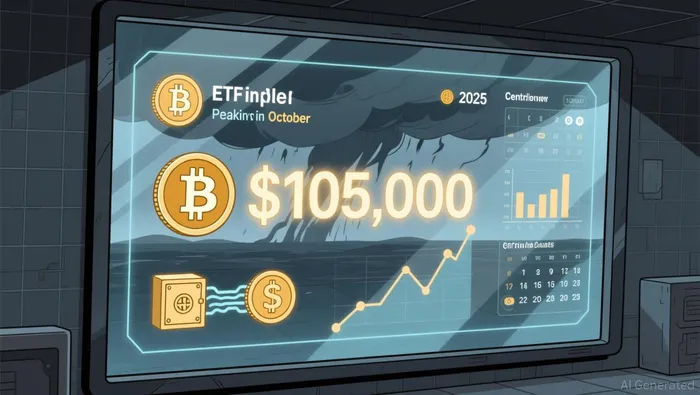
Rate Cuts as a Catalyst: Bitcoin's Safe-Haven Reimagined
The Fed's September rate cut marked a pivotal shift in monetary policy, reducing the opportunity cost of holding Bitcoin and other non-yielding assets. In Q3 2025, Bitcoin surged 8% to $114,600 amid this easing cycle, reinforcing its narrative as a digital safe-haven asset. Analysts like Tom Lee of Fundstrat argue that Bitcoin could retest $200,000 in 2025, citing structural bull market dynamics.
However, the Bank of Canada's decision to halt its rate-cutting cycle in October highlights the fragmented nature of global monetary policy. While U.S. rate cuts have bolstered Bitcoin's appeal, divergent central bank actions-such as the Fed's "risk management" approach-introduce volatility. This fragmentation complicates strategic positioning, as investors must balance regional policy divergences with global macroeconomic trends.
Strategic Positioning: Institutions Bet on Cost-Efficient Exposure
Institutional investors are increasingly favoring cost-efficient Bitcoin ETFs like Grayscale's Bitcoin Mini Trust ETF (0.15% fee), signaling a shift toward long-term portfolio diversification. Emory University's 245% increase in holdings of this ETF, now valued at $51.8 million, exemplifies this trend. Such moves suggest that institutions view Bitcoin not as a speculative play but as a hedge against inflation and geopolitical instability.
Yet, the October 10 crash-when $19 billion in leveraged positions were liquidated-has left a lingering risk-off sentiment. While Bitcoin stabilized above $104,000, the market remains sensitive to macroeconomic news, with technical indicators like the MACD and RSI offering mixed signals(https://www.bitget.com/news/detail/12560604939467). This duality-resilience amid fragility-defines Bitcoin's sideways action.
The Road Ahead: Macro Clarity or Structural Headwinds?
Bitcoin's trajectory in 2025 hinges on two critical factors: the sustainability of ETF inflows and the timing of central bank rate cuts. If the Fed's easing cycle accelerates and ETF demand rebounds, Bitcoin could break above its $115,000 resistance level. Conversely, prolonged ETF outflows or delayed rate cuts could trap Bitcoin in its current range, limiting upside potential.
For now, the market is in a holding pattern. As Treasury Secretary Scott Bessent emphasized, gradual adjustments in debt issuance and capital requirements will shape investor behavior. In this environment, strategic positioning requires a nuanced balance-leveraging Bitcoin's safe-haven appeal while hedging against macroeconomic uncertainties.





Comentarios
Aún no hay comentarios