
Bitcoin's Short-Term Weakness and On-Chain Signals of Institutional Accumulation
The Paradox of Institutional Demand
Bitcoin's institutional narrative has shifted dramatically in 2025. BlackRock's spot BTC ETF, once a cornerstone of bullish momentumMMT--, now sees inflows plummet to below 1,000 BTC per week from peaks exceeding 10,000 BTC, according to a Coinotag report. This collapse in demand has coincided with a sharp correction in price, with Galaxy DigitalGLXY-- slashing its 2025 price target from $185,000 to $120,000, according to a Coinotag report. Yet, beneath the surface, the data reveals a counterintuitive trend: ETFs and corporate treasuries now hold over 2 million BTC, or 10% of the circulating supply, according to a CryptoNews report. Accumulator addresses-wallets consistently buying Bitcoin without selling-have doubled to 262,000 in two months, controlling 262,000 BTC, according to the same CryptoNews report.
This accumulation is not a retail-driven frenzy but a calculated, capital-efficient strategy. As one analyst notes, "Institutional buyers are treating Bitcoin like a corporate bond: a low-cost, high-liquidity asset to hedge macro risks," according to a Coinmonks article. The recent $20 billion in liquidations on October 10, according to a Coinotag report, further underscores this dynamic: while retail panic sold, institutional players added to their positions, offloading only 470,000–400,000 BTC during bearish phases, according to the same Coinotag report.
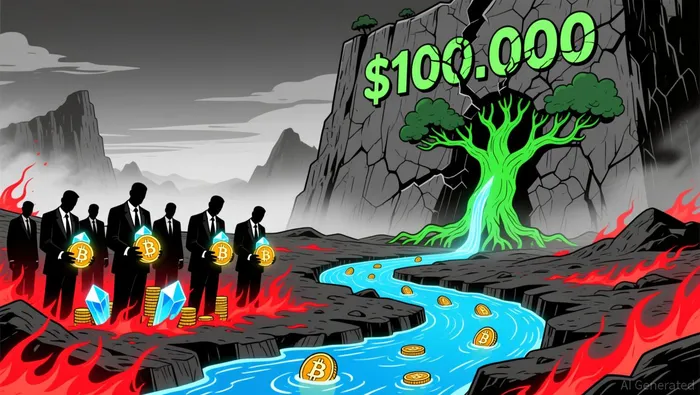
Contrarian On-Chain Signals: UTXO Growth and NVT Resilience
Historical bear markets (2018–2023) offer a blueprint for interpreting these signals. During those periods, Bitcoin's Unspent Transaction Output (UTXO) count grew despite price declines, reflecting a resilient network with deepening utility, according to a CryptoSlate report. As of November 2025, UTXO growth remains robust, with 100 million outputs in profit-a metric historically correlated with positive momentum, according to the same CryptoSlate report.
The Network Value to Transaction (NVT) ratio, a key metric for gauging Bitcoin's utility, also tells a bullish story. At 27.40, the NVT ratio is stable despite a 347% drop in exchange outflows to 18,615 BTC, according to a Bitget report. This suggests that Bitcoin's market cap is being sustained by consistent transaction volumes, a sign of enduring demand. Meanwhile, short liquidations of $929K, according to the same Bitget report, indicate that sellers are being forced out of positions, creating a vacuum for buyers to step in.
Strategic Entry Points: Lessons from the 2018–2023 Bear Markets
The 2018–2023 bear markets provide critical context for today's dynamics. During those periods, institutional buyers treated Bitcoin as a "buy-the-dip" asset, accumulating during volatility to secure long-term gains, according to a Institutional Investor article. For example, Japan's MetaPlanet leveraged its Bitcoin reserves to secure a $100 million loan, according to a Yahoo Finance report, using the proceeds to expand its holdings-a strategy now mirrored by companies like Cango, according to a CoinDesk report.
The key takeaway for 2025 is that institutional entry points often emerge when retail sentiment turns negative. The recent $1 billion in ETF outflows, according to a Coinotag report, and Galaxy's revised $120,000 target, according to the same Coinotag report, signal a psychological low point. Yet, on-chain data suggests that this is precisely when whales and corporations begin to act. Accumulator addresses now hold 262,000 BTC, according to the CryptoNews report, a figure that could drive a 5–10% price rebound if these wallets decide to rebalance.
The Path Forward: A Framework for Institutional-Grade Exposure
For investors seeking to capitalize on this divergence, the strategy is twofold:
1. Leverage UTXO and NVT signals to identify accumulation zones.
2. Time entry points around ETF outflows and short liquidations, which historically precede institutional buying, according to the Bitget report.
The risks are clear-leveraged liquidations and macroeconomic headwinds remain. However, the data suggests that Bitcoin's "maturity era" is defined by institutional flows, not retail speculation, according to the Coinotag report. As one mining firm, Cango, pivots to dual-purpose energy infrastructure, according to a CoinDesk report, the broader ecosystem is aligning with Bitcoin's long-term value proposition.
In a market where fear dominates headlines, the on-chain metrics tell a different story: one of patience, capital efficiency, and strategic accumulation. For those willing to look beyond the noise, the path to institutional-grade Bitcoin exposure is clearer than it has been in years.







Comentarios
Aún no hay comentarios