
Bitcoin's Short-Term Vulnerabilities and Contrarian Opportunities in Q3 2025
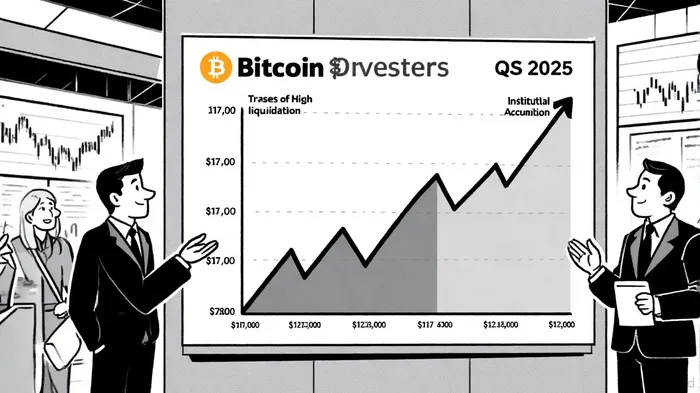
The Bull Cycle's Shadow: Supply Dynamics and Liquidation Risks
Bitcoin's Q3 2025 price action reflects a maturing bull cycle, with on-chain metrics painting a nuanced picture of resilience and vulnerability. The MVRV Z-Score, a gauge of realized capital gains relative to market value, fell from 3.36 at the $120,000 peak to 1.43, signaling a correction phase before rebounding—a pattern consistent with prior bull market retracements[1]. Meanwhile, the Value Days Destroyed (VDD) metric entered the "green zone," indicating long-term holder accumulation and the conclusion of a profit-taking cycle[1]. However, these signals coexist with tightening liquidity: 7-day exchange outflows turned deeply negative in May 2025, and exchange reserves have contracted, suggesting large holders are shifting BTC to cold storage[4]. This liquidity crunch amplifies short-term volatility risks, particularly as $594 million in leveraged shorts cluster near $117,000[1].
Derivative markets further underscore the fragility. Large holder metrics and market correlations suggest a potential Q3/Q4 2025 peak if macroeconomic conditions stabilize[1]. Yet, a deteriorating U.S. equity market could trigger a deeper correction, given Bitcoin's historical sensitivity to risk-off environments[1].
Contrarian Positioning: Navigating Momentum with Diversification
Amid these dynamics, contrarian strategies are gaining traction. Institutional investors are reallocating capital to blue-chip layer-1 protocols like SolanaSOL-- (SOL) and EthereumETH-- (ETH), prioritizing projects with robust fundamentals and real-world utility over speculative altcoins[1]. A 60-40 portfolio split—60% in layer-1s and 40% in high-utility altcoins—is emerging as a hedge against Bitcoin's volatility, supported by regulatory progress like the GENIUS Act[1].
Technically, BitcoinBTC-- faces a critical juncture. A break above $108,800 could trigger short liquidations and propel BTC toward $130,000, a target aligned with late 2024 patterns[2]. However, Q3 historically delivers weak returns for Bitcoin (average 6.03%), and this year is no exception. Concerns over trade wars and waning risk appetite amplify volatility[2]. Contrarian investors are advised to monitor institutional buying patterns and leverage Bitcoin's scarcity narrative, which has historically underpinned price resilience[3].
Balancing Risks and Opportunities
While Bitcoin's role as a digital gold asset and inflation hedge remains intact, systemic risks loom. Corporate treasuries now hold 1,011,387 BTC, but accumulation has slowed, with MicroStrategy reducing monthly buys from 134,000 BTC in November 2024 to 3,700 BTC in August 2025[5]. This shift reflects macroeconomic caution and regulatory scrutiny. A coordinated sell-off by corporate holders could destabilize liquidity, exacerbating price swings[5].
For investors, diversification is key. Bitcoin's dominance has dipped to 57.78%, signaling capital rotation into altcoins[1]. A balanced approach—combining exposure to layer-1s, high-utility altcoins, and Bitcoin—can mitigate liquidation risks while capitalizing on macroeconomic tailwinds like Fed rate cuts and rising M2 money supply[4].
Conclusion
Bitcoin's Q3 2025 trajectory is a tightrope walk between bullish fundamentals and short-term vulnerabilities. While on-chain metrics and institutional accumulation suggest a resilient bull market, liquidity constraints and macroeconomic headwinds demand caution. Contrarian strategies that diversify into blue-chip layer-1s and monitor key price levels offer a nuanced path forward. As the market navigates this inflection point, disciplined positioning and macroeconomic vigilance will be critical to unlocking long-term value.






Comentarios
Aún no hay comentarios