
Bitcoin's Short-Term Volatility Amid Profit-Taking: Tactical Entry Points and Risk Management in a Maturing Market
Bitcoin's Q3 2025 price action has been a masterclass in market maturation. After consolidating between $100,000 and $110,000 for much of the quarter, the asset now faces a critical juncture: will it break out into a new bull phase or succumb to macroeconomic headwinds? The answer lies in dissecting profit-taking cycles, institutional behavior, and on-chain signals.
![]https://cdn.ainvest.com/aigc/hxcmp/images/compress-qwen_generated_1760743026336.jpg.png
Market Structure: ETFs, Institutions, and On-Chain Signals
The U.S. spot BitcoinBTC-- ETFs have become the linchpin of Bitcoin's market structure. By mid-2025, these funds attracted $118 billion in institutional inflows, with BlackRock's IBIT alone amassing $86 billion in assets under management, according to the 99Bitcoins report. This surge reflects a broader reallocation of capital into crypto, driven by regulatory clarity (e.g., the CLARITY Act) and macroeconomic uncertainty, according to an Outposts analysis. Meanwhile, public companies expanded Bitcoin holdings by 38.7% quarter-over-quarter, now controlling 1.02 million BTC—$117 billion in value, as reported by The Market Periodical.
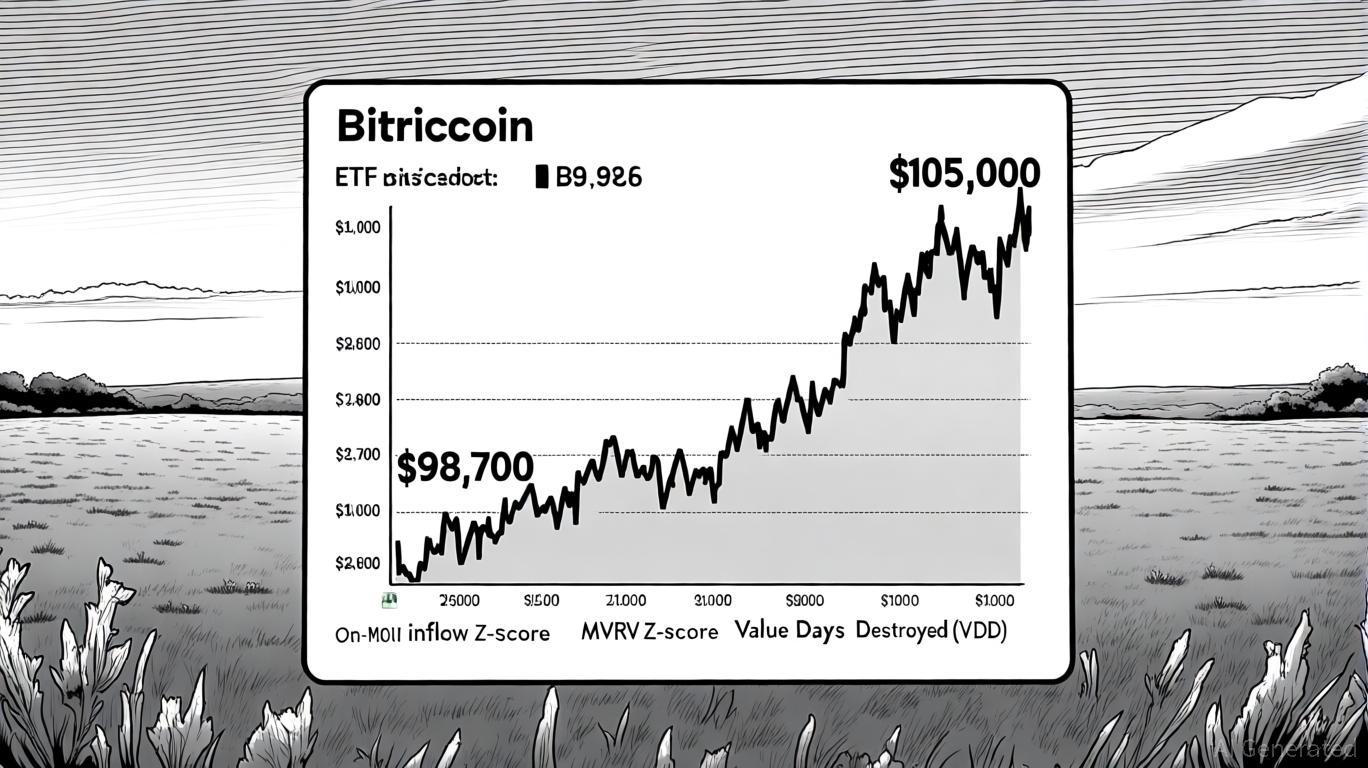
On-chain data tells a nuanced story. The MVRV Z-Score, a metric measuring realized capital gains/losses, rebounded from 1.43 (a historical local bottom) to 2.1, suggesting a healthy bull cycle rather than a terminal correction, per a Bitcoin Magazine analysis. Similarly, Value Days Destroyed (VDD) metrics indicate long-term holders (LTHs) are accumulating during dips, mirroring patterns from 2020 and 2021, as Bitcoin Magazine also notes. However, short-term holders (STHs) now control 44% of Bitcoin's realized capitalization—the highest level ever recorded—signaling speculative dominance in the final bull phase, the Market Periodical reports.
Profit-Taking Cycles and Behavioral Patterns
Profit-taking in Q3 2025 has been both a catalyst and a constraint. Institutional investors, holding 6.2% of total Bitcoin supply (1.30M BTC), have strategically rebalanced portfolios, allocating 50% to Bitcoin/ETH, 20% to mid-cap altcoins, and 20% to stablecoins, an Outposts analysis found. This diversification mitigates concentration risk while preserving exposure to growth. Meanwhile, retail investors have faced a more volatile ride: Bitcoin's 16% drop in 2025, linked to equity market declines and recession fears, triggered $438 million in liquidations during one 24-hour period, according to the Outposts analysis.
Historically, Q3 has acted as a launchpad for post-halving rallies. In 2017 and 2021, Bitcoin surged from under $2,800 and $39,000, respectively, to multi-year highs by year-end, the 99Bitcoins report noted. The 2025 cycle appears to align with this pattern, but with a twist: low volatility (30-day index at 12–15%) suggests a lateralization phase rather than a breakout, as the Outposts analysis describes. This could precede a sharp move, either upward (if ETF inflows persist) or downward (if macro risks materialize).
Tactical Entry Points: DCA and Institutional Frameworks
For disciplined investors, Q3 2025 offers tactical entry points. Key support levels at $95,000–$98,000 and resistance at $105,000–$110,000 provide clear boundaries for position sizing, according to an SSB Crack analysis. Dollar-cost averaging (DCA) remains a robust strategy, particularly for accumulating Bitcoin and EthereumETH-- through automated weekly purchases, the 99Bitcoins report recommends. With less than 1% of U.S. businesses currently holding Bitcoin, early adopters have a window to implement treasury allocations before broader adoption normalizes, the Outposts analysis adds.
Institutional frameworks offer further guidance. A 50-20-10-20 allocation model (large-cap, mid-cap, high-risk, stablecoins) balances growth and security, the SSB Crack analysis suggests. For example, BlackRock's ETF inflows and Fidelity's custodial services have enabled corporations to hold Bitcoin securely, with over 95% of assets stored in hardware wallets, the 99Bitcoins report finds. This emphasis on security is critical in a market where liquidity risks persist—sudden ETF outflows could destabilize prices, as the SSB Crack analysis warns.
Risk Management: Navigating Macro and On-Chain Uncertainty
Bitcoin's maturing market demands sophisticated risk management. While ETF inflows and on-chain accumulation are bullish, macroeconomic factors remain a wild card. A strengthening U.S. dollar or Fed rate hikes could cap Bitcoin's rally, pushing prices into the $95–110K range, the Market Periodical cautions. Similarly, regulatory shifts—such as the EU's MiCA implementation—could alter market dynamics, as Bitcoin Magazine observes.
To mitigate these risks, investors should:
1. Diversify across asset classes (e.g., Bitcoin, gold, equities) to hedge against sector-specific shocks.
2. Monitor on-chain metrics like MVRV Z-Score and VDD to gauge market health.
3. Cap exposure to high-volatility assets (e.g., limit Bitcoin to 10–20% of a portfolio).
Conclusion: A Market at the Crossroads
Bitcoin's Q3 2025 narrative is one of tension between speculative fervor and institutional pragmatism. While ETF inflows and on-chain accumulation suggest a bullish continuation, macroeconomic risks and profit-taking cycles introduce uncertainty. For investors, the path forward lies in disciplined entry strategies, diversified allocations, and a close watch on both technical and macro signals. As the market matures, those who balance aggression with caution will be best positioned to navigate what comes next.





Comentarios
Aún no hay comentarios