
Bitcoin's Short-Term Volatility vs. Long-Term Potential: Why a Top ETF Is a Strategic Buy for Contrarian Value Investors
Short-Term Volatility: A Symptom of Market Dynamics
The recent exodus from Bitcoin ETFs reflects a combination of profit-taking, macroeconomic uncertainty, and shifting risk appetites. Over the past five days, U.S. spot Bitcoin ETFs have endured a losing streak, with cumulative redemptions nearing $3.56 billion-a level not seen since February 2025. This trend is amplified by the rise of altcoin ETFs, such as those tracking SolanaSOL-- (SOL) and XRPXRP--, which have attracted $382 million and $250 million in inflows, respectively, since their October launches. These shifts highlight a market in flux, where investor preferences are rapidly evolving.
However, volatility is not inherently a warning sign. Historically, November has been one of Bitcoin's strongest months, with an average return of 41.22% based on CoinGlass data. The current selloff, while painful for short-term holders, may represent a buying opportunity for those with a longer-term horizon.
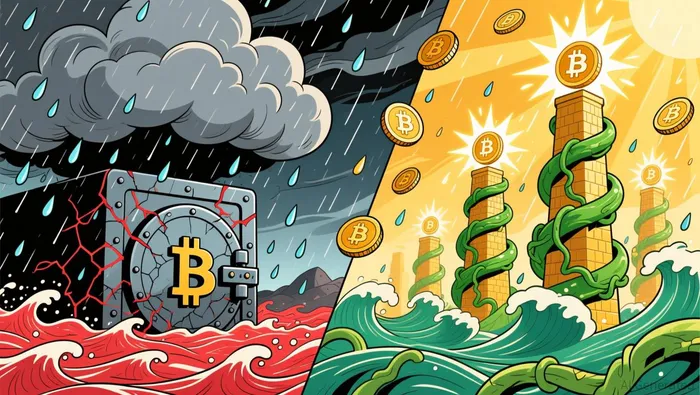
Long-Term Potential: The Case for Strategic Allocation
Bitcoin's long-term appeal lies in its dual role as a store of value and a hedge against systemic risks. Despite the recent outflows, the underlying fundamentals-institutional adoption, macroeconomic tailwinds, and technological innovation-remain intact. For contrarian investors, the challenge is to identify vehicles that balance exposure to Bitcoin's upside with mechanisms to mitigate downside risk.
Enter the Nicholas Crypto Income ETF (BLOX), a product that diverges from traditional Bitcoin ETFs by combining crypto-related equities, options strategies, and indirect crypto exposure. Unlike funds that directly hold Bitcoin or EtherETH--, BLOX gains exposure through U.S.-listed ETFs like the VanEck Bitcoin ETF (HODL) and the Fidelity Wise Origin Bitcoin Fund (FBTC). Its strategy is designed to generate income through options overlays while maintaining a diversified portfolio of crypto-mining and blockchain firms.
BLOX: A Contrarian Value Play
BLOX's recent performance underscores its potential as a strategic buy. In October 2025, the ETF returned 6.91%, outperforming the Digital Assets category's average of -1.8%. This outperformance is driven by its income-generating approach: the fund's October 2025 distribution contained 59.10% income and 40.90% return of capital. For investors seeking yield in a low-interest-rate environment, this feature is particularly compelling.
Yet, BLOX is not without its risks. The fund carries an expense ratio of 1.03%, which is high for the Digital Assets category, and its volatility metrics are stark. With a 20-day volatility of 69.01% and a beta of 4.49, BLOX is significantly more volatile than the S&P 500. Additionally, the fund has experienced a 28.22% drawdown as of November 24, 2025. These risks, however, are inherent to its strategy and align with the principles of contrarian value investing: buying when others are selling.
The Strategic Rationale
For value investors, BLOX's current valuation and strategy present an asymmetric opportunity. While its trailing twelve-month total return stands at 13.42%, the fund's high volatility and expense ratio suggest it is not for the risk-averse. Instead, it appeals to those who recognize that Bitcoin's long-term potential-rooted in its scarcity, adoption, and macroeconomic role-transcends short-term price swings.
Moreover, BLOX's focus on income generation provides a buffer against market downturns. By leveraging options strategies, the fund can generate cash flows even in sideways or declining markets, a critical advantage during periods of crypto volatility. This dual focus on capital appreciation and income aligns with the contrarian ethos of compounding returns over time.
Conclusion
Bitcoin's short-term volatility is a reality, but it should not overshadow its long-term potential. For investors with a multi-year horizon, the Nicholas Crypto Income ETF (BLOX) offers a unique combination of exposure to the crypto ecosystem, income generation, and strategic diversification. While the fund's risks are significant, they are consistent with the principles of contrarian value investing: buying undervalued assets with strong fundamentals and holding them through market cycles.
As the crypto market continues to evolve, the ability to distinguish between noise and signal will become increasingly critical. For those willing to look beyond the headlines, BLOX represents a compelling case for strategic allocation in a landscape defined by both uncertainty and opportunity.





Comentarios
Aún no hay comentarios