
Bitcoin's Short-Term Holder Distress and the Imminent Market Correction: A Strategic Entry Point Analysis
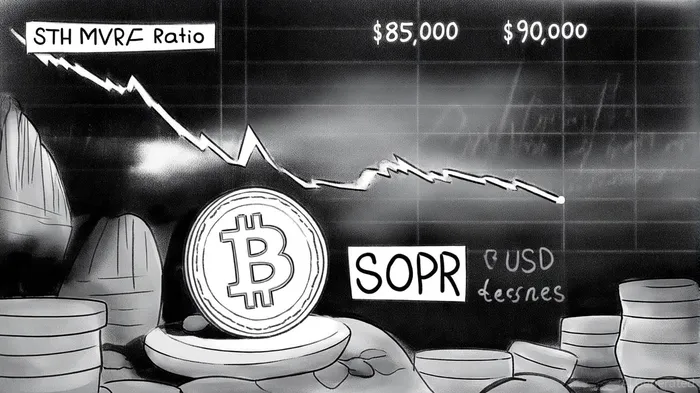
The BitcoinBTC-- market in late 2025 is at a critical juncture, marked by severe distress among short-term holders (STHs) and signs of systemic exhaustion. On-chain data reveals a dramatic capitulation phase, with STHs offloading over $3.3 billion in BTC to exchanges at a loss within a 24-hour period in late September 2025 [3]. This behavior, coupled with an STH MVRV (Market Value to Realized Value) ratio of 0.82—indicating an average 18% unrealized loss—aligns with historical patterns preceding market bottoms [2]. For investors, this represents both a cautionary signal and a potential inflection point for strategic entry.
The On-Chain Signals of Capitulation
Bitcoin's STHs have been the primary drivers of recent sell-side pressure. The STH SOPR (Spent Output Profit Ratio) metric, a critical gauge of selling profitability, has fallen below 1, confirming that STHs are transacting at a loss [4]. This mirrors the capitulation events of August 2024 and November 2022, where the MVRV ratio similarly dipped below 1.0 before reversing [3]. However, the current environment shows early signs of stabilization. Realized losses by STHs have plummeted to one-tenth of their earlier 2025 levels, suggesting panic selling is abating and stronger hands—likely long-term holders (LTHs)—are stepping in [1].
The Accumulation Trend Score, a measure of net inflows to exchanges, has remained near 0.1 since January 2025, underscoring persistent distribution dynamics as Bitcoin corrected from $108,000 to $93,000 [1]. Yet, LTHs have absorbed over 500,000 BTC since February 2025, while STHs have distributed more than 300,000 BTC, signaling a structural shift in ownership [3]. This reallocation of supply to patient capital is a bullish precursor, historically preceding sustained price recoveries.
Historical Context and Strategic Entry Points
Bitcoin's price action post-STH capitulation has consistently followed a predictable pattern. When the MVRV ratio drops below 1.0, it often marks a point of maximum pain for weak hands, creating a vacuum for LTHs to accumulate [5]. For example, in August 2024, the ratio fell to 1.74—a level associated with consolidation—before Bitcoin rebounded from $49,000 [3]. Similarly, the current MVRV level of 0.82 suggests a high probability of a trend reversal, provided LTHs continue to absorb supply.
Strategic entry points for investors may emerge as Bitcoin tests key support levels. The $85,000 and $90,000 thresholds have become critical battlegrounds, with the asset struggling to reclaim its all-time high of $108,230 [4]. A successful defense of these levels could trigger a short-covering rally, particularly if STH selling pressure fully dissipates. Meanwhile, the 4-hour chart pattern—showing higher lows and tightening ranges—hints at a potential 10% price increase if consolidation continues [2].
However, historical backtesting of support-level strategies from 2022 to 2025 reveals mixed results. A simple buy-and-hold approach at 20-day rolling lows showed a median 1-month return of -5.4%, with win rates below 50% across most holding periods. These findings suggest that relying solely on support-level touches may not be a reliable strategy, and additional confirmation signals are advisable.
Macroeconomic and Network Health Indicators
While on-chain dynamics are bearish in the short term, broader macro indicators remain resilient. The daily TBO (Total Buy Order) Slow line and weekly OBV (On-Balance Volume) trends are still upward, suggesting underlying bullish momentum [4]. Additionally, Bitcoin's hashrate has risen steadily, reflecting long-term miner confidence despite short-term profit-taking by mining entities [3]. This divergence between immediate-term weakness and long-term strength is a classic setup for a correction-driven buying opportunity.
Conclusion: Navigating the Correction
Bitcoin's current market exhaustion, driven by STH distress, is a textbook example of a capitulation phase. While the immediate outlook remains volatile, the diminishing realized losses and LTH accumulation suggest a near-term bottom is in sight. Investors with risk tolerance for short-term fluctuations may find value in dollar-cost averaging into positions as Bitcoin tests $85,000–$90,000, particularly if the STH SOPR stabilizes above 1 and the MVRV ratio begins to normalize. As history shows, capitulation is often the prelude to a new bullish cycle—provided capital flows remain robust and macro conditions hold.






Comentarios
Aún no hay comentarios