
Bitcoin's Short-Selling Dynamics and Market Timing Anomalies: Unpacking the Hyperliquid Whale's $163M Short and Insider Suspicions
In the volatile world of cryptocurrency, short-selling has long been a double-edged sword-both a tool for hedging and a weapon for manipulation. The recent $163 million BitcoinBTC-- short executed by a Hyperliquid whale, reported by Coinotag, has ignited a firestorm of speculation, not just about market mechanics but about the ethical and regulatory boundaries of decentralized finance (DeFi). This trade, taken at 10x leverage minutes before a major public political announcement in October 2025, triggered a 15% price drop and over 250 wallets losing "millionaire" status on Hyperliquid. The timing and magnitude of the trade have raised urgent questions: Was this a calculated strategic move, or evidence of insider knowledge?
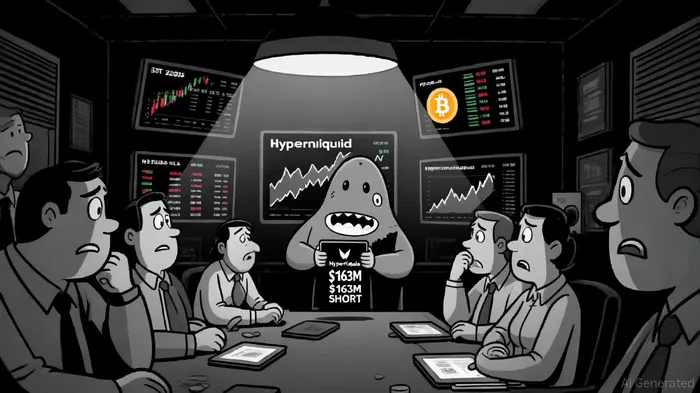
The Whale's Playbook: Leverage, Timing, and Market Psychology
The Hyperliquid whale's $163M short was not an isolated event. It followed a prior short that generated $192 million in profits, suggesting a pattern of high-risk, high-reward trading. The whale's liquidation threshold-set at $125,500 for Bitcoin-indicates a deliberate choice to amplify exposure, leveraging market volatility to maximize gains. However, the trade's execution minutes before a public announcement (widely speculated to involve regulatory or macroeconomic news) has led to accusations of front-running or even insider trading.
This is not the first time Hyperliquid has been a battleground for such tactics. A separate $423 million 40x leveraged short, executed by another whale, sparked a coordinated "whale hunt," according to a BeInCrypto report. These events highlight a growing trend: the use of extreme leverage and social media-driven market sentiment to manipulate prices.
The "Insider" Debate: Evidence and Implications
The most contentious aspect of the $163M short is its timing. According to on-chain investigators, the trade was initiated just before a political figure's public statement, which coincided with Bitcoin's sharp decline. While no direct evidence of insider trading has emerged, the correlation has led to calls for regulatory scrutiny. Notably, the whale's wallet (0xb317) has been linked to Garrett Jin, the former CEO of defunct exchange BitForex, a connection that deepens suspicions of malfeasance.
Critics argue that decentralized platforms like Hyperliquid lack the transparency of centralized exchanges, enabling actors to exploit information asymmetries. For instance, the whale may have used a dual-exchange strategy-shorting on Hyperliquid while taking a long position on a centralized exchange (CEX)-to profit from price dislocations, according to Cryptomaniaks. This "wash trading" hypothesis, though unproven, underscores the risks of unregulated leverage in DeFi.
Market Impact: A Domino Effect of Liquidations
The $163M short's fallout was immediate and severe. Hyperliquid reported over 250 wallets losing millionaire status, while Binance allocated $283 million in compensation for collateral losses. The crash also triggered a ripple effect: a $10 million 40x short closure by another whale, reported in an ABC Money article, briefly reversed downward momentum, as traders speculated on a potential Bitcoin and SolanaSOL-- bullish rebound.
This volatility illustrates a critical flaw in leveraged markets: large positions can destabilize entire ecosystems. When a whale's bet turns against them, the resulting liquidations create a feedback loop of panic selling, exacerbating price swings.
Regulatory Crossroads: Accountability in the Age of DeFi
The Hyperliquid whale saga has reignited debates about the need for regulatory guardrails in DeFi. While proponents argue that decentralized platforms democratize access, the lack of oversight enables predatory behavior. For example, on-chain investigator ZachXBT has alleged, in a BlockNews report, that the whale may be using stolen funds, a claim that-if true-would classify the trade as criminal activity rather than mere speculation.
Regulators are now faced with a dilemma: how to preserve DeFi's innovation while preventing abuse. The SEC's recent focus on leveraged products and the EU's MiCA framework suggest a global shift toward stricter oversight, but enforcement remains challenging in a borderless, pseudonymous ecosystem.
Conclusion: Lessons for Investors and the Future of Short-Selling
The $163M Hyperliquid short serves as a cautionary tale for retail and institutional investors alike. Key takeaways include:
1. Leverage is a liability: 10x and 40x positions amplify both gains and risks, making them unsuitable for most investors.
2. Timing is everything: The correlation between the whale's trade and the public announcement highlights the importance of macroeconomic and geopolitical awareness.
3. Transparency is non-negotiable: The crypto industry must adopt clearer governance standards to prevent abuse.
As Bitcoin's market capitalization continues to grow, so too will the stakes of short-selling. The Hyperliquid whale's actions are a microcosm of a broader struggle: the tension between innovation and accountability in the digital age. For now, the market watches-and waits-for the next move.






Comentarios
Aún no hay comentarios