
Bitcoin's Recent Sharp Correction: A Buying Opportunity or a Warning Signal?
Macroeconomic Catalysts: Fed Policy and Inflation Volatility
The Federal Reserve's actions in late 2025 were a double-edged sword for BitcoinBTC--. A rate cut to 4.00%-4.25% in September initially fueled a 86.76% surge in Bitcoin prices, as investors flocked to risk-on assets, according to an ET analysis. However, the Fed's hawkish pivot in October and November-triggered by a 4.2% CPI reading (vs. 3.7% expectations)-sent shockwaves through crypto markets. Bitcoin's price swung 15% in 24-hour periods during these announcements, with one session seeing a 24.9% drop, as Markets.com reported.
This volatility highlights Bitcoin's growing sensitivity to U.S. macroeconomic data. Institutional traders adapted by ramping up Bitcoin futures volume by 37% during inflation announcements, signaling a shift toward hedging strategies, according to Markets.com. Meanwhile, Bitcoin's correlation with traditional assets evolved: its link to the S&P 500 strengthened, while its historically negative relationship with gold (-0.48) turned positive, as an ET analysis noted. These shifts suggest Bitcoin is increasingly behaving like a "risk asset" rather than a safe haven.
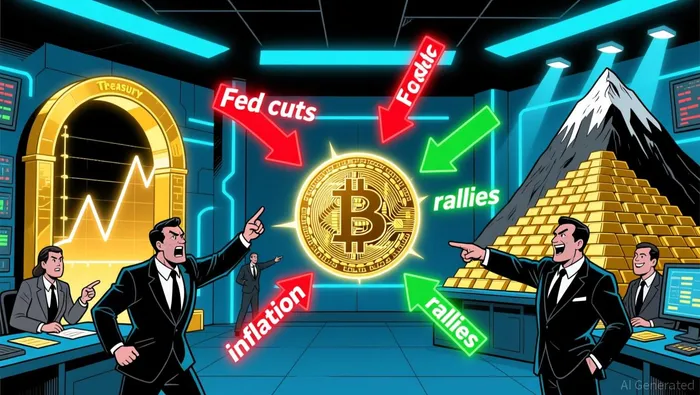
Market Sentiment: From Euphoria to Extreme Fear
The Crypto Fear & Greed Index, a real-time sentiment tracker, plummeted to 21 out of 100 in November 2025-a level last seen during major market crashes, according to Markets.com. This extreme fear is partly due to structural selling pressure from long-term Bitcoin holders, who have been steadily distributing their holdings despite the rally, as Coinotag noted. For example, Canaan Inc., a major miner, increased its hashrate to 8.25 EH/s by early November 2025 while managing a treasury of 1,610 BTCBTC-- and 3,950 ETH, reflecting disciplined but persistent selling, as an ET analysis reported.
Yet, history shows that extreme fear often precedes buying opportunities. During the 2020 market crash, Bitcoin bottomed at $3,800 when the Fear & Greed Index hit similar levels before surging to $64,000 by 2021. However, 2025's environment is different: macroeconomic uncertainty and regulatory scrutiny loom larger than in previous cycles.
Correlation Shifts and Institutional Behavior
Bitcoin's correlation with traditional assets is a key wildcard. Its newfound positive link with gold-a metal traditionally seen as inflation insurance-suggests investors are using Bitcoin as a hedge against both deflationary and inflationary risks, as an ET analysis noted. This duality could be a tailwind if inflation remains sticky.
Institutional activity also tells a story. Futures volume spikes during macroeconomic announcements indicate that professional traders are treating Bitcoin like a tradable asset class, not a speculative fad, according to Markets.com. This maturation could stabilize Bitcoin's price over time but also amplify short-term volatility.
Conclusion: A Tug-of-War Between Opportunity and Risk
Bitcoin's recent correction is neither a clear buy signal nor a definitive warning. On one hand, extreme fear and structural selling pressure suggest the market is overcorrecting. On the other, macroeconomic headwinds-including the Fed's hawkish stance and geopolitical risks-remain unresolved.
For investors, the key is to balance timing with positioning. Those with a long-term horizon might view current levels as a discount, especially if the Fed's rate cuts resume in 2026. However, short-term volatility is likely to persist, and structural selling from miners and institutional holders could prolong the downturn.
As always, the market's next move will depend on whether macroeconomic data and sentiment align-or clash.







Comentarios
Aún no hay comentarios