
Bitcoin's Sharp Correction: A Buying Opportunity Amid Macro Weakness?
The Macro Weakness Behind the Correction
The 2025 drawdown marks Bitcoin's "Third 30% Drawdown" of its cycle, a pattern that historically precedes capitulation and eventual recovery. Reduced liquidity, driven by tighter monetary policy and shifting capital flows, has exacerbated selling pressure. According to a report by , this liquidity contraction has slowed inflows into BitcoinBTC-- ETFs and triggered capital outflows. For example, HashKey's Tim Sun notes that the $100 billion influx into Bitcoin ETFs post-approval has dwindled as macro conditions deteriorate.
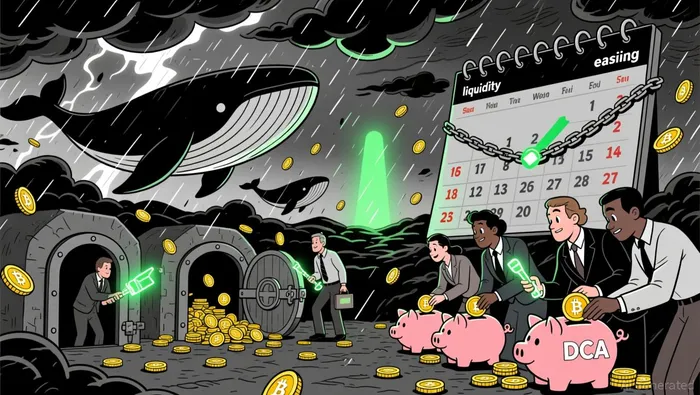
However, this environment also reveals asymmetric opportunities. Whale activity-despite the downturn suggests a potential floor forming as large holders accumulate at lower prices. This dynamic mirrors past corrections, where institutional-grade tools and disciplined strategies enabled long-term buyers to capitalize on dislocation.
Institutional Strategies: Yield, Security, and Leverage
Institutional investors are leveraging innovative tools to navigate the bear market. , in partnership with Anchorage Digital, now offer low-cost borrowing via its MUSD stablecoin and veBTC locking mechanisms. These tools allow institutions to earn passive BTC yield by locking their holdings for 6–30 days, with higher rewards for longer commitments. Such structures notNOT-- only mitigate downside risk but also align with Bitcoin's deflationary thesis by reducing circulating supply through locking.
Anchorage Digital's institutional-grade custody solutions, including its self-custody wallet Porto, further enhance security and scalability for large-scale participation. This infrastructure addresses a critical barrier for institutions entering volatile markets, enabling them to deploy capital with confidence.
Strategic buyers like Bitwise have also positioned current Bitcoin levels as attractive entry points. By combining dollar-cost averaging with structured yield-generating mechanisms, institutions can hedge against further volatility while maintaining exposure to Bitcoin's long-term value proposition.
Retail Investors: Discipline Over Timing
For retail investors, the bear market demands a shift from speculative tactics to disciplined, fundamentals-driven approaches. Analysts like Peter Chung from Presto Research emphasize avoiding short-term market timing. Instead, dollar-cost averaging-buying small amounts consistently over time-remains a robust strategy to mitigate drawdown risks.
Retail holders should also focus on understanding Bitcoin's network fundamentals and Ethereum's evolving role in the ecosystem. This knowledge helps contextualize price swings within broader macroeconomic and technological narratives. For instance, Bitcoin's historical resilience during prior corrections, such as the 2018 and 2022 bear markets, underscores the importance of long-term conviction.
The Case for Strategic Entry
While macro weakness persists, the interplay of institutional innovation and retail discipline creates a fertile ground for strategic entry. Mezo's veBTC model and Bitcoin Munari's presale highlight how structured, deflationary projects can stabilize demand during downturns. Meanwhile, the maturation of Bitcoin's financial ecosystem-through ETFs, derivatives, and custody solutions-has equipped investors with tools to manage risk more effectively.
Critically, both institutional and retail participants must await broader macroeconomic signals, such as a sustainable loosening of global liquidity, before committing large capital. Until then, measured allocations and yield-generating strategies offer a path to weather the storm while positioning for the next upcycle.
Conclusion
Bitcoin's sharp correction is undeniably painful, but it is not without precedent. Historical patterns, coupled with emerging institutional tools and retail discipline, suggest that this bear market could be a catalyst for more robust, diversified participation. For those with the patience and infrastructure to navigate macro weakness, the current environment may yet prove to be a buying opportunity in disguise.







Comentarios
Aún no hay comentarios