
Bitcoin's Sensitivity to U.S. Labor Market Data and Fed Policy Outlook: Navigating Macroeconomic Interdependence in a Dovish Environment
The interplay between BitcoinBTC-- and macroeconomic indicators has become a cornerstone of modern investment analysis. As the U.S. labor market and Federal Reserve policy continue to shape global financial conditions, Bitcoin's price movements increasingly reflect its role as a high-beta asset and inflation hedge. This article examines Bitcoin's sensitivity to U.S. labor data and Fed policy, while dissecting investment strategies for a dovish monetary environment.
Labor Market Deterioration and Bitcoin's Risk-On Dynamics
The U.S. labor market has shown signs of fragility in late 2025, with October's nonfarm payroll revision of -105,000 marking the first negative monthly print since the pandemic. This decline, coupled with the Sahm Rule's recession trigger in July 2025 and a collapsing quits rate, has created a "Schrödinger's labor market"-one that appears both resilient and vulnerable according to data. Bitcoin, as a proxy for speculative capital, has mirrored these dynamics. A 32% drawdown from its October peak of $126,210 to $87,000 by December 2025 underscores its sensitivity to risk-off sentiment amid labor weakness as research shows.
However, the labor market's mixed signals-elevated job openings alongside rising unemployment-have introduced volatility. For instance, November's 64,000 job additions and 4.6% unemployment rate, though weaker than pre-2025 levels, temporarily stabilized Bitcoin by signaling a potential Fed pivot toward easing. Historically, strong employment data can bolster risk appetite, but in a context of broader economic uncertainty, Bitcoin's correlation with labor indicators remains conditional on inflation and Fed guidance.
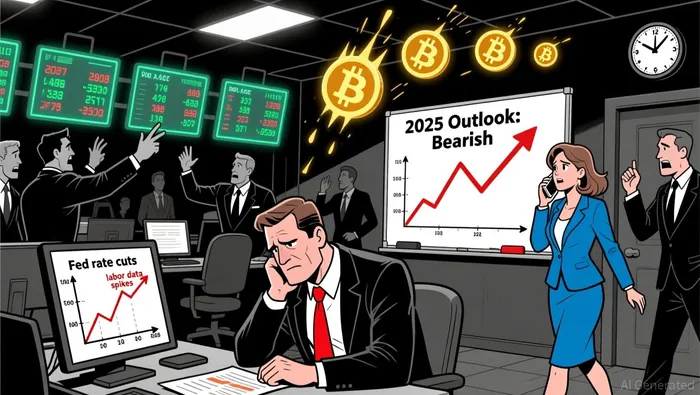
Fed Policy and Bitcoin's Inflation Hedge Narrative
The Federal Reserve's October 2025 decision to cut the federal funds rate by 25 basis points to 3.75-4% marked a pivotal shift in monetary policy. This move, driven by slowing job growth and elevated inflation, reduced real yields and softened the U.S. dollar-a dynamic historically supportive for Bitcoin as analysis shows. Analysts now project an 80% probability of a December rate cut, with dovish signals from Fed officials like Mary Daly and John Williams further reinforcing expectations of accommodative policy.
Bitcoin's performance during past dovish cycles, such as the 2020-2021 bull run, highlights its potential as an inflation hedge. During that period, aggressive Fed rate cuts and quantitative easing fueled a surge from $7,000 to $60,000. Yet, the 2024-2025 experience has been more nuanced. Despite rate cuts, Bitcoin's failure to break above $100,000 in late 2025 suggests that factors like ETF inflows and macroeconomic headwinds (e.g., Trump-era tariffs) now play a larger role in price discovery.
Investment Strategies in a Dovish Environment
In a low-interest-rate environment, investors must balance Bitcoin's speculative nature with macroeconomic fundamentals. Three strategies emerge as particularly relevant:
- Dollar-Cost Averaging (DCA): By investing fixed amounts at regular intervals, investors mitigate Bitcoin's volatility while capitalizing on prolonged liquidity. This approach is ideal for long-term holders seeking to avoid market timing risks according to analysis.
- Trend and Swing Trading: Technical indicators like moving averages and RSI can help traders navigate Bitcoin's cyclical patterns, especially during Fed-driven liquidity expansions as experts suggest.
- Long-Term HODLing: Patience remains a virtue in a dovish environment. Historical data shows that Bitcoin's multi-year gains often outweigh short-term corrections, particularly when institutional adoption and ETF approvals are factored in according to market research.
Conclusion: Macroeconomic Interdependence and Strategic Allocation
Bitcoin's price is inextricably linked to U.S. labor data and Fed policy, but its trajectory is increasingly shaped by a complex interplay of liquidity, institutional flows, and global macroeconomic trends. As the Fed continues its dovish pivot, investors must adopt a dual lens: leveraging Bitcoin's inflation-hedge narrative while hedging against volatility through diversified strategies. In this environment, understanding the nuances of macroeconomic interdependence is not just advantageous-it is essential.






Comentarios
Aún no hay comentarios