
Bitcoin's Sensitivity to Fed Policy Uncertainty in Late 2025: Positioning for a Rally or Prolonged Volatility?
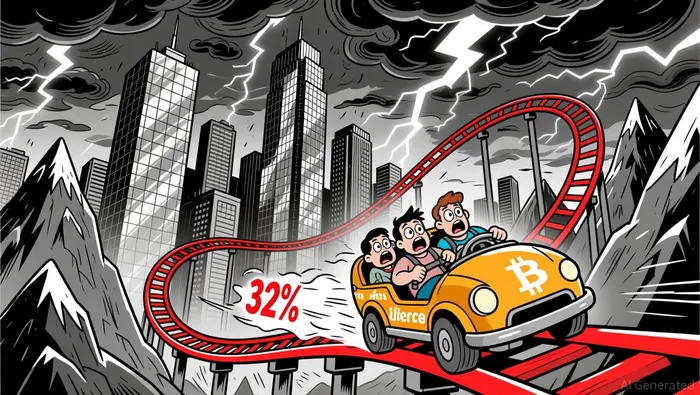
Bitcoin's price action in late 2025 has been a rollercoaster, driven by the Federal Reserve's shifting policy signals and macroeconomic uncertainty. As the year-end approaches, investors face a critical question: Should they position for a delayed Fed-driven rally or brace for prolonged volatility? The answer lies in dissecting the interplay between central bank communication, market liquidity, and investor behavior.
The Fed's Policy Flip and Bitcoin's Sharp Correction
Bitcoin's 32% drop from its October 2025 peak to around $84,000–$87,000 in early December underscores its heightened sensitivity to Fed policy expectations. This sell-off was fueled by a sudden flip in market expectations for a December rate cut, which triggered leveraged liquidations, deleveraging, and thin liquidity during volatile periods. The Fed's restrictive stance, combined with rising bond yields and institutional selling, created a perfect storm for crypto markets.
However, Bitcoin's volatility isn't just a function of policy shifts. The Bank of Japan's signals about potential rate hikes in late 2025 added to the uncertainty, particularly for the yen carry trade-a strategy that had previously supported leveraged positions in BitcoinBTC--. As borrowing costs for the yen increased, traders faced the risk of unwinding positions, further amplifying downward pressure on the cryptocurrency.
Divergence from Traditional Markets and Institutional Signals
Bitcoin's recent divergence from the Nasdaq 100 highlights its maturation as an asset class with unique drivers. While the Nasdaq 100 remained relatively stable, Bitcoin reacted to crypto-specific dynamics such as leveraged liquidations and ETF outflows. This divergence suggests that Bitcoin's price is increasingly influenced by internal crypto market forces, though macroeconomic and monetary policy factors still play a central role.
On-chain data, however, offers a glimmer of hope. Signs of capitulation exhaustion-such as declining open interest and stable funding rates-suggest the recent correction may function as a reset rather than a breakdown. Institutional inflows have continued despite the downturn, with analysts forecasting a potential rally to $100,000–$110,000 by year-end if the Fed adopts a dovish stance.
Positioning for a Delayed Rally or Prolonged Volatility
Investors must weigh two scenarios:
1. Delayed Rally: If the Fed delivers a December rate cut (currently priced at 83% probability), Bitcoin could benefit from a broader risk-on environment. A swift recovery above $90,000 in late November 2025, supported by bullish on-chain signals like the Hash Ribbon indicator and whale accumulation, reinforces this optimism.
2. Prolonged Volatility: Macroeconomic uncertainties-such as unexpected inflation data or liquidity crunches-could extend the correction. Thin order books and outflows from Bitcoin ETFs in November 2025 exacerbated downward pressure, making the market vulnerable to sudden repricing.
Strategies for navigating this uncertainty include:
- Selective Hedging: Investors should monitor funding rates and open interest for early warning signals while maintaining disciplined position sizing.
- Macro-Driven Positioning: Rotating into cyclicals and value stocks while keeping a portion of capital allocated to Bitcoin could balance risk.
- Year-End Dynamics: Portfolio rebalancing, tax-related flows, and window dressing are expected to amplify market moves during data-sensitive periods.
The Path Forward: Dovish Fed or Prolonged Uncertainty?
The Fed's end-of-year meeting will be pivotal. A dovish tilt-potentially led by Kevin Hassett as Powell's successor-could catalyze a rally, while a hawkish pivot would prolong volatility. Investors must also consider the broader macroeconomic landscape: cooling inflation and improved economic data could reinforce Bitcoin's appeal as a hedge against fiat devaluation.
For those with a longer-term outlook, the interplay between macroeconomic stability, institutional adoption, and regulatory clarity could position Bitcoin for a fresh all-time high in 2026. However, short-term volatility remains a reality, with liquidity conditions and leveraged positions acting as wild cards.
Conclusion
Bitcoin's sensitivity to Fed policy uncertainty in late 2025 reflects its evolving role in global finance. While a delayed rally is plausible if the Fed delivers on rate cuts, prolonged volatility remains a risk due to macroeconomic fragility and liquidity challenges. Investors must adopt a balanced approach, hedging against downside risks while staying positioned to capitalize on potential rebounds. As always, the key is to stay informed, flexible, and grounded in data.







Comentarios
Aún no hay comentarios