
Bitcoin's Seasonal Timing and Investment Potential Amid Morgan Stanley's 'Fall' Narrative
Morgan Stanley's "Fall Season" and Historical Precedents
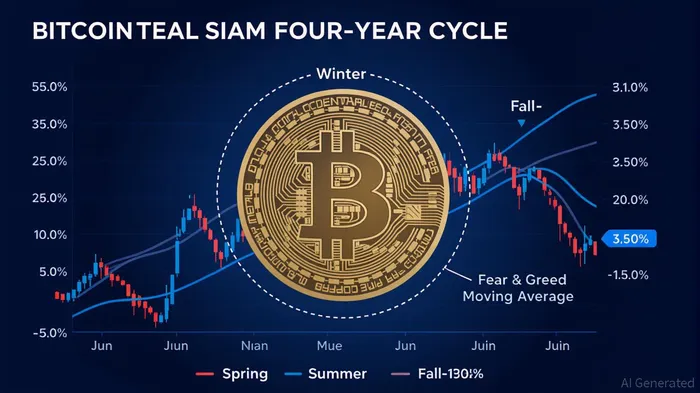
Morgan Stanley's analogy of Bitcoin's market cycle to seasonal changes-labeling the current phase as "fall"-is rooted in historical patterns. The firm's "three-up, one-down" framework suggests that after three bullish cycles, a bearish correction typically follows Morgan Stanley Sees Bitcoin in 'Fall' Phase, Urging Gains Harvest Before Potential Winter Downturn. The recent drop below Bitcoin's 365-day moving average-a key technical benchmark-has been interpreted as a bearish signal, with analysts like Julio Moreno of CryptoQuant noting the onset of a technical bear market Morgan Stanley Warns Bitcoin Entering "Fall Season," Urges Investors to Take Profits.
Historically, fall-to-winter transitions have been pivotal. For instance, in 2024, BitcoinBTC-- surged 41.2% post-halving, reaching $90,446 by November, before entering a correction phase Bitcoin Cycles, Entering 2025. Similarly, the 2020 cycle saw a V-shaped recovery after the March crash, driven by regulatory clarity and institutional adoption. These transitions often coincide with extreme Fear & Greed Index levels, where sentiment shifts from euphoria to panic Fear And Greed Index | BM Pro.
Technical Indicators: Navigating the Fall Phase
Technical analysis remains a cornerstone for timing Bitcoin's cycles. The recent breach of the 365-day moving average has triggered bearish momentum, signaling a potential consolidation phase Morgan Stanley Warns Bitcoin Entering "Fall Season," Urges Investors to Take Profits. Additionally, liquidity metrics such as stablecoin inflows and ETF activity have plateaued, indicating waning speculative fervor Morgan Stanley Sees Bitcoin in 'Fall' Phase, Urging Gains Harvest Before Potential Winter Downturn.
The Fear & Greed Index, a sentiment-based tool, further underscores the market's emotional extremes. During fall-to-winter transitions, the index often dips into "extreme fear" territory (scores below 30), historically signaling undervaluation and potential buying opportunities Fear And Greed Index | BM Pro. For example, in 2020, the index hit a low of 12 in March, coinciding with Bitcoin's 50% correction, before rebounding as institutional demand surged Bitcoin and Crypto Technical Analysis For beginners.
Institutional Sentiment and Regulatory Catalysts
While technical indicators paint a cautious picture, institutional interest in Bitcoin remains robust. U.S. spot Bitcoin ETFs now manage over $137 billion in assets under management, reflecting growing acceptance as a macro hedge against inflation and currency devaluation Morgan Stanley Warns Bitcoin Entering "Fall Season," Urges Investors to Take Profits. However, institutional allocations progress slowly due to regulatory processes and long-term mandates Morgan Stanley Warns Bitcoin Entering "Fall Season," Urges Investors to Take Profits.
Regulatory shifts have historically acted as catalysts. The 2024 approval of 11 spot Bitcoin ETFs by the SEC marked a watershed moment, legitimizing Bitcoin as a mainstream asset Regulatory Wins Push Institutional Crypto Use Past $20 .... Similarly, the proposed U.S. Bitcoin strategic reserve under a potential TrumpTRUMP-- administration could force global reevaluation of crypto holdings, potentially driving prices to $500,000 Cryptos bull market: If Trump really establishes a bitcoin reserve, 0.5 million USD will be seen!. These developments highlight the importance of monitoring regulatory shifts as strategic entry points.
Strategic Entry Points: Balancing Caution and Opportunity
For investors, the current fall phase presents a dual challenge: harvesting gains while preparing for potential rebounds. Historical data suggests that strategic entry points often emerge during extreme fear phases. For instance, in 2017, Bitcoin's price bottomed at $6,000 after a 78% correction, setting the stage for a subsequent 13x rally Bitcoin's Market Cycle & Crypto Cycles Chart | Key Insights .... Similarly, the 2020 bottom at $3,800 preceded a 150% surge into 2021.
Technical indicators like the Puell Multiple and on-chain metrics (e.g., exchange reserves) can further refine entry timing. A Puell Multiple below 0.5, for example, historically signals undervaluation, while declining exchange reserves indicate reduced selling pressure Bitcoin Cycles, Entering 2025. Investors should also consider macroeconomic factors, such as inflation trends and central bank policies, which influence Bitcoin's role as a hedge Morgan Stanley Warns Bitcoin Entering "Fall Season," Urges Investors to Take Profits.
Conclusion: Positioning for the Next Bull Cycle
Morgan Stanley's "fall season" narrative underscores the need for disciplined risk management. While the current phase may see further consolidation, the long-term fundamentals-driven by Bitcoin's scarcity, institutional adoption, and regulatory progress-remain intact. By leveraging technical indicators, sentiment tools, and regulatory catalysts, investors can strategically position themselves to capitalize on the next bull phase.
As history shows, Bitcoin's cycles are not linear but cyclical. The key lies in recognizing that "winter" is often a prelude to "spring," where patient capital can reap substantial rewards.





Comentarios
Aún no hay comentarios