
Bitcoin's Scarcity as a Hedge Against Expanding Global Debt and Monetary Erosion
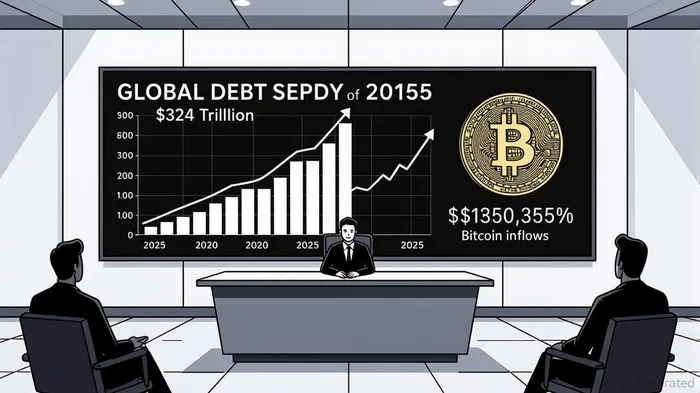
The global financial system is at a crossroads. As of Q1 2025, global debt has surged to a record $324 trillion, with emerging markets grappling with debt-to-GDP ratios exceeding 245% and U.S. household debt climbing to $18.39 trillion[1]. Central banks, meanwhile, remain locked in a delicate balancing act: the Federal Reserve has held rates steady at 4.25%-4.50% to temper inflation, which, though easing, still sits at 2.5% for core PCE in April 2025[3]. The Bank of England has even cut rates in 2025 as inflation lingers at 3.6%[4]. These dynamics underscore a world where monetary expansion and inflationary pressures are not transient but entrenched, creating fertile ground for assets with intrinsic scarcity.
Bitcoin, with its hard-capped supply of 21 million coins, has emerged as a compelling counterweight to this paradigm. Unlike fiat currencies, which face relentless devaluation from central bank interventions, Bitcoin's supply is algorithmically constrained, making it inherently resistant to the erosion of purchasing power. This scarcity is not merely theoretical: on-chain data reveals that 64% of Bitcoin's total supply is held for over one year, with large wallets (10,000+ BTC) adding 16,000 BTC during Q2–Q3 2025[5]. The Gini coefficient for BitcoinBTC-- has risen to 0.4677, reflecting a growing concentration of holdings among long-term investors—a trend reminiscent of the 2019 bull market[5].
Institutional adoption has further amplified Bitcoin's value proposition. Spot Bitcoin ETFs have seen unprecedented inflows, including a record $332.7 million in net inflows on a single day in September 2025, while EthereumETH-- ETFs faced outflows[3]. BlackRock's accumulation of 746,000 BTC and MicroStrategy's $449.3 million Bitcoin purchase[3] highlight a strategic shift among corporations and asset managers toward allocating capital to assets insulated from central bank policy. This trend is not speculative—it is a response to macroeconomic realities. As the Fed's balance sheet shrinks from $9 trillion in 2022 to $6.6 trillion in 2025[3], the market is increasingly pricing Bitcoin as a hedge against both inflation and the fragility of debt-laden economies.
The Federal Reserve's 2025 review of its monetary policy framework has reaffirmed a 2% inflation target but acknowledged the challenges of achieving it in a world of persistent supply shocks and geopolitical tensions[5]. Yet, as central banks grapple with these headwinds, Bitcoin's deflationary model offers a stark contrast. Its inverse correlation (-0.65) with the Fed's policy rate and direct correlation (0.76) with U.S. equities[5] position it as both a diversifier and a strategic complement to traditional portfolios. For long-horizon investors, this duality is critical: Bitcoin is not merely a speculative asset but a tool to hedge against the erosion of value in a fiat-centric world.
Critics argue that Bitcoin's volatility undermines its utility as a store of value. However, this perspective overlooks the broader context. As global debt levels climb and central banks normalize higher inflation, volatility in traditional markets is inevitable. Bitcoin's role is not to replace equities or bonds but to provide a floor against monetary devaluation. The growing participation of institutions—evidenced by BlackRock's ETF dominance and MicroStrategy's aggressive accumulation—signals a maturing market where Bitcoin is increasingly viewed as a core, rather than a speculative, allocation.
For investors navigating a landscape defined by liquidity risks and inflationary pressures, Bitcoin's scarcity and institutional adoption present a compelling case. While central banks continue to navigate the complexities of their 2025 policy frameworks[5], the market is already pricing in the reality that Bitcoin's fixed supply offers a unique and durable hedge. As the Fed's wait-and-see approach to rate cuts persists[3], the question is no longer whether Bitcoin can withstand macroeconomic turbulence but whether traditional portfolios can afford to ignore it.






Comentarios
Aún no hay comentarios