
Bitcoin's Role in Political and Economic Freedom: Geopolitical Catalysts and Institutional Adoption
Bitcoin's ascent as a tool for political and economic freedom has been catalyzed by a confluence of geopolitical crises and institutional innovation. From hyperinflationary economies to nations under sanctions, BitcoinBTC-- has emerged as a decentralized alternative to traditional financial systems. This analysis explores how geopolitical instability and institutional adoption are reshaping Bitcoin's role in global finance, offering insights for investors navigating this evolving landscape.
Geopolitical Catalysts: Bitcoin as a Hedge Against Instability
Political instability and economic sanctions have driven Bitcoin adoption in regions where trust in fiat currencies and state institutions has eroded. In Argentina, where inflation exceeded 140% in 2024, Bitcoin adoption became a national strategy to hedge against currency devaluation, according to Cointelegraph. Similarly, Venezuela and Turkey, plagued by hyperinflation and capital controls, saw Bitcoin adoption rates surge as citizens sought to preserve wealth, an OKX analysis found.
Economic sanctions have further accelerated Bitcoin's adoption in sanctioned jurisdictions. Iran, for instance, witnessed a 300% increase in cryptocurrency usage in 2024 as residents turned to centralized exchanges to circumvent capital controls, Chainalysis reported. Russia's reliance on no-KYC exchanges and illicit crypto networks to sustain wartime economic activity underscores Chainalysis's findings that Bitcoin can be used to bypass traditional financial restrictions. These cases highlight Bitcoin's dual function: as a tool for financial sovereignty and a vector for sanctions evasion.
Institutional Adoption: From National Reserves to ETFs
Institutional adoption has legitimized Bitcoin as a macroeconomic asset. The United States' announcement of a Strategic Bitcoin Reserve under an executive order in 2025 marked a pivotal shift, positioning Bitcoin as a reserve asset alongside gold, a development noted by Cointelegraph. Similarly, El Salvador's adoption of Bitcoin as legal tender and Bhutan's crypto-friendly regulatory framework have demonstrated how nations leverage Bitcoin to counteract inflation and attract digital innovation, as reported by ProTechBro.
Regulatory clarity in the U.S. further accelerated institutional adoption. The approval of Bitcoin and EthereumETH-- spot ETFs in 2024, coupled with the SEC's easing of crypto regulations, drew institutional investors seeking diversification-an evolution that transformed Bitcoin from a speculative asset into a mainstream financial instrument, with global institutional holdings surpassing $50 billion by mid-2025, according to Forbes.
Implications for Investors: Balancing Risk and Opportunity
For investors, Bitcoin's geopolitical and institutional adoption presents both opportunities and risks. In high-inflation economies, Bitcoin offers a hedge against currency collapse, with Argentina and Nigeria leading in peer-to-peer trading volumes, as ProTechBro documents. However, volatility linked to geopolitical events-such as U.S. strikes on Iranian nuclear sites or Middle East conflicts-remains a concern, as an OKX analysis discusses.
Long-term investors must also weigh regulatory developments. While the U.S. and UAE have created favorable frameworks, jurisdictions like Russia and Iran highlight the risks of unregulated adoption and illicit use, as Chainalysis emphasizes. The growing institutional demand, however, suggests Bitcoin's integration into global portfolios is irreversible, with BlackRock and Fidelity allocating over $10 billion to crypto assets in 2025, a trend Forbes covers.
Conclusion
Bitcoin's role in political and economic freedom is no longer speculative. Geopolitical crises have turned it into a lifeline for populations in unstable regions, while institutional adoption has cemented its place in global finance. For investors, the key lies in balancing the risks of volatility and regulatory uncertainty with the long-term potential of a decentralized, inflation-resistant asset. As nations and institutions continue to redefine their relationship with Bitcoin, its trajectory will remain a critical barometer of global economic resilience.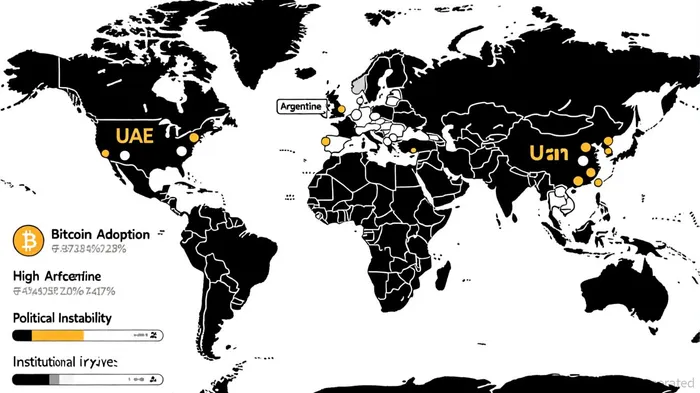






Comentarios
Aún no hay comentarios