
Bitcoin's Role in Modern Portfolios: Bridging Traditional Valuation Models and Cryptocurrency Speculation
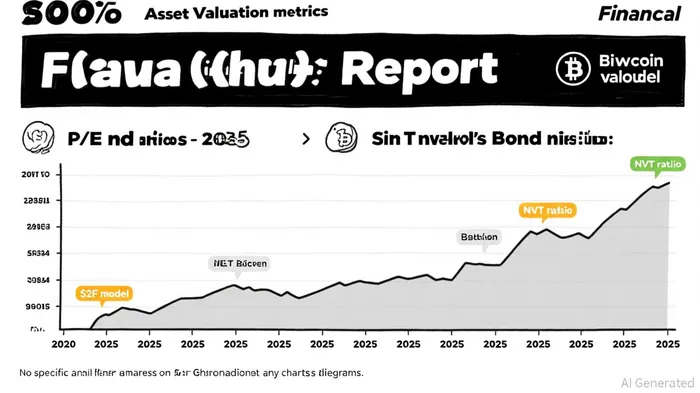
The integration of BitcoinBTC-- into modern investment portfolios has sparked a paradigm shift in asset valuation. Traditional models like the Capital Asset Pricing Model (CAPM) and Discounted Cash Flow (DCF) analysis, long the bedrock of equity and fixed-income valuation, struggle to account for Bitcoin's unique properties. Unlike stocks or bonds, Bitcoin generates no cash flows, derives no earnings, and operates outside the confines of centralized governance. Instead, its valuation is driven by speculative dynamics, network effects, and macroeconomic forces-a reality underscored by recent academic and industry research.
The Limits of Traditional Models
Traditional valuation frameworks assume predictable cash flows and risk-adjusted returns. The CAPM, for instance, calculates expected returns based on an asset's beta relative to the market, while DCF models discount future earnings to present value. However, Bitcoin's lack of dividends or revenue streams renders these approaches inadequate. A 2023 CFA Institute report acknowledges that while DCF can be adapted for cryptoassets by evaluating protocol revenue (e.g., staking yields), it remains ill-suited for Bitcoin itself, which lacks a traditional income-generating mechanism. Similarly, CAPM's reliance on historical volatility and market correlation falters when applied to Bitcoin, which has exhibited both decoupling from equities and sudden surges in correlation during macroeconomic shocks, as shown in a Castro e Silva analysis.
Bitcoin's Unique Valuation Drivers
Bitcoin's valuation is instead anchored to its digital scarcity, network adoption, and macroeconomic positioning. The Stock-to-Flow (S2F) model, which compares Bitcoin's fixed supply to its issuance rate, has gained traction as a scarcity-based framework. Analysts like PlanB projected prices of $160,000–$200,000 for 2025 using this model, in a PlanB projection. Meanwhile, Metcalfe's Law-which posits that network value scales with the square of its users-highlights Bitcoin's exponential growth potential as adoption expands, according to Citrine Capital.
On-chain metrics further refine these models. The Network Value to Transactions (NVT) ratio (Bitcoin's market cap divided by daily transaction volume) acts as a valuation benchmark, with a 2025 NVT of ~35 suggesting fair value, as discussed in a CFA blog post. The Puell Multiple, which compares miner revenue to historical averages, also signals overvaluation or undervaluation cycles; the same CFA blog post outlines how these indicators can be interpreted. These metrics, while empirical, reflect Bitcoin's dual role as both a store of value and a utility-driven asset.
Speculative Dynamics and Behavioral Factors
Bitcoin's price is inextricably tied to speculative behavior. A 2025 Financial Innovation study notes that Bitcoin's volatility stems from heterogeneous investor behavior: fundamentalists (who trade based on network metrics) and trend-followers (who chase momentum) create feedback loops that amplify price swings. Social media sentiment, particularly on platforms like Twitter, has also been shown to influence Bitcoin's short-term movements, as evidenced in a ResearchGate paper. For example, the Trump administration's 2025 executive order on digital finance-framed as a regulatory "green light"-spurred a 20% price surge within weeks, a development noted in Castro e Silva's LinkedIn analysis.
This speculative edge contrasts with traditional assets. While equities and bonds are priced through discounted cash flow or yield curves, Bitcoin's valuation often hinges on narrative-driven demand. A 2024 paper in MDPI argues that Bitcoin's price is influenced by its role as a hedge against loose monetary policy, with quantitative easing historically fueling its ascent; conversely, tightening cycles (e.g., the Fed's 2023 rate hikes) have triggered synchronized sell-offs with equities, a pattern also observed in the Castro e Silva analysis.
Portfolio Implications and Hybrid Models
For investors, Bitcoin's role in modern portfolios lies in its diversification potential and asymmetric risk profile. Over the 10 years ending 2024, Bitcoin delivered 26,931.1% returns, outpacing the S&P 500 and gold, according to a CoinGecko report. Yet its volatility necessitates a hybrid approach. The CFA Institute recommends combining S2F, Metcalfe's Law, and cost-of-production models to capture Bitcoin's multifaceted value (as discussed in the CFA Institute report). Meanwhile, advanced machine learning models-such as the NRBO-CNN-BiLSTM-Attention framework-have shown promise in forecasting Bitcoin's price with 50% lower error rates than traditional models, according to the NRBO-CNN-BiLSTM-Attention study.
Conclusion
Bitcoin's valuation challenges traditional finance but offers new opportunities for forward-thinking investors. While CAPM and DCF remain relevant for conventional assets, Bitcoin's price is best understood through a lens that incorporates network dynamics, scarcity, and speculative behavior. As institutional adoption grows and regulatory clarity emerges, Bitcoin's role in portfolios will likely evolve from speculative exposure to a strategic allocation-bridging the gap between digital innovation and time-tested financial principles.






Comentarios
Aún no hay comentarios