
Bitcoin's Role in Government Finance and Long-Term Asset Diversification
Strategic National Adoption: A New Paradigm
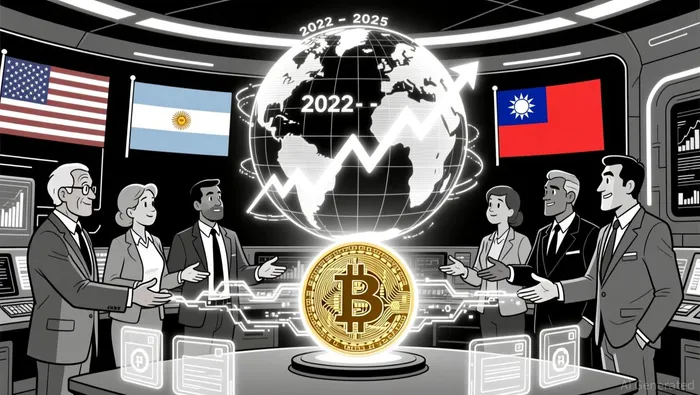
The U.S. government's March 2025 Executive Order to create the SBR marked a watershed moment. By amassing seized Bitcoin valued at $20–$23 billion, the initiative underscores Bitcoin's role as a strategic reserve asset. Similarly, Taiwan's Central Bank and Executive Yuan have launched a pilot program to study BTC's feasibility as a reserve, leveraging $146 million in seized cryptocurrency from criminal cases. These efforts are part of a broader global trend: El Salvador's 2021 adoption of Bitcoin as legal tender and Argentina's 2024 explorations of similar policies highlight how emerging economies are leveraging Bitcoin to counteract hyperinflation and dollar dependency.
The rationale for such adoption is clear. Bitcoin's finite supply (21 million coins) and decentralized nature position it as a hedge against fiat currency devaluation. For nations grappling with inflationary pressures, such as Argentina's 150% annual inflation rate, Bitcoin offers a store of value uncorrelated to traditional assets. Governments are also drawn to its potential to diversify reserves away from U.S. Treasuries, a move accelerated by geopolitical tensions and the desire to reduce exposure to dollar-centric financial systems.
Institutional Demand: A Ripple Effect
 Government adoption has catalyzed a surge in institutional Bitcoin investment, driven by regulatory clarity and market confidence. The approval of spot Bitcoin ETFs in January 2024, for instance, unlocked $36 billion in inflows and accumulated over 1 million Bitcoin, signaling a turning point for institutional participation. Major players-including MicroStrategy, Tesla, and Marathon Digital Holdings have since added Bitcoin to their corporate treasuries, treating it as a long-term asset.
This shift is not limited to corporate treasuries. Pension funds and hedge funds are increasingly allocating capital to Bitcoin. As of 2025, 3.4% of U.S. pension funds hold digital assets, while over 124 hedge funds maintain crypto allocations. The rise of Bitcoin Bond ETFs and investment vehicles tracking Bitcoin-holding companies further illustrates institutional confidence in the asset class.
Regulatory Clarity and Market Dynamics
The causal relationship between government policy and institutional demand is evident in emerging markets. Brazil's 2022 legal recognition of cryptocurrencies, for example, spurred a 150% increase in trading volume, attracting institutional investors seeking regulated environments. Conversely, regulatory ambiguity in India and Nigeria has stifled adoption, highlighting the importance of clear frameworks in fostering trust.
Bitcoin's correlation with equities has also evolved. Once considered non-correlated, the asset now exhibits a positive relationship with traditional markets, driven by institutional portfolio integration and the availability of derivatives. This shift underscores Bitcoin's growing role as a complementary asset in diversified portfolios, particularly for hedging against macroeconomic risks.
Quantifying the Impact
Quantitative data reinforces the link between national adoption and institutional demand. Digital asset assets under management (AUM) among institutions surged to $235 billion by mid-2025, up from $90 billion in 2022. Institutional crypto investments reached $21.6 billion in Q1 2025, fueled by regulatory milestones such as spot and Ethereum ETF approvals. These figures reflect a maturing market where Bitcoin is no longer a speculative fringe asset but a core component of institutional strategies.
Conclusion: A Strategic Imperative
Bitcoin's integration into government finance and institutional portfolios is no longer a question of if but how. As nations like the U.S. and Taiwan pioneer its use as a reserve asset, the ripple effects are reshaping global capital markets. For institutional investors, the message is clear: Bitcoin's role in hedging inflation, diversifying portfolios, and capitalizing on technological innovation is here to stay. The next phase of adoption will likely hinge on regulatory harmonization and further institutional innovation-factors that will determine Bitcoin's trajectory as a cornerstone of 21st-century finance.






Comentarios
Aún no hay comentarios