
Bitcoin's Role in a Fourth Turning-Style Institutional Reset: How Eroding Trust Drives Adoption and Price Appreciation
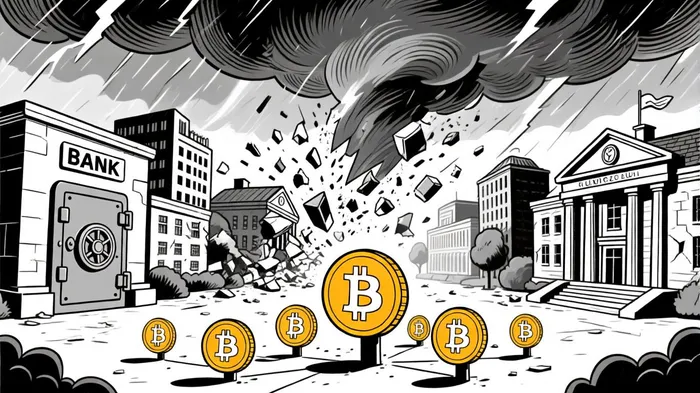
The Fourth Turning theory, a cyclical model of societal transformation, posits that every 80–90 years, civilizations face a period of institutional decay, political polarization, and economic upheaval[1]. We are now in the throes of the current Fourth Turning, which began with the 2008 financial crisis and has since been marked by K-shaped economic disparities, geopolitical instability, and a profound erosion of trust in legacy institutions[2]. Amid this backdrop, BitcoinBTC-- has emerged not merely as a speculative asset but as a potential cornerstone of a new financial paradigm. This analysis explores how Bitcoin's adoption and price appreciation are inextricably tied to the collapse of traditional systems and the search for decentralized alternatives.
The Trust Crisis and Bitcoin's Emergence
The 2008 financial crisis exposed systemic vulnerabilities in centralized banking and government-backed currencies. As trust in institutions eroded, Bitcoin's creation in 2009 offered a radical solution: a trustless, decentralized ledger system immune to manipulation by any single entity[3]. According to Jordi Visser, Bitcoin's fixed supply of 21 million coins and its cryptographic security make it a deflationary hedge against inflation and currency devaluation[4]. This is particularly relevant in a Fourth Turning context, where public confidence in banks, governments, and employersEIG-- has plummeted[5].
Empirical evidence supports this narrative. During the Russia-Ukraine war and the Israel-Palestine conflict, Bitcoin's trading volumes surged as individuals sought digital safe havens[6]. Similarly, in hyperinflationary economies like Lebanon and Nigeria, Bitcoin adoption has grown as a store of value[7]. These trends underscore Bitcoin's role as a counterbalance to institutional failure, especially in regions where traditional systems have collapsed.
Institutional Decay and the K-Shaped Economy
The Fourth Turning is characterized by a K-shaped economy, where divergent economic outcomes split society into winners and losers[8]. For those at the bottom of the K, Bitcoin represents a tool for financial sovereignty. Brandon Quittem argues that Bitcoin adoption acts as a “pressure release valve” for societal tensions, enabling individuals to bypass corrupt or unreliable institutions[9]. This is further reinforced by data showing that Bitcoin adoption rates rise sharply during crises, particularly among younger and male demographics identified as risk-seeking segments[10].
The University of Michigan's consumer sentiment report highlights a sharp decline in trust, with over 60% of respondents anticipating higher unemployment in 2026[11]. In such an environment, Bitcoin's decentralized nature and resistance to censorship become increasingly attractive. As Visser notes, Bitcoin's appeal lies in its ability to function as a neutral, permissionless asset in a world where trust in legacy systems is waning[12].
Institutional Adoption and Market Integration
While retail adoption is critical, institutional interest in Bitcoin has also accelerated. The introduction of Bitcoin ETFs and regulated investment products has allowed institutions to enter the market without directly holding the asset[13]. This shift has strengthened Bitcoin's correlation with traditional financial assets like the Nasdaq 100 and S&P 500, signaling broader acceptance[14]. However, challenges remain: regulatory uncertainty, price volatility, and environmental concerns continue to hinder full integration[15].
Despite these hurdles, Bitcoin's market efficiency has improved over time, particularly during the pandemic, when its price volatility decreased relative to traditional assets[16]. This maturation suggests that Bitcoin is evolving from a speculative asset to a strategic component of diversified portfolios, especially during periods of systemic instability.
Future Projections and Strategic Implications
As the Fourth Turning progresses, Bitcoin's role as a catalyst for institutional reset is likely to expand. Analysts predict significant price appreciation driven by macroeconomic shifts and growing demand for alternatives to traditional systems[17]. However, Bitcoin's long-term success as a safe haven remains contingent on its ability to navigate regulatory frameworks and technological scalability challenges[18].
Conclusion
Bitcoin's ascent is inextricably linked to the Fourth Turning's institutional decay. As trust in traditional systems erodes, Bitcoin's decentralized, trustless design positions it as a viable alternative for individuals and institutions alike. While challenges persist, the confluence of macroeconomic instability, technological innovation, and growing institutional adoption suggests that Bitcoin will play a pivotal role in shaping the post-crisis financial landscape. For investors, understanding this dynamic is critical to navigating the uncertainties of the Fourth Turning and capitalizing on the opportunities it presents.






Comentarios
Aún no hay comentarios