
Bitcoin's Role in a Diversified Retirement Portfolio: Strategic Allocation and Risk-Return Tradeoffs in a Post-Quantitative Easing Era
In the aftermath of decades of quantitative easing (QE), traditional retirement portfolios face a paradox: low-yield environments and macroeconomic uncertainties have eroded returns, yet investors remain tethered to asset classes that no longer deliver the growth of past decades. BitcoinBTC--, often dismissed as a speculative fad, has emerged as an unconventional yet compelling solution. Recent research and institutional adoption trends suggest that a strategic allocation to Bitcoin-particularly in the 1–5% range-can enhance risk-return profiles while addressing the unique challenges of a post-QE world.
Risk-Return Dynamics: A Quantitative Case for Bitcoin
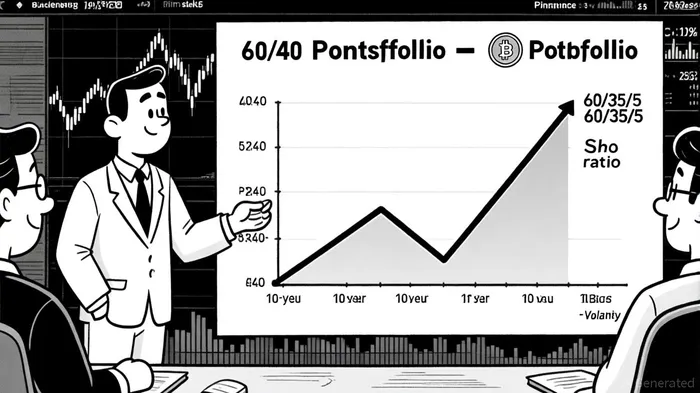
According to a Forbes analysis, a 5% allocation to Bitcoin in a retirement portfolio has historically increased annualized returns by 4–5 percentage points while adding only 1 percentage point of volatility, resulting in significantly improved Sharpe ratios over 5- and 10-year horizons. This asymmetry-higher returns for incremental risk-stems from Bitcoin's low correlation with traditional assets (0.39 with U.S. stocks) and its role as a hedge against inflation and geopolitical instability, according to BlackRock's analysis. BlackRock's analysis further validates this, noting that Bitcoin's inclusion can enhance diversification by introducing a non-correlated, scarcity-driven asset into portfolios.
However, Bitcoin's volatility remains a double-edged sword. While its price swings are daunting, they are driven by distinct factors-network adoption, regulatory shifts, and macroeconomic tailwinds-compared to equities or bonds. This divergence means Bitcoin's volatility does not necessarily amplify portfolio risk during market downturns, provided allocations remain disciplined, as the Forbes analysis notes.
Institutional Adoption: From Speculation to Strategic Allocation
The shift in institutional sentiment is striking. As of Q2 2025, 60% of cryptocurrency market activity involves institutional investors, with 59% allocating at least 10% of their portfolios to digital assets, according to the Forbes analysis. This trend is fueled by regulatory clarity, such as the approval of spot Bitcoin ETFs like BlackRock's IBITIBIT--, which has eliminated custody risks and provided a familiar vehicle for allocation, per a Kenson Investments update.
Corporate adoption has also accelerated. Businesses, particularly small-to-mid-sized firms, are allocating a median of 10% of net income to Bitcoin as part of treasury strategies, according to a Business Initiative study. Notable examples include MicroStrategy's multi-billion-dollar Bitcoin purchases and the Norway Government Pension Fund's gradual accumulation of the asset. These moves underscore Bitcoin's growing acceptance as a long-term store of value, especially in an era of U.S. fiscal uncertainty and global monetary experimentation, as the Business Initiative study notes.
Risk Management: Mitigating the Unconventional
Critics rightly highlight Bitcoin's risks: its 15-year track record is short by traditional standards, and its correlation with equities during extreme market stress remains untested. Yet, institutional-grade risk management frameworks-such as hybrid custody models, AI-driven security protocols, and diversification into complementary assets like gold or real estate-can mitigate these concerns, as the Forbes analysis explains. Fidelity Institutional emphasizes that Bitcoin's role in a portfolio should be evaluated through three lenses: returns, volatility, and correlation with existing holdings.
For retirement portfolios, the key is balance. A 1–5% allocation avoids overexposure while capturing Bitcoin's upside potential. This approach aligns with the "barbell strategy" popularized by Nassim Taleb: allocate the majority of capital to low-risk assets while reserving a small portion for high-conviction, high-reward bets, as the Forbes analysis suggests.
Conclusion: A New Paradigm for Diversification
Bitcoin's role in retirement portfolios is not about replacing traditional assets but redefining diversification. In a post-QE world where central banks have exhausted their tools, Bitcoin offers a unique combination of scarcity, decentralization, and macroeconomic resilience. While its volatility demands caution, the data suggests that a measured allocation can enhance risk-adjusted returns without compromising long-term stability.
As institutional adoption continues to normalize Bitcoin's inclusion, investors must ask not whether to allocate, but how much and how to manage the risks. The answer, increasingly, lies in strategic, data-driven allocation frameworks that balance innovation with prudence.





Comentarios
Aún no hay comentarios