
Bitcoin's Risk Profile and Macroeconomic Sensitivity: Strategic Positioning in a Low-Volatility Regime
The BitcoinBTC-- market in Q3 2025 is operating in a paradoxical equilibrium: historically low volatility coexists with heightened macroeconomic uncertainty. This duality presents a unique opportunity for investors to strategically position for a potential breakout, leveraging Bitcoin's evolving risk profile and its nuanced relationship with central bank policy.
Bitcoin's Risk Profile: A Tale of Two Forces
The Bitcoin Risk Index for Q3 2025 reveals a market at a crossroads. On the bullish side, the MVRV Z-Score has rebounded to 1.43, a level historically associated with cyclical bottoms in 2017 and 2021[2]. This suggests the current correction is structural rather than cyclical, with long-term holders accumulating at lower prices—evidenced by the rising Value Days Destroyed (VDD) Multiple[2]. The Pi Cycle Oscillator further reinforces this narrative, with the 111-day and 350-day moving averages diverging upward, signaling renewed growth momentum[3].
However, macroeconomic headwinds persist. Bitcoin's correlation with U.S. equities remains pronounced, exposing it to potential spillover risks from a global recession[2]. Whale activity, while showing signs of profit-taking[1], could exacerbate short-term volatility. The approval of Bitcoin ETFs remains a critical catalyst: sustained inflows could propel prices toward $200K by 2026[1], while regulatory delays or hawkish Fed policy could push prices toward $75K–$101K[5].
Macroeconomic Sensitivity: Fed Policy as the Linchpin
Bitcoin's price volatility in 2025 is increasingly shaped by expectations of Federal Reserve rate cuts. The anticipation of a 25–50 basis point cut in September has eased downside fears, as reflected in narrowing call/put skews[3]. Historically, Bitcoin has responded positively to dovish cycles—most notably in 2020, when emergency rate cuts and stimulus packages drove it from $4K to $28K[1]. Yet, the 2019 mid-cycle cuts serve as a cautionary tale: Bitcoin fell 30% despite rate reductions, underscoring the importance of broader macroeconomic context[5].
The Fed's September 17 rate decision and the Jackson Hole symposium will be pivotal. A dovish outcome could reinforce risk-on sentiment, with Bitcoin ETF inflows (e.g., BlackRock's IBIT, holding 3.52% of total supply[5]) amplifying liquidity-driven rallies. Conversely, a hawkish pivot—suggesting fewer cuts or tighter policy—could trigger a re-rating of risk assets, including Bitcoin[1].
Low-Volatility Phases: A Strategic Window
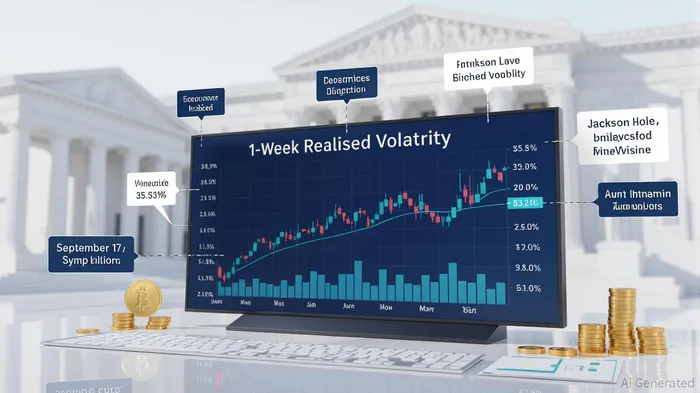
Bitcoin's 1-week realized volatility has plummeted to 23.42%, a four-year low[1], while 1-week implied volatility sits at 37.39%—its lowest since 2023[1]. This “quiet before the storm” dynamic is not new: similar volatility troughs in October and November 2024 preceded sharp rebounds[1]. The current consolidation near $114K, amid a “Goldilocks” scenario of delayed tariffs and fiscal stimulus[5], suggests a market bracing for a catalyst.
Market sentiment indicators corroborate this. The Bitcoin Put/Call Ratio at 0.72 reflects defensive positioning, with traders using puts to hedge or accumulate at a discount[2]. Meanwhile, the VIX (16.41) signals calm, but 3-month and 6-month implied volatility remain elevated at 53.1% and 56.25%[1], hinting at anticipated turbulence. Bitcoin's correlation with the VIX has weakened to -59.91%, indicating growing independence from traditional market fears[2], a trend amplified by institutional adoption (59% of Bitcoin portfolios now held by institutions[3]).
Positioning for the Breakout
The data supports a strategic entry or holding position in Bitcoin during this low-volatility phase. Key arguments include:
1. Structural Accumulation: Long-term holders are buying at lower prices[2], creating a floor for further declines.
2. Dovish Policy Tailwinds: A 90.3% probability of a September rate cut[4] could drive liquidity into risk assets, with Bitcoin ETFs acting as amplifiers.
3. Macro Divergence: Bitcoin's decoupling from the VIX[2] suggests it may outperform traditional assets in a risk-on environment.
However, risks remain. A hawkish Fed or renewed trade tensions (e.g., expiration of Trump's tariff freeze[4]) could reintroduce volatility. Investors should balance exposure with hedging strategies, such as short-term puts or options spreads, to mitigate downside risks.
Conclusion
Bitcoin's risk profile in Q3 2025 is a mosaic of resilience and vulnerability. While macroeconomic uncertainties linger, the interplay of structural accumulation, dovish policy expectations, and institutional adoption creates a compelling case for strategic positioning. As the Fed's September decision looms, investors who navigate this low-volatility phase with discipline may find themselves well-placed to capitalize on the next leg of Bitcoin's cycle.





Comentarios
Aún no hay comentarios