
Bitcoin's Retreat to $112,000 and the 'Fear' Signal: A Buying Opportunity or a Cautionary Downturn?
Bitcoin's recent drop to $112,000 has ignited a debate among investors: is this a chance to “buy the dip,” or a warning sign of deeper bearish momentum? The answer lies in dissecting market sentiment, on-chain signals, and historical patterns. Let's unpack the data.
The Bearish Case: Cycle Exhaustion and Liquidity Risks
Bitcoin's 4% decline to $112,000 last week triggered $1.6 billion in liquidations, with bearish on-chain metrics amplifying concerns. The Sharpe ratio—a measure of risk-adjusted returns—has weakened, while the Spent Output Profit Ratio (SOPR) has dipped, suggesting holders are selling at a loss[1]. The taker buy/sell ratio now sits at -0.79, indicating selling pressure has overtaken buying volume[1].
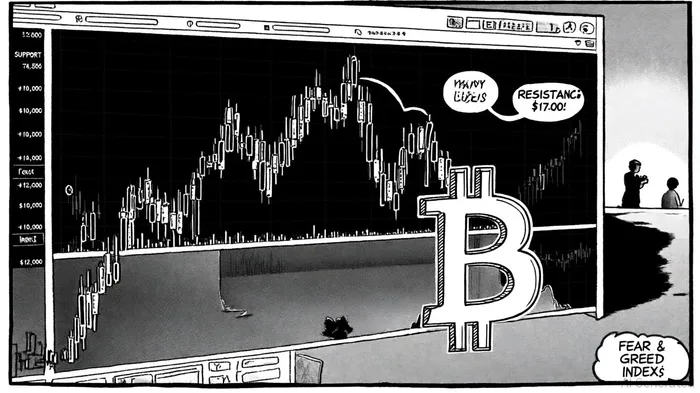
Technical analysts warn that Bitcoin's failure to break above $117,000 resistance has opened the door to a potential slide toward $100,600 if support levels fail[2]. Pseudonymous analyst Ali cautions that BitcoinBTC-- is “hanging by a thread” below $112,000, with a critical support level at $110,500[3].
The Contrarian Case: Fear as a Catalyst for Rebound
Yet amid the pessimism, contrarian signals are flashing green. The Bitcoin Fear & Greed Index has plunged into the “Fear” zone, a historically reliable precursor to rebounds. For instance, in early 2025, the index hit 25 (extreme fear) as Bitcoin fell below $90,000, only to bounce back within two months and hit new highs[4]. Similarly, in August 2025, a brief dip to 44 in the fear zone was followed by a swift recovery to $114,500[1].
On-chain data also tells a nuanced story. Large Bitcoin wallets—often dubbed “whales”—are accumulating, and the Coinbase Premium Index remains positive, signaling sustained U.S. retail demand[3]. Institutional investors are reinforcing Bitcoin's long-term narrative, with corporations like MicroStrategy and Metaplanet adding to their BTC holdings[3].
Historical Patterns and Contrarian Strategies
Bitcoin's history during fear-driven selloffs offers a playbook for investors. From 2018 to 2025, Bitcoin has consistently rebounded after extreme fear, with notable recoveries including a 1,500% surge post-2020 crash[5]. The Fear & Greed Index, which ranges from 0 (extreme fear) to 100 (extreme greed), has historically shown that scores below 20 correlate with strong 30-day returns of around +18%[5].
A practical strategy for contrarians is the Fear & Greed Dollar-Cost Averaging (DCA) approach. Instead of investing fixed amounts at regular intervals, investors trigger purchases only when the index drops below 20. This method has outperformed traditional DCA by nearly 11 times over seven years[5].
Navigating the Volatility: Key Levels to Watch
Bitcoin's immediate fate hinges on its ability to hold critical support levels. If it reclaims $112,000 and closes above $112,600 on a 4-hour chart, bullish momentum could resume[3]. Conversely, a breakdown below $110,500 would signal deeper correction risks[3].
Institutional inflows into Bitcoin ETFs and stable macroeconomic data—such as the upcoming Federal Reserve statements—will also play pivotal roles[4]. Meanwhile, reduced liquidation intensity and stable demand metrics suggest downward pressure may be easing[3].
Conclusion: Balancing Caution and Opportunity
Bitcoin's retreat to $112,000 is a textbook example of market volatility. While bearish signals like SOPR and SOPR suggest caution, contrarian indicators—fear-driven sentiment, whale accumulation, and institutional buying—paint a different picture. For disciplined investors, this is a moment to separate noise from signal.
As Warren Buffett once said, “Be fearful when others are greedy and greedy when others are fearful.” In Bitcoin's case, the current fear zone may be the most compelling buying opportunity in years—provided investors can stomach the short-term turbulence.







Comentarios
Aún no hay comentarios