
Bitcoin's Retail Revolution: Strategic Positioning and Long-Term Investment Value in a Divided Ecosystem
The retail sector's embrace of BitcoinBTC-- in 2025 represents a seismic shift in how digital assets are perceived-not merely as speculative tools but as foundational infrastructure for commerce. According to a Pleb Underground report, global crypto ownership surged to 560 million people in 2024, with Bitcoin dominating 80% of retail portfolios. This trend is amplified by the Lightning Network's 85% capacity growth in 2025, enabling 8 million monthly transactions and reducing fees to fractions of a cent, as shown in CoinLaw's statistics. For investors, these metrics signal a maturing ecosystem where Bitcoin is no longer a fringe experiment but a scalable, practical medium of exchange.
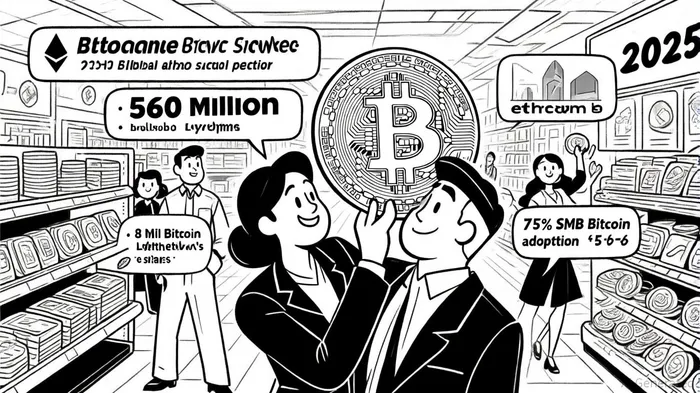
Steak 'n Shake's recent decision to double down on Bitcoin while pausing EthereumETH-- (ETH) integration epitomizes this strategic pivot. The fast-food chain faced intense backlash from Bitcoin maximalists after proposing a poll to expand crypto payments to ETHETH--. Despite 53% of voters supporting ETH, the company reversed course, declaring, "Our allegiance is with Bitcoiners." This move, while seemingly reactive, underscores a critical insight: in a fragmented crypto landscape, aligning with a dominant network's community can yield disproportionate returns.
Strategic Positioning: Bitcoin as a Competitive Differentiator
Small and medium-sized businesses (SMBs) are leading the charge in Bitcoin adoption. The River Business Report 2025 reveals that 75% of corporate Bitcoin adopters have fewer than 50 employees, with a median allocation of 10% of monthly net income to BTC, according to the Corporate Bitcoin Adoption analysis. For these businesses, Bitcoin functions as a "strategic asset" akin to real estate, offering inflation hedging and customer acquisition advantages, as detailed in a River report. Steak 'n Shake's 15% year-over-year same-store sales growth in Q3 2025-partly attributed to Bitcoiners-validates this approach.
The Lightning Network's role in this strategy cannot be overstated. By enabling instant, low-cost transactions, it transforms Bitcoin from a store of value into a viable payment rail. For retailers, this means capturing a segment of consumers who prioritize financial sovereignty over convenience. As CoinLaw notes, 62.4% of Bitcoin mining now uses renewable energy, further enhancing its appeal to eco-conscious investors and customers.
Long-Term Investment Implications
Bitcoin's retail adoption is not just a short-term fad. With 72% of its total supply held by long-term holders, daily volatility has declined by 40% since 2023, creating a stable environment for institutional and retail investment (CoinLaw). For investors, this stability reduces the risk of "store of value" erosion while amplifying Bitcoin's utility as a cross-border remittance tool. In emerging markets like Nigeria and Argentina, where traditional banking access is limited, Bitcoin adoption grew by 172% year-over-year in 2024, the report found.
Steak 'n Shake's "Bitcoin Steakburger" launch on October 16, 2025, is a masterstroke in brand alignment. By embedding Bitcoin into its identity, the company taps into a community that values decentralization and resistance to centralized systems. This loyalty translates into recurring revenue streams, as Bitcoiners are 3x more likely to frequent businesses that share their values, the Pleb Underground report observed.
The Tribal Divide and Its Impact on Investment
The backlash against Steak 'n Shake's ETH proposal reveals deeper philosophical splits in the crypto ecosystem. Vitalik Buterin's defense of the company's decision-arguing that businesses should "commit to one community"-highlights the tension between broad appeal and ideological purity, a point discussed in the River report. For investors, this tribalism creates a binary: Bitcoin's cohesive, value-driven community versus Ethereum's fragmented, innovation-focused ecosystem.
The data supports Bitcoin's edge in retail adoption. While Ethereum's DeFi and NFT ecosystems attract speculative capital, Bitcoin's simplicity and network effect make it the default choice for everyday transactions. As the report notes, 55% of 18–34-year-olds in the U.S. plan to purchase Bitcoin in 2025, a demographic poised to drive long-term demand.
Conclusion
Bitcoin's retail adoption in 2025 is a testament to its evolution from speculative asset to economic infrastructure. For investors, the strategic positioning of companies like Steak 'n Shake-prioritizing Bitcoin's network and community-offers a blueprint for capturing value in a polarized market. As Lightning Network scalability and renewable energy adoption reduce friction, Bitcoin's role in commerce will only expand. The lesson for investors is clear: align with the network that dominates both the store of value and the medium of exchange.






Comentarios
Aún no hay comentarios