
Bitcoin's Response to Fed Policy: A New Era of Macro-Driven Momentum
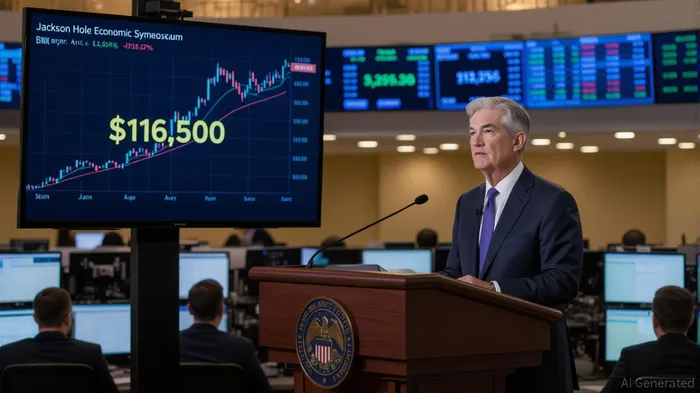
The Federal Reserve's Jackson Hole 2025 symposium marked a seismic shift in the relationship between central bank policy and cryptocurrency markets. For years, BitcoinBTC-- has been viewed as a hedge against inflation and a store of value in a world of fiat currency debasement. But in August 2025, the market witnessed something new: a direct, real-time correlation between Fed signals and crypto liquidity, as Powell's dovish pivot catalyzed a $300 million Bitcoin futures surge in under 15 minutes. This event underscores a structural evolution in how cryptocurrencies are priced—not just as speculative assets, but as macroeconomic barometers.
The Jackson Hole Pivot: A Policy Signal with Global Ripples
Federal Reserve Chair Jerome Powell's speech on August 22, 2025, was a masterclass in central bank communication. Amid a fragile economic backdrop—labor market slowdowns, inflation stubbornly above 2%, and a global shift toward risk-off positioning—Powell's words carried immense weight. His admission that the Fed was “no longer on a preset course” and his acknowledgment of “rising downside risks to employment” signaled a potential pivot toward rate cuts. This dovish shift was not just a policy adjustment; it was a psychological reset for global markets.
The immediate impact was staggering. Bitcoin, which had been trading in a consolidation phase near $112,000, surged to $116,500 within hours. But the most telling metric was the liquidity flood in Bitcoin futures markets. According to data from CryptoQuant and analyst Darkfost, $300 million in fresh capital poured into Binance's Bitcoin futures contracts within 15 minutes of Powell's remarks. This pushed Binance's Bitcoin Open Interest to $13.3 billion, a 2.3% spike in a matter of minutes. The broader crypto derivatives market saw total Open Interest rise by 8.5% to $215 billion, reflecting a systemic repositioning of capital toward risk-on assets.
Why This Matters: A Structural Shift in Crypto's Macroeconomic Sensitivity
The Jackson Hole event highlights a critical development: cryptocurrencies are now priced as macro assets, not just speculative plays. Historically, Bitcoin's price action was driven by on-chain metrics, institutional adoption, and retail sentiment. Today, it's equally influenced by Fed policy, inflation data, and global liquidity conditions. This shift is driven by three factors:
- Institutional Onboarding: The filing of a spot Bitcoin ETF by BlackRockBLK-- in June 2023 normalized crypto as an asset class for institutional investors. These players now treat Bitcoin like gold or Treasuries—assets that react to central bank policy.
- Derivatives Market Growth: The explosion of crypto derivatives (futures, options, and perpetual contracts) has created a leveraged feedback loop. When the Fed signals easing, speculative capital floods into futures markets, amplifying price swings.
- Global Liquidity Dynamics: A dovish Fed reduces the cost of capital, incentivizing investors to chase yield in high-risk, high-reward assets like Bitcoin. This is particularly true in a world where traditional safe-haven assets (e.g., U.S. Treasuries) offer diminishing returns.
The $300 million liquidity surge in Bitcoin futures is a case study in this new paradigm. Traders interpreted Powell's comments as a green light to reposition capital into risk assets, leveraging futures contracts to amplify gains. The result? A parabolic spike in Open Interest and a price rebound that reclaimed key technical levels, including the 200-period SMA on the 4-hour chart.
The Broader Implications: A Macro-Driven Bull Market?
The Jackson Hole pivot raises a critical question: Is this the start of a new bull market driven by macroeconomic tailwinds? The data suggests yes.
- Ethereum's Rally: While Bitcoin's surge was headline-grabbing, EthereumETH-- outperformed, hitting a new all-time high of $4,885. This was fueled by a surge in Ethereum-based options trading, with call options volume spiking 40% in a single day.
- Market Cap Expansion: The total crypto market cap jumped $200 billion in 24 hours, reaching $4.1 trillion. This mirrors the 2020–2021 bull run, which was also preceded by Fed easing.
- Rate Cut Expectations: The probability of a 25-basis-point rate cut in September 2025 skyrocketed from 73% to 87% post-speech, according to CME FedWatch data. This creates a self-fulfilling prophecy: the more investors price in rate cuts, the more capital flows into risk assets like Bitcoin.
Investment Strategy: Positioning for a Macro-Driven Cycle
For investors, the Jackson Hole event offers a clear playbook: align portfolios with the Fed's policy trajectory. Here's how to capitalize on the new era of macro-driven momentum:
- Bitcoin and Ethereum as Core Holdings: These assets are now leading indicators of monetary policy. A 25-basis-point rate cut in September would likely push Bitcoin above $120,000 and Ethereum toward $5,500.
- Derivatives Exposure: Futures and options markets offer amplified returns in a bullish environment. However, leverage comes with risk—prioritize long-dated options or futures with tight stop-losses.
- Macro Correlation Plays: Gold, the U.S. dollar index (DXY), and equities (e.g., Nasdaq 100) will also benefit from rate cuts. A diversified portfolio that includes Bitcoin, gold, and tech stocks can hedge against volatility while capturing upside.
Conclusion: The New Normal
The Jackson Hole 2025 speech was more than a market event—it was a tectonic shift in how cryptocurrencies are priced. Bitcoin's $300 million futures surge in 15 minutes is a testament to the growing influence of macroeconomic signals in crypto markets. As central banks continue to navigate inflation-labor market trade-offs, cryptocurrencies will remain at the forefront of capital flows. For investors, the lesson is clear: in this new era, macro matters more than ever.






Comentarios
Aún no hay comentarios