
Bitcoin's Resilience and Recovery Amid Record Liquidations
Understanding Liquidations: A Contrarian Compass
Liquidation data acts as a real-time barometer of market sentiment. When leveraged traders face margin calls, their forced exits create cascading price movements. For example, short liquidations in the $102,000–$103,500 range historically signal a potential short squeeze, while long liquidations above $106,800 often precede bearish reversals. These patterns are not random-they reflect concentrated leverage in specific price zones.
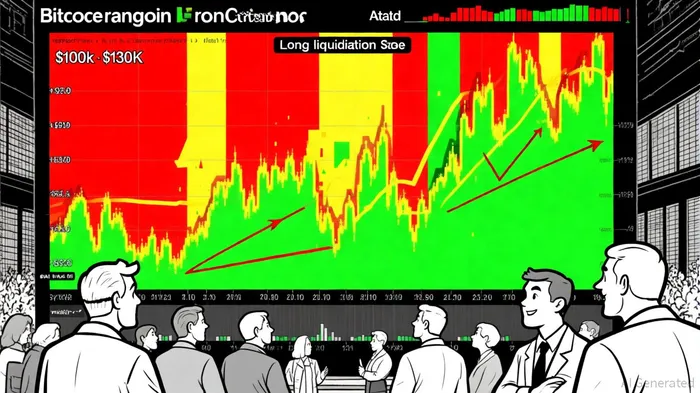
Platforms like CoinGlass and Bybit now offer granular, real-time liquidation data, as detailed in a Bybit API announcement, allowing investors to map out "risk zones" where forced selling or buying is likely to occur. A liquidation heatmap visualizes these clusters, acting as an early warning system. For instance, if shorts are being liquidated en masse near $103,000, it suggests a floor for the price. Conversely, a surge in long liquidations above $125,000 could indicate a ceiling.
Strategic Entry Points: Leverage the Chaos
For long-term investors, the key is to identify entry points where liquidations create buying opportunities rather than panic. Here's how to do it:
Identify Liquidation Clusters as Support/Resistance
Historical liquidation data reveals where leveraged positions are most vulnerable. If Bitcoin's price approaches a zone with high short liquidation history (e.g., $102,000–$103,500), it becomes a strategic entry point. The forced buying from liquidations can prop up the price, creating a low-risk entry for long-term buyers.Use Volatility as a Filter
Bitcoin's recent volatility-driven by ETF inflows and macroeconomic shifts-has created overbought and oversold conditions. When the price dips after a sharp rally (e.g., from $126k to $113k), liquidation data can help distinguish temporary pullbacks from deeper corrections. For example, if shorts are being liquidated during a dip, it signals strong demand at lower levels.Combine On-Chain and Derivative Data
Tools like Glassnode and TradingView provide on-chain metrics (e.g., whale activity, NVT ratio) that complement liquidation data, as reviewed in the Cryptodolphine roundup. A drop in Bitcoin's price accompanied by rising short liquidations and stable on-chain metrics (e.g., stable hash rate, increasing small-holder dominance) suggests a healthy correction rather than a bear market.
Case Study: October 2025's "Uptober" Rally
Bitcoin's October rally to $126k was fueled by $5.95 billion in ETF inflows, according to the Analytics Insight coverage, but the subsequent pullback to $113k created a textbook entry scenario. By October 12, liquidation heatmaps showed heavy short liquidations in the $103k–$105k range, indicating a potential rebound. Long-term investors who entered here capitalized on the subsequent recovery to $115k, avoiding the worst of the volatility while securing a position below the all-time high.
The Long-Term Play: Patience and Precision
Bitcoin's volatility is a feature, not a bug, for long-term investors. By leveraging liquidation data, investors can avoid emotional decisions and instead use market stress as a guide. The key is to:
- Enter during liquidation-driven rebounds, when forced buying creates a floor.
- Avoid over-leveraged zones, where cascading liquidations could deepen corrections.
- Stay informed with real-time tools, using platforms like CoinGlass and Bybit's API to track leverage shifts.
As BitcoinBTC-- approaches its next phase-potentially targeting $130k–$140k-the path to resilience is clear for those who can read the liquidation signals.






Comentarios
Aún no hay comentarios