
Bitcoin's Resilience Amid Market Volatility: A Strategic Entry Point for Long-Term Investors?
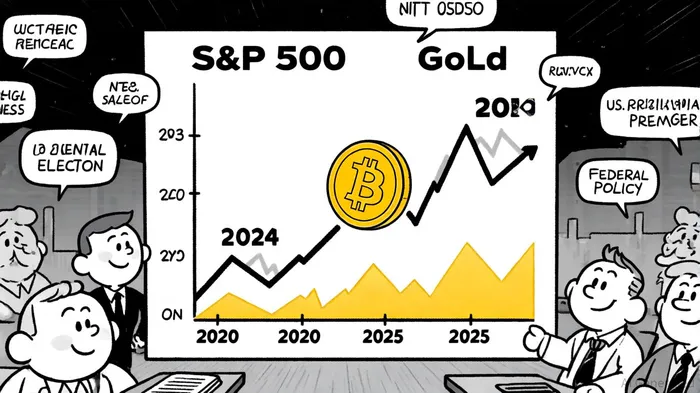
In the ever-shifting landscape of global markets, BitcoinBTC-- has emerged as both a lightning rod and a potential haven for contrarian investors. As macroeconomic uncertainty intensifies—marked by trade policy volatility, Federal Reserve rate uncertainty, and geopolitical tensions—Bitcoin's performance relative to traditional assets like the S&P 500 and gold offers critical insights for long-term investors. The question remains: Is Bitcoin's current volatility and price action a signal to buy, or a warning to wait?
Historical Divergence and Convergence
Bitcoin's relationship with the S&P 500 has long been a tug-of-war between alignment and divergence. From 2020 to 2024, the S&P 500 surged from 4,000 to 6,000, while Bitcoin lagged, peaking at $30,000 before retreating to $25,000 in 2024 [1]. This divergence, however, is not unprecedented. Historical patterns suggest Bitcoin often lags during early phases of bull cycles but catches up as macroeconomic conditions stabilize [1]. For instance, the S&P 500's rally from April to October 2024 (5,200 to 6,000) was followed by Bitcoin's November 2024 rebound, coinciding with the U.S. presidential election—a key macroeconomic event [1].
This dynamic underscores a critical contrarian insight: Bitcoin's underperformance relative to equities may signal a buying opportunity. As noted by Coindesk, “history suggests Bitcoin is likely to catch up” after periods of divergence [1]. For long-term investors, this implies that volatility—while uncomfortable—can create asymmetric risk/reward scenarios.
Volatility as a Double-Edged Sword
Bitcoin's volatility has long been a barrier to mainstream adoption, yet recent data reveals a narrowing gap with traditional assets. Over the past 12 months, Bitcoin's annualized volatility stood at 35.48%, significantly lower than its 10-year average of 46.31% but still higher than the S&P 500 (9.64%) and gold (8.68%) [2]. However, this volatility is no longer as extreme as commonly perceived. In August 2025, Bitcoin's 260-day volatility was only 2.2 times that of gold—the narrowest margin ever recorded between the two assets [4].
This convergence suggests Bitcoin is maturing as an asset class. While it remains more volatile than equities, its price swings are increasingly comparable to high-beta tech stocks like Tesla and NVIDIA [2]. For investors stress-testing portfolios against macroeconomic shocks, Bitcoin's volatility profile now offers a balance between risk and diversification.
Institutional Adoption and On-Chain Signals
Institutional interest in Bitcoin has surged, with major financial firms framing it as a non-correlated hedge against equities and fiat currencies [3]. On-chain data further reinforces this narrative. As of September 2025, over 19,130 addresses hold more than 100 BTC, signaling robust whale accumulation [1]. Meanwhile, Bitcoin ETFs saw $751 million in outflows in August, reflecting short-term caution but not long-term disinterest [1].
Contrarian investors should also note Bitcoin's defensive positioning. Key support levels at $108,000 and $107,400 in September 2025 align with historical on-chain metrics, suggesting a strong base for a potential rebound [1]. Analysts like Joao Wedson argue that Bitcoin's September 2025 performance—while weaker than in 2012 or 2015—has outperformed cycles like 2014 and 2022, hinting at structural improvements in its market dynamics [3].
Macroeconomic Stress Testing: The 2025 Scenario
Bitcoin's resilience in September 2025 has been tested by a $162 billion market selloff driven by a stronger U.S. dollar, regulatory uncertainty, and leveraged liquidations [5]. Yet, its performance contrasts with traditional safe-havens like gold and the Swiss Franc, which have historically outperformed during geopolitical instability [2]. While Bitcoin's short-term reactions to events like trade policy shifts can be positive, its long-term safe-haven status remains unproven [2].
However, macroeconomic tailwinds could tilt in Bitcoin's favor. A weaker U.S. dollar and anticipated Fed rate cuts are expected to boost liquidity in risk assets, potentially propelling Bitcoin toward $120,000 in September 2025 and $200,000 by year-end [1]. For investors stress-testing portfolios against scenarios like inflationary shocks or dollar depreciation, Bitcoin's inverse correlation with the U.S. dollar makes it a compelling addition [1].
Strategic Entry Point or Overhyped Bet?
The case for Bitcoin as a strategic entry point hinges on three pillars:
1. Historical Convergence: Bitcoin's tendency to catch up after lagging the S&P 500.
2. Volatility Normalization: Its narrowing volatility gap with gold and tech stocks.
3. Macro Tailwinds: A weaker dollar and Fed easing creating a favorable backdrop.
Critics will argue that Bitcoin's recent selloff in September 2025 reflects lingering risks, particularly in a regulatory environment still evolving. Yet, for long-term investors, volatility is a feature, not a bug. As Forbes notes, “Bitcoin's volatility is being increasingly understood and managed by investors” [2].
Conclusion
Bitcoin's resilience amid 2025's market volatility challenges the narrative of it being a speculative fad. While its price action remains unpredictable in the short term, the interplay of historical patterns, narrowing volatility, and macroeconomic tailwinds suggests a compelling case for contrarian entry. For investors willing to endure short-term turbulence, Bitcoin's current positioning—anchored by whale accumulation and defensive on-chain metrics—may represent a strategic inflection point.






Comentarios
Aún no hay comentarios