
Bitcoin's Resilience Amid Macroeconomic Volatility: Can NFP Data Truly Move BTC/USD?
Bitcoin's journey through 2025 has been a masterclass in resilience. While traditional markets grapple with macroeconomic headwinds-ranging from inflationary pressures to geopolitical tensions-Bitcoin has demonstrated an uncanny ability to decouple from conventional volatility triggers. This raises a critical question for investors: Can U.S. Nonfarm Payrolls (NFP) data still move BTC/USD, or has Bitcoin evolved into a macroeconomic outlier?
Historical Correlation: NFPNFP-- as a Policy Barometer
For years, NFP data served as a bellwether for Bitcoin's price action. Strong job creation numbers, which typically signaled a robust U.S. dollar and delayed Federal Reserve rate cuts, historically correlated with Bitcoin's bearish phases. Conversely, weak NFP reports-such as the September 2025 release of just 22,000 jobs added-sparked bullish momentum as investors anticipated accommodative monetary policy, as noted in a two-year analysis by Darkex. A two-year analysis (2022–2024) revealed that BitcoinBTC-- rose by an average of 0.74% on days when NFP exceeded expectations, while it fell by the same margin when data fell short, according to a Coin Republic analysis. This pattern underscored Bitcoin's sensitivity to Fed policy, as reflected in NFP-driven dollar strength.
However, this dynamic has shifted in 2025. Despite a weak September NFP report, Bitcoin's price remained relatively flat around $98,000, with only a brief surge to $113,000, according to a Bitcoin Protocol report. The disconnect suggests that Bitcoin's valuation is increasingly influenced by factors beyond traditional macroeconomic indicators.
2025's Divergence: Institutional Adoption and On-Chain Resilience
The 2025 bull market has been fueled by structural shifts rather than cyclical macroeconomic signals. The approval of spot Bitcoin ETFs in mid-2024, highlighted in a Gate analysis, marked a turning point, institutionalizing demand and insulating Bitcoin from short-term volatility. On-chain metrics further reinforce this narrative:
- MVRV Z-Score: Dropped to 1.43 during the Q3 2025 correction but rebounded, signaling a "local bottom" consistent with historical bull cycles, according to a CryptoRank analysis.
- Value Days Destroyed (VDD): Low levels indicate long-term holders are accumulating Bitcoin at lower prices, a pattern seen in 2020 and 2021 bull recoveries, as noted by CryptoRank.
These indicators suggest Bitcoin is in a transitional phase, where institutional capital and regulatory clarity are overshadowing traditional macroeconomic drivers. For instance, gold-a traditional safe-haven asset-has outperformed Bitcoin in 2025, reaching record highs as investors sought refuge from economic uncertainty, a trend highlighted in the Bitcoin Protocol coverage. Yet, Bitcoin's on-chain behavior and ETF inflows indicate a different kind of resilience: one rooted in structural adoption rather than speculative trading.
Contrarian Opportunities: Decoupling from Traditional Volatility
For contrarian investors, Bitcoin's reduced correlation with NFP data presents a unique opportunity. While traditional markets remain tethered to Fed policy and employment data, Bitcoin's price is increasingly shaped by:
1. Regulatory Developments: The delayed release of economic data due to potential U.S. government shutdowns has amplified Bitcoin's appeal as a decentralized alternative, as discussed in a CoinDesk preview.
2. Supply Constraints: The 2024 halving has tightened Bitcoin's supply, creating scarcity-driven demand that outpaces macroeconomic noise, a trend tracked by CryptoRank.
3. Institutional ETF Flows: Record-breaking inflows into Bitcoin ETFs suggest a shift toward long-term capital allocation, reducing reliance on short-term macro signals, as noted in the Darkex analysis.
This divergence is not without risks. A Fed rate cut in response to weak NFP data could still boost Bitcoin by weakening the dollar. However, the September 2025 NFP-driven rally-a brief spike to $113,000-was quickly tempered by ETF outflows and regulatory uncertainty, a lesson underscored by Bitcoin Protocol coverage, highlighting the fragility of macro-driven momentum in a structurally bullish market.
The Investment Thesis: Positioning for a Decoupled Future
Bitcoin's 2025 trajectory underscores a broader trend: digital assets are evolving into a distinct asset class with its own drivers. For investors seeking contrarian opportunities amid traditional market headwinds, Bitcoin offers a compelling case. Its resilience is not a rejection of macroeconomic forces but a redefinition of how value is created in a decentralized, institutionally driven era.
As Q4 2025 approaches, the focus should shift from NFP data to structural metrics: ETF inflows, on-chain accumulation, and regulatory clarity. These factors, rather than employment numbers, will likely dictate Bitcoin's next move. In a world where macroeconomic volatility is the norm, Bitcoin's decoupling from traditional indicators may prove to be its greatest strength.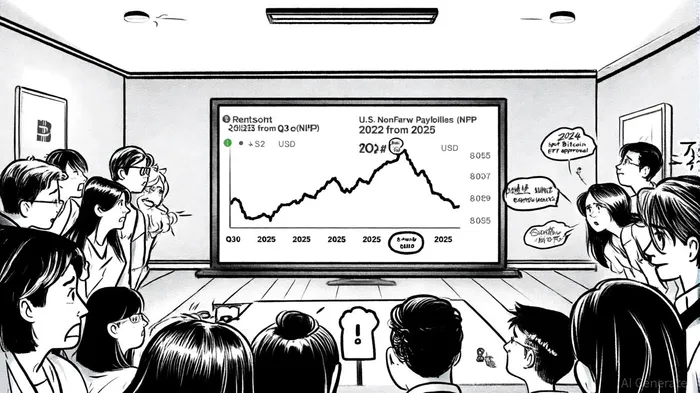






Comentarios
Aún no hay comentarios