
Bitcoin's Resilience and Institutional Reentry Post-Market Meltdown: Citi's Price Prediction as a Strategic Buy Signal
The October 2025 market crash, which saw BitcoinBTC-- plummet to a 12-month low, initially signaled a period of uncertainty. However, the subsequent recovery has underscored Bitcoin's resilience and the growing institutional confidence in its long-term value proposition. At the heart of this narrative is Citi's updated price forecast, which positions Bitcoin as a strategic buy for institutional investors navigating post-crash market dynamics.
Citi's Price Prediction: A Framework for Institutional Confidence
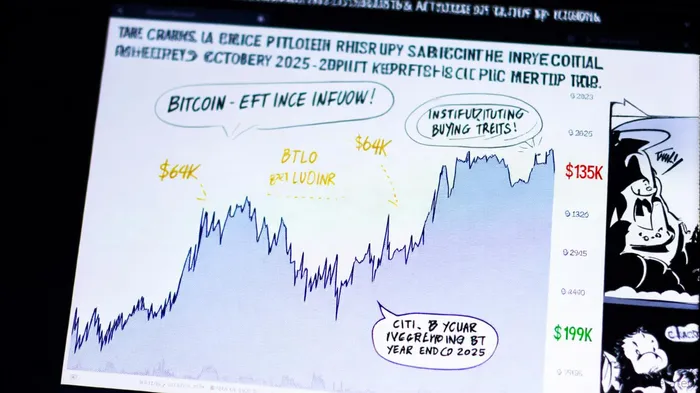
Citi's 2025 Bitcoin price projection, released in July 2025, outlines three scenarios: a base-case target of $135,000, a bullish case of $199,000, and a bearish case of $64,000 by year-end [1]. These projections are rooted in a combination of macroeconomic conditions, ETF-driven demand, and user adoption trends.
The base-case scenario assumes $15 billion in additional inflows into U.S. spot Bitcoin ETFs, which have already accumulated $58 billion in assets since their January 2024 launch [2]. CitiC-- estimates that ETF demand alone accounts for over 40% of Bitcoin's price variation, with inflows potentially adding $63,000 to the price in 2025 [3]. This is further reinforced by a projected 20% growth in active Bitcoin users, which Citi suggests could independently support a baseline price of $75,000 [4].
The bullish case hinges on accelerated ETF adoption and macroeconomic tailwinds, such as a weaker U.S. dollar and Fed rate cuts. Conversely, the bearish scenario accounts for severe macroeconomic downturns, which could reduce the price by $3,200 [5]. Notably, Citi's analysis emphasizes that institutional demand has become a dominant force, with ETFs now managing $163.5 billion in BTC [6].
Institutional Reentry: A Post-Crash Surge in Bitcoin Demand
The October 2025 crash triggered a sharp but temporary selloff, followed by a robust rebound fueled by institutional reentry. Data from Bitcoin Magazine reveals that global exchange-traded products (ETPs) and publicly traded companies acquired 944,330 BTC between January and October 2025-surpassing the total purchases of 2024 [7]. This surge reflects Bitcoin's growing acceptance as a store of value and portfolio diversifier, with over 70% of institutional portfolios now including digital assets by early 2025 [8].
Key drivers of this trend include:
1. ETF Inflows: U.S. spot Bitcoin ETFs, such as BlackRock's iShares Bitcoin Trust (IBIT), recorded $3.24 billion in net inflows during the week of October 3, 2025-the second-highest weekly inflow since their launch [9].
2. Regulatory Clarity: The approval of spot Bitcoin ETFs has streamlined institutional access, reducing friction and compliance risks [10].
3. Corporate Treasury Holdings: Companies like MicroStrategy and Tesla have expanded Bitcoin holdings as a hedge against inflation, with institutional treasuries now accounting for 12% of total BTC supply [11].
Strategic Buy Signal: Why Now?
Citi's price targets gain credibility when contextualized against post-crash market behavior. The $135,000 base-case aligns with historical patterns where Bitcoin has historically outperformed traditional assets during periods of macroeconomic uncertainty [12]. For institutional investors, the current environment offers a unique confluence of factors:
- Undervaluation: Post-crash prices in October 2025 traded below Citi's base-case target, creating a margin of safety.
- Network Effects: A 20% rise in user adoption strengthens Bitcoin's utility as a decentralized asset, enhancing its long-term value proposition [13].
- Liquidity: ETFs have created a liquid on-ramp for institutions, with $1.3 billion in inflows recorded within two days in July 2025 [14].
Critically, Citi's analysis acknowledges risks, such as a potential drop to $64,000 under severe macroeconomic stress. However, the resilience of on-chain metrics-such as stable hash rate and growing institutional wallet activity-suggests Bitcoin's fundamentals remain intact [15].
Conclusion: A New Paradigm for Institutional Investment
Bitcoin's post-crash recovery, coupled with Citi's bullish price projections, signals a paradigm shift in institutional investment strategies. The interplay of ETF-driven demand, regulatory progress, and macroeconomic tailwinds has transformed Bitcoin from a speculative asset into a core component of diversified portfolios. For institutional investors, the current price levels present a strategic entry point, supported by both quantitative analysis and qualitative shifts in market sentiment.
As Citi's forecasts illustrate, the path to $135,000 by year-end is not merely a price target-it is a reflection of Bitcoin's maturation as a financial asset and its growing integration into the global capital markets.





Comentarios
Aún no hay comentarios