
Bitcoin's Resilience Amid Geopolitical Tensions: A Strategic Case for Holding and Buying the Downturn
In the ever-shifting landscape of global finance, BitcoinBTC-- has emerged as both a lightning rod and a barometer for macroeconomic sentiment. Over the past three years, its performance during geopolitical crises has oscillated between mirroring traditional safe-haven assets like gold and diverging sharply from them. As we approach the end of 2025, the question for investors is no longer whether Bitcoin can withstand geopolitical shocks-but whether its recent downturn presents a strategic opportunity to acquire it at a discount.
The Gold Correlation: A Tale of Two Assets
From 2022 to mid-2024, Bitcoin and gold shared an uncanny alignment. During the Ukraine war and Middle East tensions, both assets surged as investors sought refuge from inflation and currency devaluation. Gold rose 67%, while Bitcoin spiked nearly 400%. This correlation was rooted in their shared role as hedges against weak monetary policy and geopolitical instability. However, this harmony began to fracture in 2025. By December 2025, gold had hit an all-time high of $4,370 per ounce (+55% year-to-date), while Bitcoin had fallen over 30% from its October peak.
The divergence highlights a critical insight: while both assets are scarce and non-correlated to equities in theory, their real-world dynamics are shaped by institutional trust and macroeconomic context. Gold's dominance in 2025 was fueled by central banks-China, India, and others-purchasing gold at unprecedented rates, collectively surpassing U.S. Treasury holdings in reserves. Bitcoin, meanwhile, faced headwinds from tighter monetary policy and profit-taking after a speculative rally.
Geopolitical Tensions: A Test of Resilience
Bitcoin's performance during specific crises offers a nuanced view. During the 2023 Hamas-Israel war, Bitcoin surged to a 17-month high amid risk-off sentiment, aligning with gold's rally. However, by 2025, Bitcoin's behavior during escalations-such as U.S. and Israeli airstrikes on Iran-became more volatile, dropping nearly 10% amid uncertainty. This contrast underscores Bitcoin's evolving identity: in 2023, it acted as a hedge; in 2025, it mirrored risk-on/risk-off swings more akin to equities.
Gold, by contrast, maintained its safe-haven status. During the same 2023 tensions, spot gold surged 7% to a three-month high, while the U.S. dollar weakened as investors shifted away from dollar-denominated assets. This inverse relationship between gold and the dollar-driven by de-dollarization trends-further complicates Bitcoin's role in a diversified portfolio.
The Case for Buying the Downturn
Despite Bitcoin's 2025 slump, the case for holding or buying the dip remains compelling. Three factors justify this stance:
- Macroeconomic Rebalancing: Bitcoin's recent underperformance reflects its exposure to interest rate cycles. As the Federal Reserve pauses hikes and hints at rate cuts by mid-2024, Bitcoin's discount to gold may represent a mispricing. Historically, Bitcoin has rebounded sharply after corrections, as seen in its 2023 rally during geopolitical uncertainty.
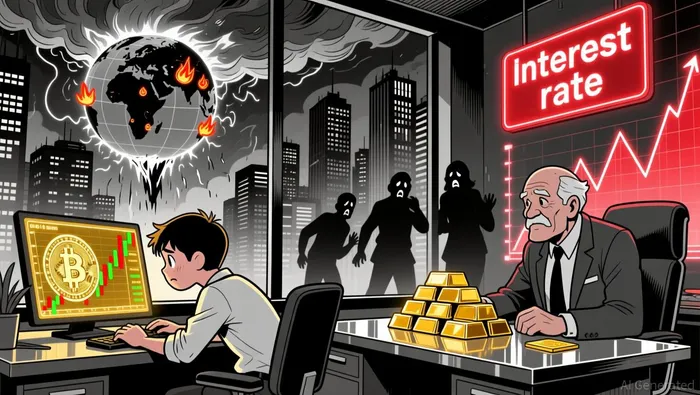
Geopolitical Tailwinds: Bitcoin's utility as a hedge against sanctions and currency devaluation is growing. In a world where central banks are diversifying away from dollar reserves, Bitcoin's decentralized nature offers a unique alternative. While gold's institutional backing gives it an edge, Bitcoin's programmability and global accessibility make it a complementary asset.
Long-Term Scarcity Narrative: Bitcoin's fixed supply of 21 million coins ensures its role as a hedge against inflation remains intact. Unlike gold, which requires physical storage and is subject to geopolitical hoarding, Bitcoin's digital scarcity is verifiable and immutableIMX--. As alternative cryptocurrencies siphon liquidity, Bitcoin's dominance is likely to stabilize over time.
Conclusion: A Strategic, Not Sentimental, Bet
Bitcoin's 2025 downturn is not a failure of its "digital gold" narrative but a reflection of its maturing role in the financial ecosystem. While gold's institutional trust and central bank demand will likely keep it ahead in the short term, Bitcoin's unique properties-scarcity, programmability, and global accessibility-position it as a critical asset for portfolios navigating geopolitical instability.
For investors, the key is to view Bitcoin not as a direct competitor to gold but as a complementary hedge. The current discount offers an opportunity to acquire it at a price that may not fully reflect its long-term utility in a world increasingly defined by uncertainty.






Comentarios
Aún no hay comentarios