
Bitcoin's Resilience Amid Geopolitical Shocks: Safe-Haven Demand and Macroeconomic Stress Testing
Bitcoin's journey as a potential safe-haven asset has been anything but linear. Amid geopolitical turbulence and macroeconomic volatility, its performance has oscillated between speculative frenzy and strategic refuge. This analysis examines Bitcoin's resilience during crises, evaluates its alignment with risk-on/risk-off investor behavior, and explores how macroeconomic stress-testing frameworks-adapted from traditional banking models-might illuminate its evolving role in global finance.
Safe-Haven Demand: Geopolitical Shocks and Divergent Correlations
Bitcoin's behavior during geopolitical crises reveals a duality: it often mirrors traditional safe-haven assets like gold in the short term but diverges over the long term. During the Russia-Ukraine war (2022) and Israel-Gaza conflict (2023), BitcoinBTC-- prices surged in tandem with gold, reflecting a flight-to-safety dynamic[1]. For instance, Bitcoin rose 38% during the Russia-Ukraine conflict, outperforming equities while rivaling gold's 25% gain[3]. However, this correlation weakened over months, as Bitcoin's volatility and speculative underpinnings reasserted themselves.
A 2025 study using XGBoost classifiers found Bitcoin acts as a conditional safe haven only when it appreciates while traditional assets like gold and the S&P 500 decline[1]. This "divergence-driven" safe-haven behavior was evident during the 2023 banking crisis, when Bitcoin gained 32.9% in a week as Silicon Valley Bank collapsed[2]. Yet, during the 2020 pandemic, Bitcoin's mixed relationship with gold and the U.S. dollar underscored its inconsistency: while gold surged 25%, Bitcoin's gains were shorter-lived and less correlated with pandemic-driven uncertainty[4].
Macroeconomic Stress and Risk-On/Risk-Off Dynamics
Bitcoin's alignment with macroeconomic stress scenarios is equally nuanced. During the 2025 equity correction-triggered by Trump's tariff announcements and geopolitical tensions-the S&P 500 fell 21%, while Bitcoin dropped from $109,200 to $74,600[1]. This co-movement with risk assets highlights Bitcoin's vulnerability to shifting investor sentiment, despite its "digital gold" narrative.
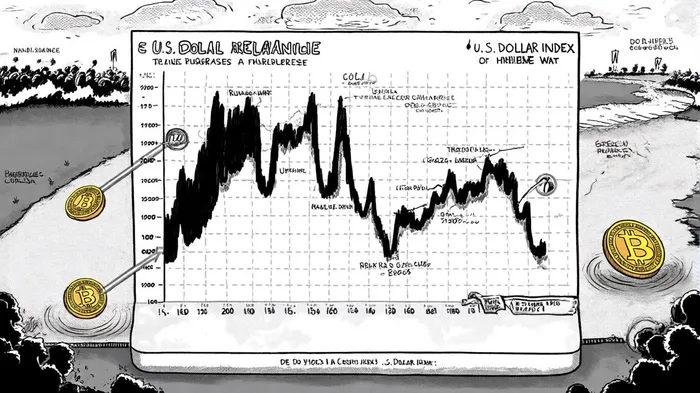
Macroeconomic indicators further complicate its safe-haven status. The U.S. dollar index (DXY) and Treasury yields have shown significant negative and positive impacts on Bitcoin returns, respectively[1]. For example, during the 2023 banking crisis, Bitcoin's rise coincided with a decline in the DXY, suggesting a substitution effect between fiat and crypto assets[2]. Conversely, Bitcoin's fixed supply and decentralized nature make it a hedge against inflation and capital controls, as seen in El Salvador and Venezuela[3].
Stress-Testing Frameworks: Bridging Traditional and Digital Paradigms
While Bitcoin lacks formal stress-testing frameworks akin to the ECB's or Fed's, innovative methodologies are emerging. A 2025 study applied explainable AI (XGBoost) to classify Bitcoin's safe-haven role during U.S. macroeconomic stress episodes, achieving 99.7% accuracy in identifying conditional safe-haven behavior[1]. Similarly, stablecoin stress-testing frameworks-simulating depegging events and liquidity crunches-offer insights into Bitcoin's resilience during systemic shocks[5].
Traditional banking stress tests, such as the Fed's 2025 scenarios (projecting a 6.3% European economic contraction), provide a backdrop for evaluating Bitcoin's systemic risks. Unlike banks, which are tested for capital adequacy, Bitcoin's resilience hinges on network throughput and transaction fees. A 2016 spam attack stress test revealed Bitcoin's vulnerability to mempool congestion, with 23.41% of transactions flagged as spam during peak spam campaigns[6]. These findings underscore the need for tailored stress-testing models for crypto ecosystems.
The Road Ahead: Institutional Adoption and Macroeconomic Realities
Bitcoin's future as a safe-haven asset will depend on institutional adoption and macroeconomic trends. The 2024 halving event-reducing supply by 900,000 BTC-has already influenced price trajectories, with Bitcoin surging to $94,419.76 by early 2025[4]. Meanwhile, entities like BlackRock and the Norwegian Government Pension Fund are indirectly investing in Bitcoin, signaling growing recognition of its strategic value despite volatility[3].
However, Bitcoin's role in reshaping global power dynamics remains contentious. While it challenges U.S. dollar hegemony (e.g., Iran using crypto to bypass sanctions[3]), it also faces regulatory headwinds and sustainability concerns. The energy-intensive mining process and geopolitical competition for resources could undermine its appeal as a long-term safe haven[4].
Conclusion
Bitcoin's resilience amid geopolitical shocks reflects its dual identity: a speculative asset and a potential hedge against fiat devaluation. While it mirrors gold in short-term crises, its long-term safe-haven status remains conditional, dependent on macroeconomic stress, institutional adoption, and regulatory frameworks. As stress-testing methodologies evolve-from AI-driven classifiers to stablecoin simulations-the crypto market's systemic risks and opportunities will become clearer. For investors, the key lies in balancing Bitcoin's volatility with its unique utility in a fragmented, digitized financial landscape.






Comentarios
Aún no hay comentarios