
Bitcoin's Resilience Amid Declining Whale Influence: A Signal of Market Maturity?
Bitcoin's price action in late 2025 has defied expectations, holding key support levels despite persistent selling pressure from large holders. This resilience raises a critical question: Is the market maturing, with reduced whale influence signaling a shift toward broader-based demand and institutional-driven dynamics? For long-term investors, the interplay between on-chain exhaustion metrics and whale behavior offers a compelling case for a potential low-risk entry point.
The Diminishing Role of Whale Selling Pressure
Bitcoin's whale activity-traditionally a bellwether for market sentiment-has shown signs of exhaustion. Whale addresses holding 1,000–10,000 BTC have reached their lowest levels since late November 2025, while long-term "OG whales" have liquidated multi-hundred-million-dollar positions. However, the BitcoinBTC-- Seller Exhaustion Constant, a Glassnode metric, now reads near 0.019, a historically low-risk level for local price bottoms. This metric, which combines loss-taking behavior and volatility, last reached this threshold in April 2025, preceding a 33% rally over six weeks.
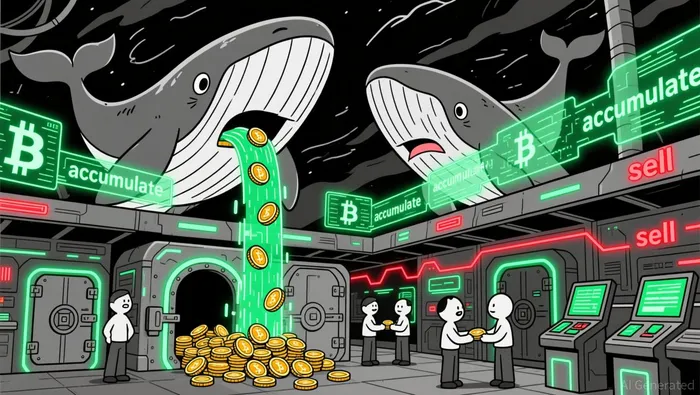
Notably, whales are no longer panic-selling but instead waiting for favorable prices to accumulate. Cost-basis clusters between $83,000 and $88,000 suggest a strategic shift toward accumulation rather than distribution. This behavior contrasts with earlier 2025, when large stakeholders aggressively offloaded holdings, exacerbating downward pressure. The transition from active selling to patient accumulation indicates a maturing market, where whales prioritize long-term value over short-term gains.
On-Chain Exhaustion and Structural Demand Deficits
On-chain data reveals a "demand void" at current price levels, signaling structural deficits in buyer interest. This void has contributed to Bitcoin's sideways consolidation, as sellers struggle to find matching demand. However, the 30-day trend of whale funds flowing into exchanges has stabilized at levels consistent with historical market stabilization periods. This suggests that the most aggressive selling may be subsiding, even as smaller retail investors continue to take profits.
Whale accumulation patterns further reinforce this narrative. Between December 17 and 29, 2025, large stakeholders added 56,227 BTC to their balances, a move Santiment identified as a local bottom signal. Meanwhile, wallets holding Bitcoin for over five years have shown minimal turnover, indicating long-term holders remain committed. These dynamics mirror historical accumulation phases observed in late 2020 and 2022–2023, which preceded significant price surges.
Institutional Reentry and Macroeconomic Tailwinds
The market's potential inflection point is also supported by renewed institutional interest. Coinperps data shows over $1 billion in inflows to Bitcoin ETFs in early 2026, signaling a return of institutional capital. This aligns with broader macroeconomic trends, including a steepening yield curve and a weaker U.S. dollar, both of which favor assets like Bitcoin.
Historically, whale accumulation often coincides with institutional buying. For example, in early 2025, coordinated whale activity preceded Bitcoin's rebound from $81,000, a pattern similar to the 2020 bull run. The current environment, with whales and institutions aligning their strategies, suggests a structural shift toward a more mature, institutional-driven market.
A Low-Risk Entry Point for Long-Term Investors
For investors, the convergence of whale exhaustion, on-chain stabilization, and institutional reentry creates a compelling case for a low-risk entry. Key support levels, such as $89,250, remain intact, and a break below this threshold could trigger deeper corrections. However, if accumulation resumes in this range-as seen in December 2025-Bitcoin may form a structural bottom.
Retail investors, meanwhile, are still exiting positions, a trend historically associated with bullish setups. This retail capitulation, combined with whale and institutional accumulation, mirrors patterns from previous cycles, where price appreciation followed periods of retail pessimism.
Conclusion
Bitcoin's resilience amid declining whale influence reflects a maturing market, where structural demand and institutional participation are beginning to outweigh speculative selling. While on-chain exhaustion metrics and historical correlations suggest a potential bottom, investors should remain cautious, monitoring key support levels and macroeconomic signals. For those with a long-term horizon, the current environment offers a rare opportunity to enter a market poised for a trend reversal.






Comentarios
Aún no hay comentarios