
Bitcoin's Resilience Amid Central Bank Policy Uncertainty: Strategic Crypto Allocations as a Hedging Tool
In an era of unprecedented central bank interventions, BitcoinBTC-- has emerged as a compelling hedge against monetary policy volatility. As global policymakers grapple with inflation, debt, and currency devaluation, the cryptocurrency's unique properties—decentralization, scarcity, and programmability—are reshaping how investors approach portfolio resilience. This analysis explores Bitcoin's historical performance amid policy shifts, real-world adoption in hyperinflationary economies, and evidence-based allocation frameworks to mitigate central bank-driven risks.
The Historical Nexus: Bitcoin and Central Bank Policies
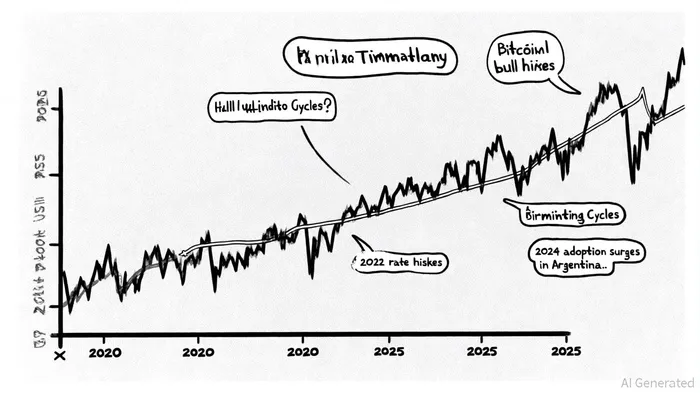
Bitcoin's price dynamics are inextricably linked to central bank actions. During periods of monetary easing—such as the 2020 pandemic-era quantitative easing (QE)—Bitcoin surged as liquidity flooded risk assets. From November 2021 to early 2022, Bitcoin's price skyrocketed from $10,000 to nearly $70,000, coinciding with expansive monetary policies[3]. Conversely, tightening cycles, like the 2022 rate hikes by the Federal Reserve and European Central Bank, triggered sharp declines, underscoring the inverse relationship between interest rates and Bitcoin's demand[4].
This duality reflects Bitcoin's evolving role: it behaves like a speculative asset during liquidity booms but increasingly functions as a store of value during inflationary crises. For instance, Argentina's 2024 adoption surge—driven by hyperinflation exceeding 200% and President Javier Milei's pro-crypto policies—showed Bitcoin representing 36% of digital assetDAAQ-- holdings, with transaction volumes rising tenfold[5]. Similarly, Turkey's lira depreciation has spurred crypto adoption, mirroring a global trend where fiat-losing trust drives demand for decentralized alternatives[6].
Strategic Allocation Frameworks: Hedging Policy Risks
For investors seeking to hedge against central bank volatility, strategic crypto allocations are critical. Harvard economist Matthew Ferranti's research suggests that central banks facing sanctions risks could allocate 10–25% of reserves to Bitcoin, leveraging its potential to complement gold in diversifying against geopolitical shocks[1]. Meanwhile, BlackRockBLK-- recommends a more conservative 2% allocation for individual portfolios, balancing Bitcoin's volatility with traditional assets in a 60/40 framework[2].
Institutional adoption is accelerating this shift. The 2025 approval of Bitcoin ETFs has enabled funds to introduce 1–3% crypto exposure, targeting inflation hedging and non-correlated returns[4]. However, challenges persist: Bitcoin's volatility and regulatory uncertainty necessitate disciplined risk management. A Bayesian modeling approach, as outlined in the Journal of International Money and Finance, emphasizes dynamic portfolio adjustments based on sanctions risk and liquidity stress tests[1].
Challenges and Considerations
While Bitcoin's case as a hedge is compelling, non-Bitcoin cryptocurrencies remain unfit for mainstream hedging. EthereumETH-- and altcoins face liquidity, volatility, and regulatory hurdles that exclude them from central bank reserve portfolios[5]. Moreover, stablecoins like TetherUSDT-- may even correlate positively with economic policy uncertainty in the long term, diminishing their hedging utility[3].
For individual investors, the key lies in balancing exposure. The World Bank cautions that crypto-assets lack the liquidity and stability required for central bank reserves today[4], but this does not negate their potential as a strategic allocation tool for retail portfolios. As the IMF notes, robust policy frameworks are emerging to address crypto risks, though market infrastructure must mature before widespread adoption[5].
Conclusion: A New Paradigm for Portfolio Resilience
Bitcoin's resilience amid central bank policy uncertainty is not a coincidence—it is a reflection of its design as a hedge against currency devaluation and systemic risk. As Argentina and Turkey demonstrate, Bitcoin thrives in environments where fiat currencies fail. For investors, the path forward involves strategic allocations tailored to risk tolerance, leveraging Bitcoin's dual role as both a speculative asset and a store of value.
In 2025, the crypto-native investor must ask: Is Bitcoin a speculative bet, or a necessary hedge in a world of monetary experimentation? The answer lies in the data—and the data is clear.






Comentarios
Aún no hay comentarios