
Bitcoin's Repeated $94K Rejection: A Strategic Buying Opportunity Amid Post-FOMC Volatility
Bitcoin's price action in late 2025 has been defined by a relentless tug-of-war at the $93,000–$94,000 resistance level, a psychological and technical battleground that has repeatedly repelled upward momentum. This repeated rejection, coupled with a tightening institutional supply environment and post-FOMC volatility, has created a unique confluence of conditions that may signal a contrarian entry point for long-term investors.
Liquidity Dynamics and Institutional Supply Tightening
Bitcoin's liquidity dynamics near $94K are shaped by a critical accumulation of long positions, with over 420,000 BTC held at this level, forming one of the strongest support zones in the current cycle. This concentration of liquidity implies that a breakdown below $94K could trigger a sharp sell-off, while a breakout could reinvigorate the bullish trend toward $100K according to technical analysis. However, recent on-chain data reveals a decline in Bitcoin selling pressure, with exchange deposits and whale selling dropping, easing short-term downward pressure.
Institutional supply tightening has further complicated liquidity dynamics. ETF outflows, particularly from BlackRock's iShares Bitcoin TrustIBIT-- (IBIT), reached a record $523.2 million in a single day during November 2025, signaling waning retail confidence. Yet, this bearish narrative is counterbalanced by institutional accumulation. For instance, a $405 million transfer to Anchorage Digital within 9 hours in late November, with transfers originating from major players like Coinbase and Galaxy Digital, historically precedes major rebounds, as seen in past cycles when institutional buying during crashes led to significant price recoveries.
Contrarian Entry Points and Technical Indicators
The $94K resistance level has become a focal point for contrarian traders. 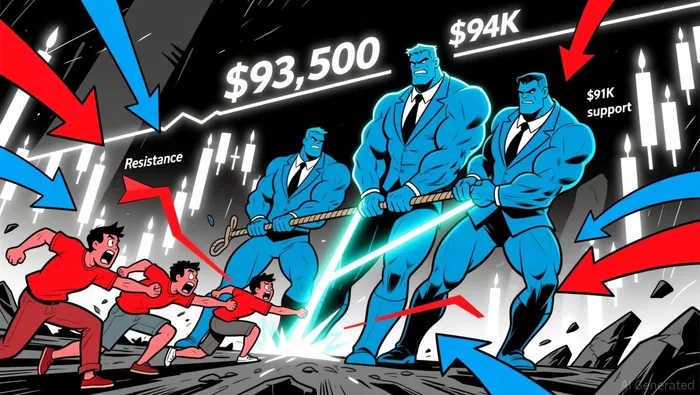 A limit order at $81,250 is increasingly viewed as a strategic entry point to capture the final wick down before a potential bounce back to equilibrium at $94K according to technical analysis. This setup is underpinned by a bear trap pattern, where panic selling by retail traders provides liquidity for larger buyers. Additionally, the $90K–$91K zone has emerged as a critical support cluster, with historical significance as a recurring support point during major cycle lows.
Technical indicators reinforce this thesis. The MACD shows bullish momentum, with a reading above the signal line, while Bitcoin's proximity to the Bollinger Band lower band at $88,690.89 suggests short-term bearish pressure but also hints at a potential rebound. The 30-day MVRV ratio at -7.56% indicates that recent buyers are holding unrealized losses, signaling accumulation below perceived fair value. Meanwhile, the Fear & Greed Index hitting extreme fear levels (below 20) has historically marked bottoms, offering a contrarian signal for potential reversals.
Post-FOMC Volatility and Institutional Positioning
The Federal Reserve's December 2025 rate cut injected liquidity into the financial system, historically supporting risk assets like BitcoinBTC--. This policy shift coincided with a surge in Bitcoin ETF inflows, totaling $237.5 million in December, as institutional demand returned to the market. However, the post-FOMC environment remains volatile, with Bitcoin's price dropping to a seven-month low of $85,788 in December 2025 amid thin order books and leveraged position unwinding.
Institutional positioning further underscores the potential for a rebound. Addresses holding 1K+ BTC accumulated 44,111 BTC in December 2025, while retail cohorts distributed 15,330 BTC, signaling a classic wealth transfer pattern. This institutional accumulation, combined with reduced leverage, and spot-driven buying, suggests genuine demand is building.
Strategic Implications for Investors
For disciplined investors, the $94K–$84K range represents a high-probability area for a cyclical bottom. If Bitcoin holds above $89,500, the bullish bias remains intact, with potential for a rally toward $91,500 and $93,000 according to market analysis. A breakdown below $88K, however, could trigger deeper corrections toward $83K–$85K according to technical forecasts.
The key to navigating this volatility lies in recognizing the interplay between institutional supply tightening and retail panic. While ETF outflows and macroeconomic uncertainty create near-term headwinds, the resilience of institutional demand and contrarian technical signals suggest that the current dip may represent a strategic entry opportunity.







Comentarios
Aún no hay comentarios