
Bitcoin's Regulatory Resilience and Market Dynamics in 2025: Government Asset Management and Supply Impacts
Bitcoin's journey in 2025 has been defined by a confluence of regulatory clarity, institutional adoption, and strategic government policies that have reshaped its market dynamics. As the U.S. government and private sector increasingly treat BitcoinBTC-- as a legitimate asset class, the interplay between regulatory frameworks, supply-side interventions, and institutional demand has created a resilient ecosystem. This analysis explores how these forces are redefining Bitcoin's role in global finance, with a focus on government asset management and its implications for market supply.
Regulatory Developments: A New Era of Clarity
The Trump administration's 2025 Executive Order, Strengthening American Leadership in Digital Financial Technology, marked a pivotal shift in U.S. policy. By explicitly endorsing public blockchain networks and prohibiting a U.S. CBDC, the order signaled a pro-innovation stance. The establishment of the President's Working Group on Digital Assets further underscored this commitment, aiming to streamline regulations and reduce ambiguity for market participants.
The Securities and Exchange Commission (SEC) also recalibrated its approach under Chair Paul Atkins, who emphasized a nuanced application of the Howey test to distinguish between securities and non-securities tokens. This departure from the prior administration's broad classification of digital assets as securities has reduced regulatory friction for startups and institutional investors. Complementing this, the SEC's Project Crypto initiative seeks to balance innovation with investor protection, fostering a framework that mitigates systemic risks while encouraging growth.
Legislatively, the GENIUS Act (July 2025) provided critical clarity for banks and custodians, enabling them to handle digital assets without fear of regulatory overreach. This act transformed digital asset management from a compliance risk into a competitive imperative, accelerating institutional onboarding.
Government Asset Management: Strategic Reserves and Market Signals
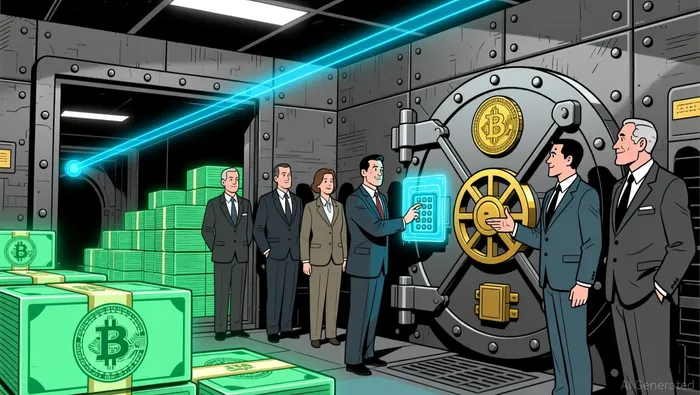
A cornerstone of 2025's policy landscape was the creation of the Strategic Bitcoin Reserve (SBR), established via Executive Order in March 2025. The SBR, holding over 200,000 seized BTC, positions Bitcoin as a national asset rather than a liability. By committing to long-term stewardship, the U.S. government has effectively removed a significant overhang of supply from the market, sending a bullish signal to investors.
The SBR is part of a broader United States Digital Asset Stockpile, which includes other cryptocurrencies and is managed by the Treasury Secretary. These reserves are not merely symbolic; they act as a "sovereign air cover," legitimizing Bitcoin's role as a strategic reserve asset and hedge against traditional financial volatility. This policy shift has emboldened corporate treasuries to follow suit, with firms like Strategy managing $62 billion in digital assets as of 2025.
Market Supply Dynamics: Institutional Demand and Supply Constraints
The institutionalization of Bitcoin in 2025 has been driven by a combination of regulatory tailwinds and economic incentives. The repeal of SAB 121-a prior accounting rule that restricted banks from holding digital assets- allowed financial institutions to treat Bitcoin under a risk-based framework. This change catalyzed major players like Visa and PayPal to integrate stablecoin-based settlement systems, further embedding Bitcoin into the financial infrastructure.
Corporate adoption has also surged, with businesses now holding 6.2% of the total Bitcoin supply (1.30M BTC). Specialized "treasury companies" have spearheaded this trend, accounting for 76% of business BTC purchases since 2024. These firms, often modeled after MicroStrategy's strategy, have raised capital through equity and convertible debt to acquire Bitcoin as a long-term store of value.
However, this institutional demand has not come without risks. Critics highlight concerns about concentration of holdings and exposure to volatility. Additionally, the SBR's 200,000 BTC reserve, while bullish in intent, could face political or economic pressures that might alter its long-term trajectory.
Balancing Innovation and Guardrails
Despite the momentum, lawmakers and advocacy groups have called for stronger guardrails to prevent fraud, money laundering, and systemic risks. They argue that applying traditional securities standards to crypto markets is essential to protect investors and maintain financial integrity. While the SEC's Project Crypto and the GENIUS Act address some of these concerns, the pace of innovation often outstrips regulatory implementation, creating a need for agile, adaptive frameworks.
Conclusion: A Foundation for 2026 and Beyond
The regulatory and institutional developments of 2025 have positioned Bitcoin as a cornerstone of modern finance. Government asset management policies, coupled with institutional adoption and regulatory clarity, have created a resilient ecosystem that mitigates supply-side pressures while fostering innovation. As the U.S. solidifies its leadership in digital asset policy, the stage is set for further institutionalization in 2026. However, the balance between innovation and oversight will remain critical to ensuring Bitcoin's long-term viability.






Comentarios
Aún no hay comentarios