
Can Bitcoin Rebound After Falling Below Key Fib Support?
Bitcoin's price action in late 2025 has been a tug-of-war between technical resilience and liquidity-driven pressures, with Fibonacci support levels serving as both battlegrounds and barometers for market sentiment. As the cryptocurrency tests critical retracement zones, investors are left to weigh whether on-chain strength and macroeconomic catalysts can catalyze a recovery-or if the breakdown of key Fibonacci levels will signal a deeper capitulation phase.
Technical Resilience: On-Chain Metrics and Wave Structure
Bitcoin's current position near the 38.2% Fibonacci retracement level at $98,100-a historically significant mid-cycle reaction point-has drawn attention from technical analysts. On-chain data suggests a nuanced picture: while the Cumulative Value Days Destroyed (CVDD) metric warns of a potential capitulation zone near $45,880, the MVRV ratio and active address metrics indicate a moderate accumulation phase. Small-bodied candles with long lower wicks and moderate trading volumes further imply consolidation rather than full liquidation according to technical analysis.
Wave structure analysis places BitcoinBTC-- in Wave 4, with projections suggesting a continuation into Wave 5 if the $80K–$69K zone holds. If confirmed, this could target $147K to $213K, though macroeconomic factors remain a wildcard. Crucially, the 0.382 Fibonacci level at $88,000 has become a psychological battleground. A breakdown here could send Bitcoin back to April lows near $76,000, while a successful defense might trigger a rebound toward $96K–$100K.
Liquidity-Driven Recovery: ETF Flows and Order Book Dynamics
Liquidity metrics paint a mixed picture. U.S. spot Bitcoin ETFs recorded a record $3.79 billion in outflows in November 2025, led by BlackRock's IBIT. These outflows reflect broader caution amid macroeconomic uncertainty, yet some altcoin ETFs (e.g., SolanaSOL-- and XRP) attracted inflows, signaling a shift in risk appetite.
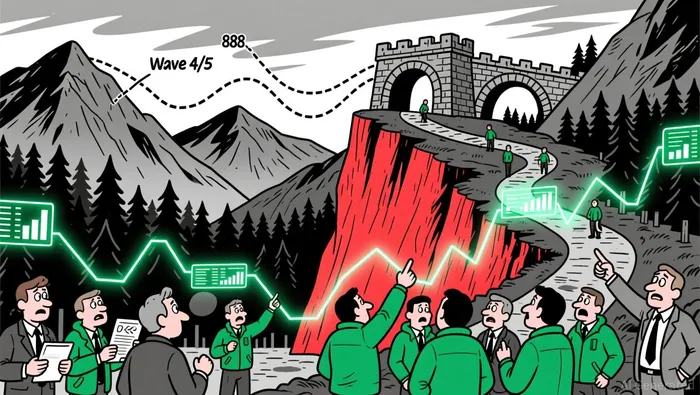
The ETF cost basis around $83,000 has historically acted as a reflexive anchor during corrections. Bitcoin's recent rebound from $84,600 to nearly $90,000 suggests this level may hold, particularly if institutional inflows resume. However, derivatives markets show thin open interest and reduced order book depth, exacerbating volatility during leveraged liquidations. Funding rates for perpetual futures also spiked during the November selloff, indicating heightened leverage flushes.
Historical Precedents: Rebounds After Fibonacci Breakdowns
Historical patterns offer both caution and hope. In 2024, Bitcoin's price stabilized after ETF inflows turned positive, despite breaking the 0.618 Fibonacci level at $93,600. Similarly, the 2020–2024 cycles saw rebounds when institutional adoption and macroeconomic catalysts (e.g., Fed rate cuts) aligned with on-chain accumulation according to market analysis.
However, the 127.2% Fibonacci extension often acts as a profit-taking level in bearish setups, with repeated failed attempts to break key resistance signaling weakening buyer conviction according to technical indicators. For example, Bitcoin's 2025 drop below $94,000 triggered bearish technical signals like a flipped SuperTrend indicator and a narrowing trading channel.
The Path Forward: Macro Factors and Institutional Inflows
The Federal Reserve's policy stance will be pivotal. A 0.25% rate cut in December 2025 could improve risk appetite and support a floor near $83,000. Conversely, a hawkish tone would likely delay recovery. Institutional adoption-such as Vanguard and Bank of America enabling crypto ETF trading-has already begun to counterbalance ETF outflows according to market reports.
On-chain "liveliness" metrics, which track dormant coin movements, suggest underlying demand may be returning. Yet, the market remains fragile: tight liquidity and fading retail euphoria mean recovery hinges on renewed institutional inflows rather than speculative retail demand according to analysts.
Conclusion
Bitcoin's ability to rebound after falling below key Fibonacci support depends on a delicate interplay of technical resilience and liquidity dynamics. While on-chain accumulation and historical precedents hint at a potential floor near $83,000, the path to recovery will require renewed institutional confidence and favorable macroeconomic conditions. For now, the 0.382 Fibonacci level at $88,000 remains a critical inflection point-its defense could signal a reversal, while a breakdown may force a deeper capitulation phase. Investors must remain vigilant, balancing short-term volatility with long-term structural trends.






Comentarios
Aún no hay comentarios