
Is Bitcoin Reaching a Bottom? Interpreting the Turning Tide in Long-Term Holder Behavior
Bitcoin's 2025 market structure has revealed a critical divergence in holder behavior, with long-term holders (LTHs) maintaining stable balances while medium-term holders (MTHs) aggressively offload assets. This structural shift, combined with evolving institutional dynamics and investor sentiment, raises compelling questions about whether the market is nearing a cyclical bottom.
Structural Shifts: Long-Term Holders vs. Medium-Term Sellers
Long-term holders-those holding BitcoinBTC-- for over five years-have shown remarkable resilience, with balances increasing by 50 basis points for tokens held over a decade. In contrast, MTHs (1–5 years) have seen sharp declines, with monthly reductions of -900 bps for 1–2-year holders and -1250 bps for 2–3-year holders according to data. This divergence suggests a maturation of Bitcoin's market structure, where short-term speculative capital is being flushed out, while long-term conviction remains intact.
Digital Asset Treasuries (DATs) have emerged as a stabilizing force, accumulating 42,000 BTC in mid-December-the largest single-month accumulation since July 2025. This corporate buying contrasts with Bitcoin ETP investors, who reduced holdings by 120 bps m/m, bringing total holdings to 1.308 million BTCBTC--. DATs' shift to preferred share sales for funding further underscores their long-term orientation, signaling a structural realignment in institutional participation.
Hash Rate Dips and Contrarian Signals
The network hash rate dropped 4% in December 2025, the sharpest decline since April 2024. While this raises concerns about miner profitability-breakeven electricity costs for S19 XP miners fell to $0.077 from $0.12 in December 2024-historical data shows that such declines often precede positive returns over 90- to 180-day periods, with 77% of cases showing gains. This aligns with a classic contrarian narrative: bearish on-chain signals may foreshadow bullish price action.
Investor Sentiment: Fear, Institutional Optimism, and Thinning Liquidity
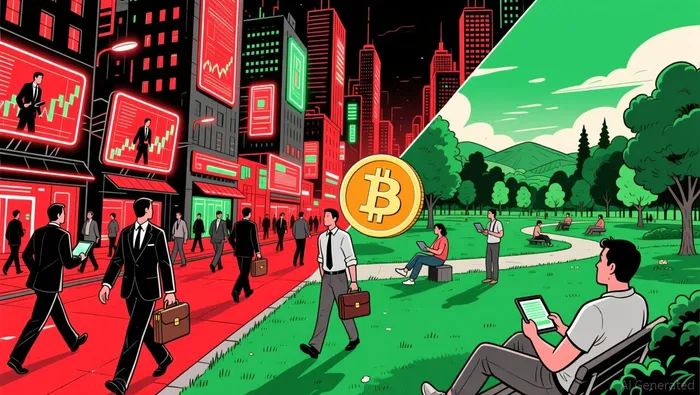
Bitcoin's investor sentiment in late 2025 is a tapestry of fear and institutional optimism. The Crypto Fear & Greed Index has lingered in "extreme fear" territory for much of the year, despite regulatory clarity and spot ETF approvals. This disconnect reflects a market grappling with structural fragility.
Spot investors, however, have shown resilience, purchasing $4.11 billion in December, while perpetual traders remain bullish, with taker buy/sell ratios above 1 and positive funding rates according to data. Yet short traders face disproportionate losses, with exposure ratios of 16.4:1, hinting at a potential short squeeze if prices break above key resistance.
Liquidity conditions, meanwhile, remain precarious. Order-book depth has thinned, with peak liquidity on BTC/FDUSD at $3.86 million within 10 basis points of mid-price at 11:00 UTC, dropping to $2.71 million at 21:00 UTC. This temporal volatility amplifies execution risks, while inter-exchange flows have collapsed, reducing arbitrage activity and exacerbating fragility.
The Overhead Supply Wall and Market Psychology
A dense supply cluster in the $93k–$120k range continues to cap Bitcoin's recovery according to data, mechanically suppressing momentum. However, patient buyer demand has prevented a breakdown below the True Market Mean of $81.3k according to analysis, suggesting a market under time-driven stress rather than outright collapse. The growing share of underwater supply-6.7 million BTC as of mid-December according to Glassnode-intensifies psychological pressure, creating a self-fulfilling prophecy of selling.
Conclusion: A Bottoming Process in Motion?
The confluence of divergent holder behavior, institutional accumulation, and contrarian on-chain signals points to a potential bottoming process. While liquidity constraints and overhead supply walls persist, the structural shift toward long-term holder dominance and DAT-driven buying suggests a maturing market. Investors must weigh the risks of thin liquidity and short-term volatility against the growing conviction of institutional actors. If history holds, the current hash rate decline and MTH selling could mark the final capitulation phase before a new bull cycle.






Comentarios
Aún no hay comentarios