
Bitcoin’s Ranging Consolidation Amid Rising Fed Rate-Cut Expectations: A Strategic Entry Point for Long-Term Investors
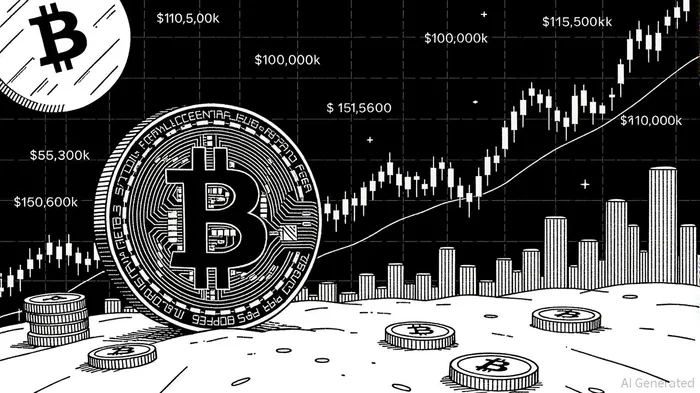
Bitcoin’s current price action reflects a period of consolidation, with the asset trading within a defined range between $110,000 and $116,000. This pattern, observed across multiple timeframes, aligns with historical trends where BitcoinBTC-- enters consolidation phases following periods of euphoria—such as the all-time high of $124,500 in early 2025 [6]. The market’s recent 14% pullback to $107,400 has created a critical juncture, with bears aggressively defending the $112,000 support level [6]. However, this consolidation is not a sign of weakness but rather a strategic pause driven by macroeconomic tailwinds and institutional accumulation.
Institutional Buying: A Catalyst for Stability and Long-Term Confidence
Institutional adoption has emerged as a stabilizing force in Bitcoin’s price dynamics. By Q2 2025, 59% of institutional investors had allocated at least 10% of their portfolios to digital assets, with Bitcoin Spot ETFs amassing over $65 billion in assets under management (AUM) globally [4]. BlackRock’s iShares Bitcoin Trust (IBIT) alone attracted $18 billion in AUM by the end of Q1 2025, signaling a shift toward regulated, accessible investment vehicles [4]. This institutional inflow has reduced Bitcoin’s realized volatility compared to earlier cycles, as sustained demand and deeper liquidity mitigate short-term swings [4].
On-chain data further reinforces this narrative. Exchange reserves—the number of Bitcoin held on exchanges for trading—have hit multi-year lows, indicating that fewer coins are available for immediate selling [2]. Meanwhile, the number of Bitcoin whale addresses (wallets holding over 1,000 BTC) has surged to a record 19,130, reflecting long-term confidence in Bitcoin’s price trajectory [3]. Notably, dormant wallets, such as a 13-year-old address holding 479.69 BTC, have recently moved significant portions of their holdings, suggesting strategic accumulation by early adopters or estate-related transfers [2].
Macro Tailwinds: Fed Rate Cuts and Liquidity Expansion
The Federal Reserve’s anticipated rate cuts in late 2025 are poised to amplify Bitcoin’s appeal as a risk-on asset. As of September 2025, the probability of a 50-basis-point rate cut at the September meeting has surged to nearly 100%, driven by weaker-than-expected job growth data [5]. Historical precedents, such as the 2024 rate cut cycle, demonstrate Bitcoin’s responsiveness to monetary easing. For instance, Bitcoin’s price rose from $60,000 to $64,000 within two days of the September 2024 rate cut announcement [1]. A hypothetical 1% reduction in the federal funds rate could correlate with a 13.25% to 21.20% rise in Bitcoin’s price, with potential for a 30% surge under favorable conditions [6].
Bitcoin’s correlation with traditional macroeconomic indicators—such as the Consumer Price Index (CPI) and gold—also strengthens its case as a hedge during rate-cut cycles. When CPI readings fall below expectations, Bitcoin often rebounds, as seen in 2024 [4]. Similarly, Bitcoin and gold exhibit a 70-day offset correlation, both currently consolidating ahead of potential breakouts [1]. If the Fed follows through on its rate-cut projections, Bitcoin could mirror gold’s trajectory, with a potential breakout above $116,000 by mid-November [1].
Strategic Entry Point: Balancing Risk and Reward
For long-term investors, Bitcoin’s current consolidation phase presents a strategic entry opportunity. The $110,000 support level acts as a critical psychological barrier; a successful defense could trigger a test of the $116,000 resistance, where institutional buying pressure is likely to intensify [2]. Historical patterns suggest that Bitcoin’s consolidation corridors (e.g., $104,100–$114,300) often precede sustained bull runs, particularly when macroeconomic conditions align with institutional adoption [5].
Moreover, the divergence between stablecoin supply growth and Bitcoin’s price stagnation is a temporary anomaly. As stablecoin liquidity—representing potential demand in the crypto market—continues to expand, capital is likely to flow into risk assets like Bitcoin [1]. This dynamic, combined with the Fed’s dovish pivot, creates a favorable environment for accumulation.
Conclusion
Bitcoin’s ranging consolidation is not a sign of capitulation but a prelude to a potential breakout fueled by institutional buying and macroeconomic tailwinds. With the Fed poised to cut rates and Bitcoin’s on-chain metrics pointing to long-term accumulation, the current price range offers a compelling entry point for investors with a multi-year horizon. As history has shown, Bitcoin thrives in environments of liquidity expansion and regulatory clarity—conditions that are increasingly materializing in 2025.
Source:
[1] These 3 Signals Statistically Predict Bitcoin's Next Big Move [https://bitcoinmagazine.com/markets/3-signals-predict-bitcoin-big-move]
[2] Bitcoin Price Analysis: Is This BTC's Calm Before Another Major Storm [https://cryptopotato.com/bitcoin-price-analysis-is-this-btcs-calm-before-another-major-storm/]
[3] Crypto Whale Movements in September 2025 [https://digivestasi.com/news/detail/aset_kripto/crypto-whale-movements-in-september-2025-major-accumulation-trends-and-strategic-rotations-you-should-watch?lang=eng]
[4] Institutional Bitcoin Investment: 2025 Sentiment, Trends, ..., [https://pinnacledigest.com/blog/institutional-bitcoin-investment-2025-sentiment-trends-market-impact]
[5] Standard Chartered Raises Fed Rate Cut Forecast, Crypto Market Reacts [https://coincentral.com/standard-chartered-raises-fed-rate-cut-forecast-crypto-market-reacts/]
[6] White Paper: Bitcoin's Positive Correlation with Federal Reserve Rate Declines, [https://cognac.com/white-paper-bitcoins-positive-correlation-with-federal-reserve-rate-declines-and-projected-30-price-surge-per-1-rate-cut/]





Comentarios
Aún no hay comentarios