
Bitcoin's Range-Bound Struggle and Downside Risks as U.S. Investors Sell Off: A Technical and Behavioral Analysis
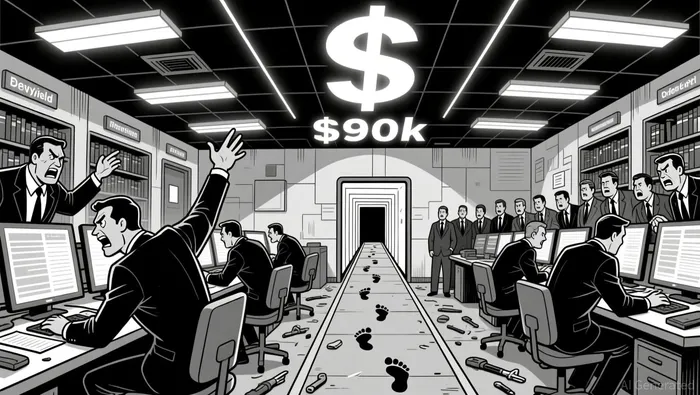
Bitcoin's price action in late 2025 has been defined by a persistent tug-of-war at the $90,000 resistance level, a critical juncture that has become a focal point for both technical and behavioral market analysis. Despite multiple attempts to breach this threshold, the asset remains trapped in a high-stakes range, with on-chain metrics and corporate liabilities amplifying near-term bearish risks. This analysis explores how repeated failures at $90,000, liquidity imbalances, and forced selling dynamics from corporate treasuries are shaping Bitcoin's trajectory, while offering strategic positioning insights for cautious investors.
Technical Failure at $90,000: A Psychological and Structural Bottleneck
Bitcoin has repeatedly failed to sustain price above the $90,000 resistance zone, a level that serves as both a technical milestone and a psychological turning point. According to a report by MEXC, this level represents the break-even point for many short-term holders, and its inability to hold has reinforced a bearish bias. On-chain analytics further highlight that the average cost basis for newer holders is clustered around $100,500, making every move toward $100,000 a high-stakes moment for whale activity and distribution.
The failure to close above $90,000–$90,180 has entrenched this region as a dominant supply zone, with each retest producing sharp rejections. A rising wedge pattern, where price remains within a descending channel, suggests exhaustion in the market's ability to push higher. Meanwhile, the Point of Control (POC)-a high-volume support level-is now being tested as the last meaningful barrier before a potential move toward $80,000. A breakdown below the POC would likely trigger a cascade of stop-loss orders and forced liquidations, accelerating the path toward the $80,000 range.
Corporate Liabilities and Liquidity Imbalances: A Feedback Loop of Forced Selling
The technical challenges BitcoinBTC-- faces are compounded by structural weaknesses in its corporate treasury ecosystem. Digital Asset Treasury Companies (DATCos), which raised $42.7 billion in 2025 to purchase and hold Bitcoin, now find themselves underwater as the price has dropped from a peak of $126,000 in October to $91,500 by November. This decline has forced many DATCos, particularly those with solana-focused treasuries, to liquidate assets as their market-to-net-asset-value (mNAV) ratios approach parity.
The funding structures of these companies-reliant on convertible notes and PIPE deals-have created "forced seller dynamics," where falling prices trigger asset sales to cover debt obligations, exacerbating downward price pressures. For example, MicroStrategy (now Strategy), the largest corporate Bitcoin holder, has seen its stock price drop more than 60% from its 2025 highs, reflecting broader stress in corporate Bitcoin treasuries. The company's recent shift to maintaining a USD reserve instead of relying solely on Bitcoin underscores its recognition of the risks posed by a potential deep and extended bear market.
Liquidity imbalances have further worsened the situation. Bitcoin's order book depth fell from $20 million in early October to just $14 million by mid-November, making even small sales moves more impactful. This thin liquidity has been compounded by a withdrawal of market makers, who reduced their bids after foreseeing potential liquidation cascades from large long positions. The result is a self-reinforcing cycle: forced selling by DATCos pushes prices lower, triggering further liquidations and stop-loss orders from other market participants.
Behavioral and Derivatives Dynamics: Amplifying Volatility
Bitcoin's volatility is also amplified by behavioral and derivatives positioning. Derivatives positioning and open interest remain elevated, making the asset particularly sensitive to small price movements in funding rates and risk appetite. The October 2025 sell-off, marked by more than $19 billion in liquidated leverage within a day, exemplifies this fragility. This event, driven by high leverage and stressed market conditions, led to a 90% shrinkage in intraday order-book depth on key venues.
Bitcoin's dual positioning as both a high-beta asset and a store of value further complicates its behavior. While it reacts to liquidity and risk sentiment like high-beta tech stocks, it also retains characteristics of a hard-asset store of value, akin to gold. This hybrid identity has led to underperformance relative to both asset classes, as Bitcoin struggles to align with either narrative.
Strategic Positioning for Cautious Investors
Given these risks, cautious investors are adopting strategies to manage liquidity and corporate liabilities. Institutional investors are increasingly favoring registered vehicles such as ETFs to manage risk, with 94% of institutional investors believing in the long-term value of blockchain and digital assets. However, volatility has prompted a reevaluation of risk budgets and position sizing to ensure appropriate risk management.
For example, Strategy's shift to a USD reserve to cover dividends and liquidity needs reflects a broader trend among Bitcoin treasury companies, where firms are moving from aggressive accumulation to liquidity-focused strategies. Similarly, the broader corporate Bitcoin treasury landscape has seen over 191 public companies following similar strategies, with many facing stock price drawdowns of 50–80% as Bitcoin's performance underwhelmed expectations.
Macro factors also play a critical role. The U.S. Federal Reserve's rate policy and global liquidity conditions are key determinants of Bitcoin's performance. While the market is pricing in a high probability of a Fed rate cut, which could provide a near-term boost to risk assets, Bitcoin's technical indicators suggest a deeper consolidation phase is required for a full recovery.
Conclusion: A Path of Least Resistance Downward
Bitcoin's current trajectory is defined by a confluence of technical, corporate, and behavioral risks. The repeated failures at $90,000, coupled with liquidity imbalances and forced selling dynamics from corporate treasuries, have created a path of least resistance downward. For cautious investors, the priority is to prioritize liquidity, manage exposure to leveraged positions, and adopt a long-term perspective amid the volatility. While the short-term outlook remains bearish, historical data suggests that corrections often precede attractive entry points for long-term investors. However, the immediate risks-particularly those tied to corporate liabilities and derivatives stress-demand a disciplined and strategic approach to positioning.





Comentarios
Aún no hay comentarios