
Bitcoin's Rally and Its Spillover Effects on Crypto Stocks and Altcoins in 2025: Navigating Structural Risks Amid Institutional Adoption
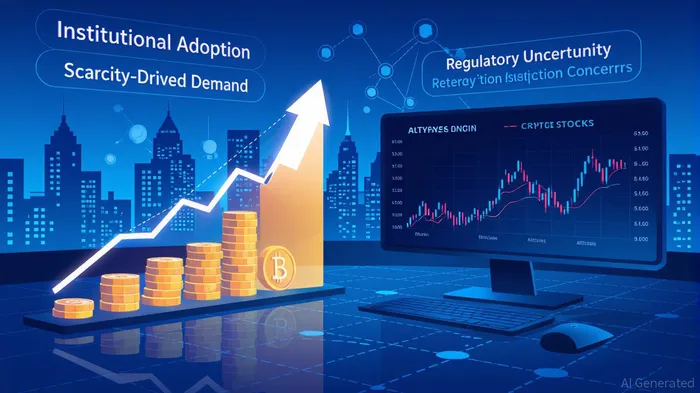
Bitcoin's price surge to $115,865.87 in 2025[4] has ignited a broader debate about the cryptocurrency's role as a “digital gold” and its potential to catalyze growth across the crypto ecosystem. While institutional adoption has solidified Bitcoin's status as a store of value[2], the spillover effects on crypto stocks and altcoins remain uneven, shaped by a tug-of-war between structural risks and long-term adoption trends.
Institutional Adoption: A Tailwind for the Ecosystem
Bitcoin's rally in 2025 is underpinned by a wave of institutional interest. Pension funds, hedge funds, and asset managers have increasingly allocated capital to BitcoinBTC--, viewing it as a hedge against inflation and a diversifier in portfolios dominated by fiat currencies[2]. This shift has not only driven Bitcoin's price higher but also created a halo effect for crypto infrastructure. For instance, companies offering custody solutions, blockchain analytics, and mining hardware have seen their valuations rise in tandem with Bitcoin's ascent[4].
The limited supply of 21 million Bitcoin coins[4] further reinforces its appeal to institutions, mirroring the scarcity of gold. This structural scarcity has spurred demand for related assets, such as altcoins with utility-driven use cases (e.g., Ethereum's Layer 2 solutions or Solana's high-throughput smart contracts). However, the correlation between Bitcoin's price and altcoins remains imperfect. While some altcoins have benefited from Bitcoin's rally—driven by speculative flows and macroeconomic tailwinds—others have lagged due to regulatory headwinds and inherent volatility[3].
Structural Risks: The Dark Side of the Rally
Bitcoin's proof-of-work mechanism, which secures the network, has come under scrutiny for its energy consumption. Critics argue that the environmental footprint of mining could deter mainstream adoption, particularly as regulators and ESG-focused investors prioritize sustainability[3]. This risk is amplified by Bitcoin's volatility: a 2025 report by CoinDesk noted that Bitcoin's price swung by over 30% in a single month, eroding confidence among risk-averse investors[4].
For altcoins and crypto stocks, these risks create a double-edged sword. On one hand, Bitcoin's rally attracts capital to the broader crypto space; on the other, its volatility and regulatory uncertainty act as a drag. For example, when the U.S. Securities and Exchange Commission (SEC) intensified its crackdown on unregistered securities in June 2025, altcoin prices dipped despite Bitcoin's resilience[4]. Similarly, crypto stocks like CoinbaseCOIN-- and Riot Blockchain have experienced whipsaw trading patterns, reflecting investor anxiety over regulatory clarity and competition from decentralized finance (DeFi) protocols[4].
The Path Forward: Balancing Optimism and Caution
The long-term institutional adoption of Bitcoin hinges on mitigating these structural risks. Technological upgrades like SegWit and the Lightning Network have already improved scalability and reduced transaction costs[3], but broader adoption will require addressing energy consumption and regulatory alignment. For altcoins and crypto stocks, the key lies in demonstrating tangible utility beyond speculative trading. Projects that integrate with Bitcoin's ecosystem—such as cross-chain bridges or Bitcoin-backed stablecoins—may capture more of the spillover demand.
Investors must also navigate the tension between short-term volatility and long-term potential. While Bitcoin's rally has created a tailwind for the crypto sector, the path to mainstream adoption is likely to be bumpy. As one analyst put it, “Bitcoin is the canary in the coal mine; its success highlights the opportunities, but its risks remind us that the crypto ecosystem is still a work in progress.”[4]





Comentarios
Aún no hay comentarios