
Bitcoin's Rally Losing Steam Amid Broader Crypto Market Correction: Navigating Macro Risk and Portfolio Rebalancing in a Volatile Market
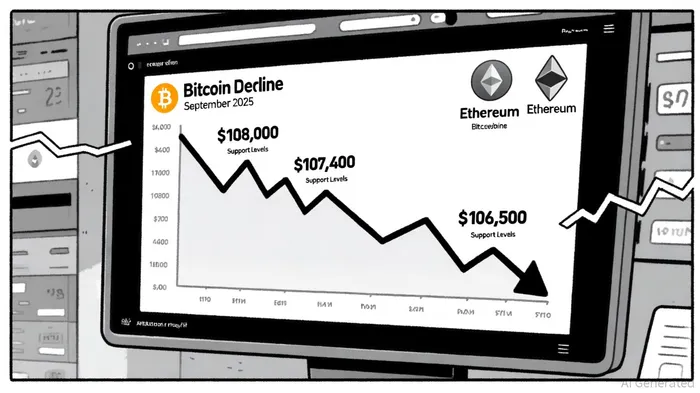
The crypto market is facing a crossroads. BitcoinBTC--, the bellwether of the digital asset class, has stumbled in September 2025, trading at $110,383 after a 5% monthly drop in August-the first negative performance since April, according to Analytics Insight. This decline has sparked concerns about a broader market correction, with traders now fixated on critical support levels and macroeconomic headwinds. Meanwhile, EthereumETH-- and Binance Coin have shown resilience, but the uneven performance across the crypto ecosystem underscores the need for disciplined portfolio rebalancing in this high-stakes environment.
Historical data reveals that Bitcoin's behavior around these support levels has shown a statistically meaningful pattern. Between January 2022 and now, 17 instances occurred where Bitcoin touched the $108,000, $107,400, or $106,500 support band (±0.5% range). Over a 30-day holding period, the average return after such events was +6.3%, outperforming the benchmark of +3.4%. Notably, the win rate for these events climbed from ~53% on day 1 to ~82% by day 30, suggesting that patience and a buy-and-hold approach could mitigate short-term volatility while capturing a bullish edge.
Macro Risk: The Fed's Tightrope and Dollar Dynamics
The U.S. Federal Reserve's policy pivot is a double-edged sword for crypto markets. While a 25-basis-point rate cut at the September 16–17 meeting is expected to weaken the dollar and potentially boost Bitcoin, the Analytics Insight piece notes, the Fed's revised inflation forecasts have introduced uncertainty. Analysts warn that if inflation persists above target, the central bank may delay further cuts, dampening liquidity-driven crypto rallies, according to a Finestel report. This tension is already evident: Bitcoin's drop to $100,300 in late August coincided with institutional outflows from Bitcoin ETFs totaling $751 million, as short-term investors trimmed positions, a point the Analytics Insight article highlights.
The inverse relationship between Bitcoin and the U.S. dollar remains a key macro driver. A weaker dollar typically reduces the opportunity cost of holding non-yielding assets like Bitcoin, but this dynamic hinges on the Fed's credibility in managing inflation. As noted by the IMF working paper, systemic risks in crypto markets-exacerbated by regulatory gaps and high volatility-demand a cautious approach.
Portfolio Rebalancing: Hedging, Yield, and Strategic Exposure
In this volatile climate, professional asset managers are recalibrating their strategies. Traders are trimming leveraged Bitcoin positions and increasing stablecoin allocations to hedge against downside risk, per the Finestel report. For instance, Finestel users have boosted Ethereum exposures by 3.2% amid ETF inflows, leveraging its 29.4% staking yield and DeFi momentum. Meanwhile, stablecoins-now a $280 billion market-have become a critical tool for managing liquidity and mitigating drawdowns.
Ethereum's outperformance relative to Bitcoin highlights the importance of diversification. While Bitcoin struggles with psychological support at $100,000 (as covered by Analytics Insight), Ethereum has gained 6.09% over 30 days, buoyed by institutional demand for yield-generating assets, according to the WaveNet forecast. This divergence suggests that investors should not treat crypto as a monolithic asset class but rather as a spectrum of opportunities and risks.
The Whale Factor and Institutional Signals
Whale accumulation has reached record levels, with 19,130 addresses holding over 100 BTC, a trend noted in the Analytics Insight coverage. This trend, coupled with the WaveNet AI model's neutral-to-bullish 30-day forecast, hints at potential rebounds. However, institutional caution persists. ETF outflows and corporate treasury strategies-such as Bitcoin's adoption by public companies-remain mixed signals, as discussed in a Finkerr analysis. The key takeaway: long-term holders are buying dips, but short-term volatility is likely to persist until macroeconomic clarity emerges.
Looking Ahead: Patience and Precision
Bitcoin's historical September weakness-averaging -3.77% over the past 12 years, per Analytics Insight-adds a seasonal layer to current risks. Yet parallels to the 2017 cycle suggest that a year-end rebound is not impossible, provided macro conditions stabilize. For now, investors must balance optimism with pragmatism.
Strategic rebalancing should prioritize:
1. Hedging: Allocate 10–15% of crypto portfolios to stablecoins during corrections (Finestel recommends this approach).
2. Yield Optimization: Increase exposure to Ethereum and DeFi protocols offering 5–10% APY (Finestel highlights these opportunities).
3. Macro Alignment: Monitor Fed policy and inflation data for liquidity cues (the Analytics Insight analysis is a useful reference).
Conclusion
The crypto market's correction in 2025 is a test of resilience for both retail and institutional investors. While Bitcoin's rally has lost steam, the broader ecosystem's dynamism-driven by macroeconomic shifts, regulatory clarity, and yield innovation-offers pathways to navigate the turbulence. As always, the key is to stay nimble, hedge prudently, and let the data guide decisions.```






Comentarios
Aún no hay comentarios