
Bitcoin's Quiet Resilience Amid Macroeconomic Shifts: A 2026 Buying Opportunity?
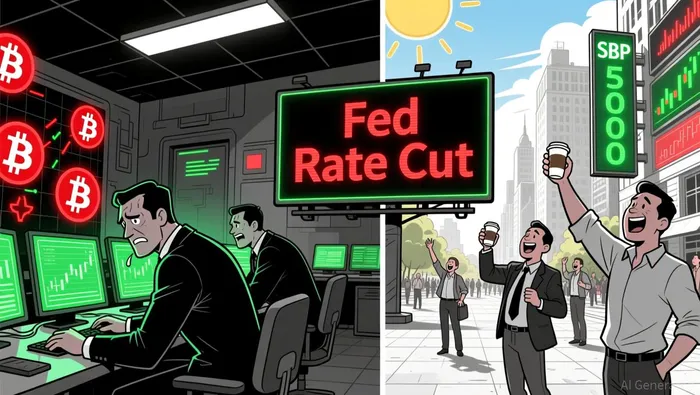
The Federal Reserve's December 2025 rate cut, the third in a series of dovish moves, sent ripples through global markets. While the S&P 500 surged and gold held near record highs, Bitcoin's response was muted. This divergence raises a critical question: Is Bitcoin's underperformance a sign of fragility, or is it quietly positioning itself for a 2026 rebound?
The Fed's Dovish Pivot and Market Reactions
The Fed's 25-basis-point cut in December 2025 brought the federal funds rate to 3.5%–3.75%, signaling a shift toward accommodative policy amid a cooling labor market and inflation above targets. The S&P 500 and Dow Jones Industrial Average closed at record highs, with the Russell 2000 leading small-cap stocks to new peaks. Gold, meanwhile, consolidated near $4,200 per ounce, buoyed by central bank demand and a weaker dollar.
Bitcoin, however, remained near $91,800, 26% below its October 2025 peak. Despite ETF inflows, the cryptocurrency struggled to capitalize on the Fed's liquidity injection, with traders attributing this to lingering macroeconomic uncertainty and internal market pressures.
Bitcoin's 2026 Outlook: A Tale of Two Scenarios
Analysts remain divided on Bitcoin's trajectory. J.P. Morgan predicts $170,000 by 2026, citing institutional adoption and ETF-driven demand, while Tom Lee of Fundstrat forecasts $250,000, assuming major tech companies enter the BitcoinBTC-- market. Conversely, Standard Chartered has trimmed its 2026 target to $150,000, reflecting waning institutional demand and macroeconomic headwinds.
Investor sentiment is similarly split. Bitcoin traders are placing heavy call options on $130,000 and $180,000 strikes for March 2026, signaling a preference for a delayed rally over a near-term "Santa rally". This suggests a belief in Bitcoin's long-term potential, even as short-term volatility persists.
Traditional Assets: S&P 500, Gold, and Treasury Yields
The S&P 500's 2026 outlook is robust, with earnings growth projected at 14.2% and the index potentially reaching 7,700 by year-end. This optimism is fueled by the Fed's anticipated three additional rate cuts in 2026 and a weak dollar environment.
Gold's performance, meanwhile, is tied to falling Treasury yields and geopolitical tensions. Central banks added 19 tonnes of gold in November 2025 alone, with China, India, and Turkey leading the charge. The 10-year Treasury yield, currently at 4.15%, remains below the critical 4.5% threshold that could trigger market volatility.
Macroeconomic Uncertainty and Institutional Dynamics
Bitcoin's resilience is complicated by macroeconomic headwinds. A weakening labor market and elevated inflation concerns have led to cautious investor behavior. Institutional demand, a key driver in previous cycles, has stagnated, with public companies and ETF-like vehicles holding only 12% of the total Bitcoin supply.
Yet, Bitcoin's ETF-flows fair value is near $85,000, suggesting a potential stabilization point. If liquidity conditions improve in 2026, as projected, this could reignite institutional interest.
Is 2026 a Buying Opportunity?
Bitcoin's 2026 trajectory hinges on three factors:
1. Fed Policy Clarity: A definitive shift to aggressive easing could reignite risk-on sentiment.
2. Institutional Re-entry: Stagnant accumulation rates must reverse to restore marginal demand.
3. Macro Stability: A resolution of inflation and labor market concerns would reduce volatility.
While Bitcoin's immediate outlook is mixed, its long-term fundamentals remain intact. The projected 50–60% drawdown from its 2025 high, with a bottom between $45,000 and $65,000, could create a compelling entry point for investors willing to weather near-term turbulence.
Conclusion
Bitcoin's quiet resilience in 2026 is not a sign of weakness but a reflection of its unique position in the macroeconomic landscape. While traditional assets like the S&P 500 and gold have thrived on Fed-driven liquidity, Bitcoin's path is more nuanced. For investors, the key lies in balancing short-term volatility with long-term potential. If the Fed's dovish pivot continues and institutional demand rebounds, 2026 could mark the beginning of a new bull cycle for Bitcoin.






Comentarios
Aún no hay comentarios