
Bitcoin's Quantum Vulnerability: Why PQC Readiness is a Strategic Investment Imperative
Bitcoin's cryptographic foundations-Elliptic Curve Digital Signature Algorithm (ECDSA) and SHA-256-have long been considered robust. Yet, the emergence of quantum computingQUBT-- has introduced a paradigm shift. While the threat remains distant, the urgency to act is growing. For investors, understanding the interplay between near-term risk and long-term resilience is critical to safeguarding digital asset portfolios.
Near-Term Risk: A Decade of Denial or Prudent Preparation?
Quantum computing's ability to break ECDSA and SHA-256 hinges on algorithms like Shor's and Grover's, which could theoretically crack Bitcoin's 256-bit secp256k1 curve. However, experts like Adam Back argue that viable quantum computers capable of this feat are decades away, with no credible timeline suggesting a threat before 2030. Current systems lack the 8,000+ qubits required to break SHA-256 according to research, and even if progress accelerates, the transition to post-quantum cryptography (PQC) is already underway.
That said, the "harvest now, decrypt later" strategy-a tactic where adversaries collect encrypted data today for decryption in the future-adds urgency. Around 25% of Bitcoin's supply (4 million BTC) is stored in vulnerable Pay-to-Public-Key (P2PK) and Pay-to-Public-Key-Hash (P2PKH) addresses, which expose public keys and make wallets susceptible to future attacks. For institutional holders, this represents a ticking clock.
Long-Term Resilience: PQC as a Strategic Imperative
Post-quantum cryptography (PQC) is no longer a theoretical safeguard. The NIST Post-Quantum Cryptography Standardization Project has already approved algorithms like CRYSTALS-Kyber and CRYSTALS-Dilithium, with lattice-based cryptography leading the market in 2024. Hybrid models combining classical and quantum-resistant cryptography are being explored to ensure backward compatibility during the transition according to industry analysis.
The PQC market is projected to grow from $0.42 billion in 2025 to $2.84 billion by 2030, driven by demand from IT, finance, and hardware sectors according to market research. Companies like Cloudflare and NXP are already integrating PQC into their infrastructure. Cloudflare, for instance, has deployed ML-KEM 768 across 38% of its systems since 2019, demonstrating that quantum-safe protocols can be implemented incrementally without disrupting existing workflows. NXP's approach-embedding PQC into hardware roots of trust-highlights how long-life devices can be future-proofed against quantum threats.
For BitcoinBTC--, the Bitcoin Improvement Proposal (BIP)-360 and similar initiatives aim to introduce quantum-resistant address formats, enabling a user-driven migration to more secure cryptographic standards according to industry reports. The development of benchmarks like the ECDLP challenge ladder further accelerates progress by tracking advancements in breaking Bitcoin's encryption according to research.
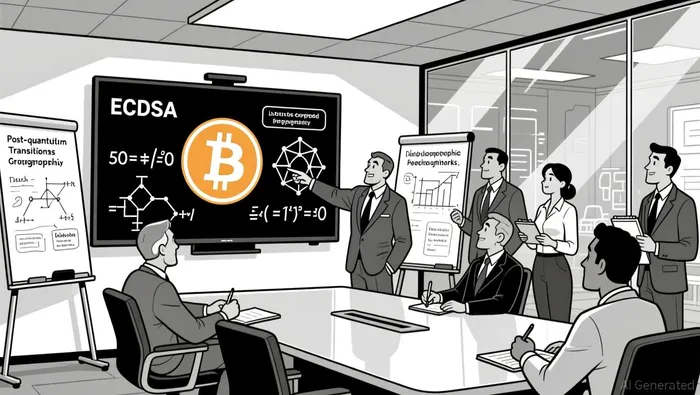
Institutional adoption is also gaining traction. Financial institutions are exploring hybrid quantum-classical workflows to optimize portfolio management and risk modeling according to academic research. For example, D-Wave's quantum annealers are being tested to improve risk-return trade-offs in small portfolios according to research. Meanwhile, post-quantum cryptographic defenses are being prioritized to protect sensitive financial data against future threats according to industry reports.
Conclusion: Preparing for the Quantum Future
Bitcoin's quantum vulnerability is a long-term risk, but the tools to mitigate it are already available. While the threat to ECDSA and SHA-256 is negligible in the next 5–10 years, the cost of inaction grows with every year of delay. For investors, the strategic imperative is clear: allocate capital to PQC-ready solutions and support projects that prioritize cryptographic agility.
As quantum computing advances, the winners will be those who act now-not out of fear, but out of foresight. The future of digital assets depends on it.





Comentarios
Aún no hay comentarios