
Bitcoin's Quantum Vulnerability and the Market Implications for 2028
The next decade will test whether BitcoinBTC-- can survive one of its most existential threats: quantum computing. While the cryptocurrency has weathered regulatory storms, market crashes, and scalability debates, the looming risk of quantum decryption could redefine its value proposition-and its survival. By 2028, the race to secure Bitcoin's cryptographic foundations will reach a critical inflection point. For investors, understanding this risk and its hedging strategies is no longer optional-it's a necessity.
The Quantum Threat: A Clock Ticking Toward Q-Day
Bitcoin's security relies on the Elliptic Curve Digital Signature Algorithm (ECDSA), a cryptographic standard that has held up against classical computing for decades. However, quantum computers, leveraging Shor's algorithm, could break ECDSA in hours rather than millennia once they achieve sufficient qubit capacity-approximately 1,673 logical qubits according to Coinsbench. IBMIBM-- and Google are on track to deliver such systems by 2028, with IBM's Nighthawk processor already demonstrating 120 qubits and plans to scale to 10,000 two-qubit gates by 2027 as reported by Forbes.
The urgency is compounded by the fact that 20–25% of Bitcoin's supply is already at risk due to exposed public keys from older address formats according to a crypto analysis. 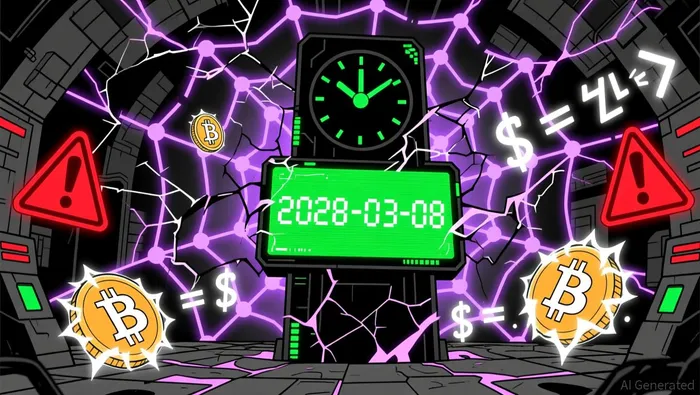 If quantum computers materialize as projected, these funds could be stolen or manipulated, triggering a cascade of trust erosion. As Charles Edwards of Capriole Investments warns, "Bitcoin could fall below $50,000 by 2028 if quantum-resistant upgrades are not implemented in time" per Capriole's analysis.
Market Implications: A Bear Market as a Catalyst for Change
The market's response to this threat will likely mirror past crises. Historically, bear markets have forced innovation-SegWit and Taproot upgrades emerged during downturns. A similar dynamic could unfold here. Michael Saylor of MicroStrategy argues that quantum computing could strengthen Bitcoin by prompting protocol upgrades that migrate active coins to quantum-resistant addresses, effectively reducing supply and enhancing security according to stocktwits. However, skeptics counter that a bear market may be necessary to eliminate complacency. As Vitalik Buterin notes, "The crypto industry must act before 2028, or we risk exposing critical infrastructure to quantum attacks" as stated in a security blog.
The timeline is tight. The Quantum Doomsday Clock estimates a "Q-Day"-when quantum computers break Bitcoin's encryption-as early as March 8, 2028 according to financial analysis. This compressed window leaves little room for error. If the network fails to adopt quantum-resistant cryptography by then, the result could be a prolonged bear market, with Bitcoin's price plummeting to levels not seen since 2018 as predicted by CoinMarketCap.
Hedging Strategies: From Post-Quantum Wallets to Policy Frameworks
Investors and institutions are already preparing for this scenario. BTQ Technologies has demonstrated a quantum-safe Bitcoin implementation using NIST-standardized ML-DSA, aiming to secure the entire network by 2026 according to a technology report. This approach replaces ECDSA with lattice-based cryptography, a quantum-resistant alternative. Meanwhile, projects like 01 Quantum Inc.'s Quantum-Sig wallet embed post-quantum primitives into smart contracts, offering an additional layer of protection as reported by Barchart.
Financial instruments are also emerging to hedge against quantum risk. Goldman Sachs, JPMorgan, and Morgan Stanley have introduced structured notes tied to Bitcoin ETFs, offering leveraged upside with downside protection as reported by Bloomberg. These products cater to investors seeking exposure to Bitcoin's growth while mitigating the risk of a quantum-induced crash.
On the policy front, the U.S. Securities and Exchange Commission (SEC) is advancing the Post-Quantum Financial Infrastructure Framework (PQFIF), which mandates the migration of digital assets to quantum-resistant standards by 2035 according to a regulatory update. This regulatory push underscores the growing consensus that proactive measures are essential to safeguard the $2.4 trillion Bitcoin market.
The Path Forward: Innovation vs. Inaction
The coming years will determine whether Bitcoin adapts or collapses under quantum pressure. For investors, the key is to balance optimism with caution. While projects like BTQ and Naoris Protocol offer hope, the risk of inaction remains high. As the 2028 deadline approaches, the market will likely price in the probability of a successful upgrade. Those who act early-whether by adopting quantum-resistant wallets, investing in post-quantum infrastructure, or hedging with structured products-will position themselves to thrive in a post-quantum era.
The quantum threat is not a distant hypothetical; it's a ticking clock. For Bitcoin, the next six years will define its legacy-or its obsolescence.





Comentarios
Aún no hay comentarios