
Bitcoin's Quantum-Resistant Future: Strategic Investment Timing and Risk Mitigation in a Post-Quantum Era
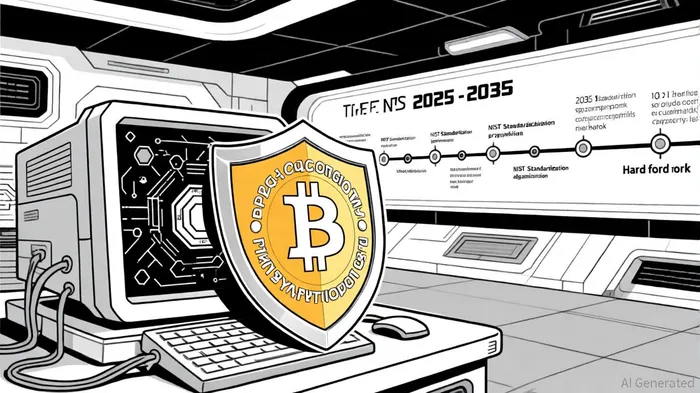
The advent of quantum computing has introduced a paradigm shift in the security landscape of cryptocurrencies, particularly BitcoinBTC--. As quantum algorithms like Shor's and Grover's threaten to break the Elliptic Curve Digital Signature Algorithm (ECDSA) and SHA-256 encryption underpinning Bitcoin's infrastructure, the urgency for proactive risk mitigation and strategic investment timing has never been greater. With approximately 25% of Bitcoin's supply—roughly 4 million BTC, valued at over $500 billion—stored in legacy wallets vulnerable to quantum attacks[1], the stakes for institutional investors and governance bodies are monumental.
Quantum Threats and the Race for Resilience
Quantum computing's ability to derive private keys from public keys via Shor's algorithm poses an existential risk to Bitcoin's cryptographic security[2]. While a full-scale quantum attack remains a 10–20 year horizon, the “harvest now, decrypt later” strategy—where adversaries collect encrypted data today for future exploitation—has already intensified the need for immediate action[3]. For instance, Bitcoin wallets with exposed public keys, such as Pay-to-PubKeyHash (P2PKH) addresses, are particularly susceptible.
The Bitcoin community is responding with post-quantum cryptography (PQC) solutions. Lattice-based algorithms like CRYSTALS-Dilithium and hash-based schemes like SPHINCS+ are being standardized by the U.S. National Institute of Standards and Technology (NIST) to resist quantum threats[4]. A proposed hard fork, the Quantum-Resistant Address Migration Protocol (QRAMP), aims to incentivize users to migrate funds to quantum-safe addresses through a network-wide deadline[5]. However, such upgrades require consensus, and resistance from users averse to technical changes could delay adoption.
Strategic Investment Timing: The Quantum-Resistant Opportunity
Institutional investors are increasingly allocating capital to quantum-resistant blockchain projects and infrastructure. The global quantum cryptography market, valued at $170.46 million in 2024, is projected to grow at a 18.39% CAGR, reaching $778.87 million by 2033[6]. This growth is driven by projects like Quantum Resistant Ledger (QRL), IOTAIOTA--, and Rootstock, which integrate PQC into their architectures. For example, QRL employs hash-based signatures, while IOTA uses Winternitz One-Time Signatures (WOTS) to secure IoT transactions[7].
Investors are also prioritizing quantum-safe custody solutions. Platforms like QuantumBlock Vault and BitShield QuantumSafe offer hybrid encryption methods, combining lattice-based and hash-based algorithms to protect assets[8]. According to a report by CoinBuzzNow, QRL could capture up to 20% of Bitcoin's value by 2025, with optimistic return projections exceeding 100,000x[9]. This underscores the potential for quantum-resistant assets to outperform traditional cryptocurrencies in a post-quantum era.
Governance Challenges and Risk Mitigation Frameworks
Transitioning to quantum-resistant cryptography is not without hurdles. Performance trade-offs, such as larger key sizes and computational overhead, pose challenges for resource-constrained environments like IoT devices[10]. Additionally, governance frameworks must balance technical upgrades with user adoption. A risk-driven approach—prioritizing high-value systems and data—has emerged as a pragmatic strategy[11]. For instance, the “harvest now, decrypt later” threat model necessitates immediate inventorying of vulnerable assets and layered security measures[12].
Governance bodies are also grappling with the complexity of hard forks. The QRAMP proposal, while ambitious, requires coordination among developers, miners, and users to avoid network fragmentation. As noted in a 2025 Forbes analysis, the success of such upgrades hinges on community trust and clear communication[13].
Conclusion: Preparing for the Quantum Era
The convergence of quantum computing and blockchain technology demands a dual focus on technical innovation and strategic governance. For investors, the window to act is narrowing: while a quantum attack may not materialize before the 2030s, the “silent collapse” of Bitcoin systems due to undetected breaches could occur earlier[14]. By allocating capital to quantum-resistant projects, advocating for standardized PQC adoption, and prioritizing risk-driven migration strategies, stakeholders can future-proof their portfolios.
As the race to quantum resilience accelerates, the next five years will be pivotal. Those who act now—whether through early adoption of quantum-safe wallets, investment in PQC research, or advocacy for governance upgrades—will be best positioned to navigate the uncertainties of a post-quantum world.






Comentarios
Aún no hay comentarios