
Bitcoin's Q4 2025 Price Trajectory Amid U.S. Macroeconomic Uncertainty: Navigating Data Delays and Policy Opacity
The fourth quarter of 2025 has emerged as a pivotal period for BitcoinBTC--, with its price trajectory increasingly shaped by U.S. macroeconomic uncertainty. A confluence of delayed data releases, policy opacity, and institutional adoption has created a volatile yet opportunity-rich environment for investors. This analysis examines how these factors are influencing market sentiment and asset allocation decisions, drawing on recent developments and empirical evidence.
Delayed Data Releases and Market Volatility
The partial U.S. government shutdown in October 2025 disrupted the release of critical macroeconomic data, including the Bureau of Labor Statistics' jobs report and Consumer Price Index (CPI) figures. According to a Reuters report, this informational void forced the Federal Reserve to rely on alternative metrics like the ADP National Employment Report, creating uncertainty around inflation and employment trends. The absence of official data amplified market volatility, with Bitcoin experiencing sharp price swings as investors speculated on the Fed's potential rate-cut trajectory. For instance, Bitcoin surged past $116,000 in late September 2025 amid anticipation of softer inflation data, only to retreat as delayed releases introduced ambiguity, as a ScienceDirect paper documents.
The shutdown also stalled regulatory decisions, such as approvals for Bitcoin ETFs, further exacerbating uncertainty. Cointelegraph noted that the SEC's reduced staffing during the shutdown delayed key rulings, pushing back timelines for institutional products and fueling a "risk-off" sentiment that briefly drove capital into Bitcoin as a perceived safe-haven asset.
Policy Opacity and Institutional Allocation Shifts
Beyond data delays, broader U.S. fiscal and monetary policy opacity has driven institutional adoption of Bitcoin. The passage of the "One Big Beautiful Bill Act" (OBBBA), which added $3 trillion to the federal deficit, intensified concerns about fiat currency devaluation. Grayscale research highlights that this fiscal risk spurred record inflows into U.S.-listed spot Bitcoin ETFs, with over $5.2 billion in net inflows during May 2025 alone. By October, BlackRock's iShares Bitcoin Trust (IBIT) had attracted $967 million in a single week, reflecting institutional confidence in Bitcoin as a hedge against monetary expansion, Reuters reported.
Institutional adoption has also been bolstered by regulatory clarity, such as the approval of spot Bitcoin ETFs and the inclusion of Bitcoin in retirement accounts under the CLARITY Act. These developments normalized Bitcoin's role in diversified portfolios, with corporate treasuries now holding 6.2% of the total Bitcoin supply-a 21x increase since 2020, as Analytics Insight reported. A Federal Reserve analysis underscores that Bitcoin's inverse correlation with the U.S. dollar (negative 0.75) makes it an attractive asset during periods of dollar weakness and policy uncertainty.
Retail Investor Behavior and the "Debasement Trade"
Retail investors have mirrored institutional trends, with Bitcoin surging over $125,000 in October 2025 amid government shutdown fears. JPMorgan's analysis attributes this surge to a "debasement trade," where younger investors and male-dominated demographics increasingly view Bitcoin as a non-sovereign store of value amid U.S. fiscal risks; Federal Reserve data show similar demographic skews in risk-on asset adoption. The rise of "Bitcoin treasury" corporations-public companies holding Bitcoin on balance sheets-has further legitimized the asset, with entities like Strategy (formerly MicroStrategy) and Twenty One Capital signaling broader adoption (Grayscale research also documents these flows).
However, retail participation remains uneven. While inflows into crypto accounts spiked during price surges, demographic disparities persist, with adoption concentrated among specific age and gender cohorts, according to Federal Reserve analysis.
Quantifying the Impact of Policy Uncertainty
The U.S. Economic Policy Uncertainty (EPU) index, which measures uncertainty through newspaper articles and economic indicators, reached a 68% increase in Q1 2025-the highest since the 1980s, as Grayscale research reports. Studies by the Federal Reserve and Oxford University demonstrate that high EPU correlates with reduced investment and industrial production, with Bitcoin serving as a dynamic hedge during such periods, according to a ScienceDirect paper. While exact Q4 2025 correlation coefficients remain unpublished, historical patterns suggest that Bitcoin's price movements amplify during EPU spikes, particularly in markets with loose regulations, as the Federal Reserve analysis indicates.
Conclusion: A New Equilibrium in Q4 2025
Bitcoin's Q4 2025 trajectory reflects a new equilibrium between macroeconomic uncertainty and institutional adoption. Delayed data releases and policy opacity have heightened volatility, but they have also accelerated Bitcoin's integration into traditional finance. As the Fed navigates an informational void and investors seek hedges against fiat devaluation, Bitcoin's role as a strategic asset is likely to solidify. However, the extent of its price resilience will depend on the resolution of regulatory bottlenecks and the duration of fiscal uncertainty. For now, the interplay of these forces suggests a market primed for both risk and reward.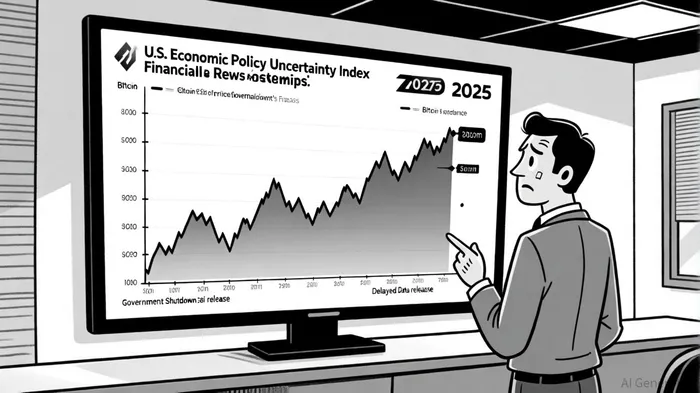







Comentarios
Aún no hay comentarios