
Bitcoin's Pullback: A Tactical Buying Opportunity?
The recent 30% pullback in Bitcoin's price has ignited a heated debate among investors: Is this a temporary correction within a broader bull market, or the beginning of a prolonged bear cycle? For long-term investors, the answer hinges on distinguishing between cyclical patterns and structural shifts. Historical data, on-chain metrics, and macroeconomic signals offer a nuanced framework to evaluate whether this dip represents a tactical buying opportunity.
Historical Context: Corrections vs. Bear Markets
Bitcoin's price history reveals a recurring pattern of sharp corrections during bull cycles. In 2021, the asset fell 31% from its peak, and in 2017, a 34% decline preceded a multi-year rally, according to a CoinEdition analysis. These corrections, typically ranging between 30% and 70%, have historically served as accumulation phases for long-term holders. As stated by Benjamin Cowen of Into the Cryptoverse, a 70% correction in the next bear market remains a plausible scenario, with potential bottoms varying from $37,337 to $150,000 depending on the cycle's peak, according to a CoinRepublic forecast. This suggests that while volatility is inevitable, Bitcoin's bull cycles often absorb such dips before resuming upward trajectories.
On-Chain Metrics Signal a Healthy Correction
Q3 2025 on-chain data provides further clarity. The MVRV Z-Score-a measure of realized capital gains/losses-dropped to 1.43 following the 30% correction but has since rebounded, aligning with historical bull market behavior, according to a Bitcoin Magazine analysis. Simultaneously, Value Days Destroyed (VDD) metrics indicate that long-term holders are accumulating BitcoinBTC-- during the dip, a trend that same analysis shows is often observed before price recoveries. These signals suggest that the current pullback is more akin to a "healthy bear trap" than the end of a bull run.
However, caution is warranted. CryptoQuant CEO Ki Young Ju has noted that fresh liquidity is drying up, and whale selling at lower prices could signal bear market dynamics, a point reported by CoinEdition. This duality underscores the importance of monitoring both technical and behavioral indicators.
Macroeconomic Risks and Market Sentiment
Bitcoin's correlation with U.S. equities remains a double-edged sword. While the asset has historically decoupled during periods of monetary tightening, its recent underperformance against gold-22% below its August 2025 high-has raised concerns about its safe-haven appeal, according to a CoinGabbar analysis. Peter Schiff, a vocal critic of Bitcoin, argues that the asset is already in a "stealth bear market," citing its relative weakness against traditional stores of value, a view quoted by CoinGabbar.
Meanwhile, the Fear & Greed Index, currently at 34 (Fear), reflects cautious investor behavior, per CoinGabbar. Historically, such fear phases have led to accumulation and eventual rebounds, though near-term volatility persists. The decline in Bitcoin's dominance from 65% to 57.16% also signals a shift in capital toward altcoins, complicating the market outlook, as noted by CoinRepublic.
Strategic Implications for Long-Term Investors
For investors with a multi-year horizon, the current pullback offers a critical juncture. Historical corrections have often created asymmetric risk-reward scenarios, where disciplined buying during dips has outperformed market timing. The on-chain data-particularly VDD trends-suggests that institutional and retail investors are viewing this dip as an opportunity to accumulate at lower prices.
Yet, strategic positioning must account for macroeconomic headwinds. If global markets face prolonged stress, Bitcoin's correlation with equities could amplify downside risks. Diversification and dollar-cost averaging remain prudent strategies to mitigate these uncertainties.
Conclusion: A Tactical Opportunity with Caveats
Bitcoin's pullback in 2025 appears to align with historical correction patterns, supported by on-chain metrics and long-term accumulation trends. While macroeconomic risks and bearish arguments cannot be ignored, the data leans toward a continuation of the bull cycle rather than its termination. For long-term investors, this dip may represent a tactical buying opportunity-provided they maintain a disciplined approach and remain cognizant of evolving market conditions.
As always, the key lies in balancing historical context with real-time data, and in recognizing that Bitcoin's journey is as much about patience as it is about precision.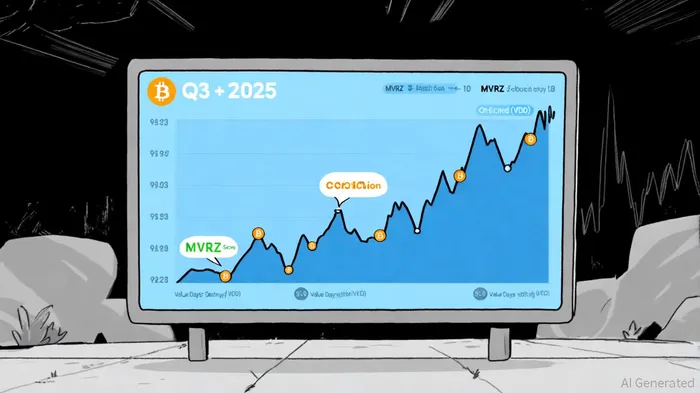






Comentarios
Aún no hay comentarios