
Bitcoin's Privacy Challenges and the Emergence of Privacy-Enhancing Solutions as a Catalyst for Future Growth
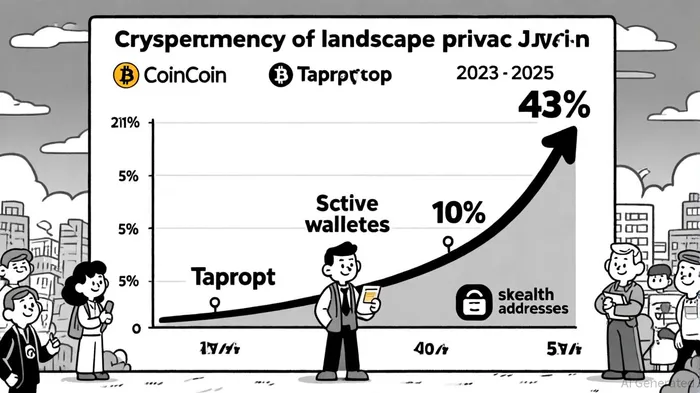
Bitcoin’s journey toward mainstream adoption has always been a balancing act between transparency and privacy. While its public ledger ensures accountability, it also exposes users to surveillance, address clustering, and deanonymization risks. In 2025, however, privacy-enhancing technologies (PETS) like CoinJoin, Taproot, and stealth addresses are reshaping Bitcoin’s trajectory, addressing these vulnerabilities while navigating a complex regulatory landscape. This analysis evaluates how these innovations are catalyzing growth, bolstering institutional confidence, and redefining Bitcoin’s role in a privacy-conscious financial ecosystem.
The Privacy Paradox: Bitcoin’s Dual Identity
Bitcoin’s pseudonymity—where transactions are public but identities are not inherently tied to addresses—has long been a double-edged sword. While this design fosters trust through transparency, it also enables blockchain analytics firms to trace flows, identify patterns, and deanonymize users through address clustering [2]. For instance, Chainalysis data reveals that 95% of traditional Bitcoin transactions are traceable to senders or recipients [1]. This vulnerability has spurred demand for privacy solutions that align with Bitcoin’s decentralized ethos while mitigating risks.
CoinJoin: Scaling Anonymity Through Collaboration
CoinJoin remains the most adopted privacy tool, leveraging transaction aggregation to obscure input-output mappings. By combining multiple users’ transactions into a single batch, CoinJoin expands the “anonymity set”—the number of participants in a transaction—by tenfold in default configurations like Wasabi Wallet [1]. This reduces the accuracy of blockchain analysis to under 18% for amounts above 1 BTC [1].
Adoption metrics underscore its growing influence: 43% of active wallets now use non-reusable addresses to avoid clustering, a practice closely tied to CoinJoin’s integration [1]. Japan’s regulatory push for stronger default cryptography has further amplified its impact, correlating with a 47% decline in deanonymization cases [1]. Despite its efficacy, CoinJoin’s reliance on user participation and centralized mixing services introduces friction, highlighting the need for protocol-level solutions.
Taproot: Privacy Through Complexity
The Taproot upgrade, activated in 2021, has quietly revolutionized Bitcoin’s privacy and scalability. By introducing Schnorr signatures and enabling complex spending conditions to appear as standard transactions, Taproot hides multisignature and smart contract activity on-chain [5]. This not only reduces transaction sizes and fees but also thwarts forensic analysis of high-value transactions.
By Q1 2024, 10% of daily transactions utilized Taproot, a figure projected to rise as institutional investors prioritize discretion [2]. For example, multisignature wallets and time-locked contracts now appear indistinguishable from single-signature transactions, making it harder to attribute ownership or trace spending history [5]. This feature is particularly appealing to institutions, which increasingly treat BitcoinBTC-- as a strategic reserve asset [4].
Stealth Addresses: Untapped Potential
While stealth addresses are more commonly associated with privacy coins like Monero, Bitcoin developers are exploring similar one-time address mechanisms to prevent address reuse. These addresses generate unique, unlinked addresses for each transaction, drastically reducing traceability risks [1]. However, adoption remains limited, with stealth addresses available only in pilot wallets [1].
Monero’s success—despite bans in Japan and the EU—demonstrates the demand for robust privacy. Anecdotal evidence suggests no single address holds an outsize portion of Monero’s supply, underscoring its fungibility [5]. Bitcoin’s cautious approach to stealth addresses reflects a broader tension between privacy and regulatory compliance, particularly in jurisdictions like the EU, which mandates KYC/AML checks under AMLD-5 [3].
Regulatory Responses: A Global Divide
Regulators are grappling with the implications of these innovations. Japan has taken a hardline stance, banning privacy coins and enforcing privacy-by-default measures like Schnorr/Taproot signatures [3]. This approach has reduced deanonymization cases but risks stifling innovation.
In contrast, the EU is adopting a data-driven strategy, standardizing transaction graph analysis and emphasizing privacy-by-design features [2]. The U.S., meanwhile, has focused on asserting digital sovereignty through initiatives like the Strategic Bitcoin Reserve, balancing privacy with institutional oversight [2]. These divergent approaches highlight the challenge of harmonizing privacy with compliance.
Market Impact: Privacy as a Growth Catalyst
Privacy innovations are directly influencing Bitcoin’s adoption and investor sentiment. Institutional adoption has surged, with $86 billion in assets under management (AUM) in U.S. spot Bitcoin ETFs by mid-2025 [4]. The integration of privacy tools like CoinJoin and Taproot has reduced volatility by 75% compared to historical levels, attracting long-term investors [4].
Moreover, privacy-focused wallets like Wasabi have seen a 43% annual increase in CoinJoin transactions, reflecting growing user demand for discretion [1]. This trend is mirrored in institutional behavior: 24% of new privacy coin wallets in 2025 are attributed to institutional investors, signaling a strategic shift toward privacy-preserving assets [1].
Conclusion: Privacy as a Competitive Advantage
Bitcoin’s privacy challenges are not insurmountable. CoinJoin, Taproot, and stealth addresses are proving that privacy can coexist with transparency, scalability, and regulatory compliance. As institutional adoption accelerates and volatility declines, these innovations are positioning Bitcoin as a viable alternative to privacy coins while maintaining its role as a global reserve asset.
The path forward will require balancing privacy with oversight, but the data is clear: privacy-enhancing solutions are not just a technical fix—they are a catalyst for Bitcoin’s next phase of growth.
Source:
[1] How the Trade War is Reshaping the Global Economy [https://moldstud.com/articles/p-the-role-of-privacy-solutions-in-shaping-bitcoins-future-development]
[2] Balancing Transparency and Anonymity in Bitcoin [https://www.technology-innovators.com/the-privacy-paradox-balancing-transparency-and-anonymity-in-bitcoin/]
[3] What Are Privacy Coins and Are They Legal? [https://www.coindesk.com/learn/what-are-privacy-coins-and-are-they-legal]
[4] Institutional Bitcoin Investment: 2025 Sentiment, Trends [https://pinnacledigest.com/blog/institutional-bitcoin-investment-2025-sentiment-trends-market-impact]
[5] Bitcoin's Taproot - Galaxy [https://www.galaxy.com/insights/research/bitcoin-taproot]






Comentarios
Aún no hay comentarios