
Bitcoin’s Price Stuck Near $112K Amid Fed Rate Cut Hopes and Market Volatility: Strategic Positioning for Institutional Investors in a Dovish Macro Environment
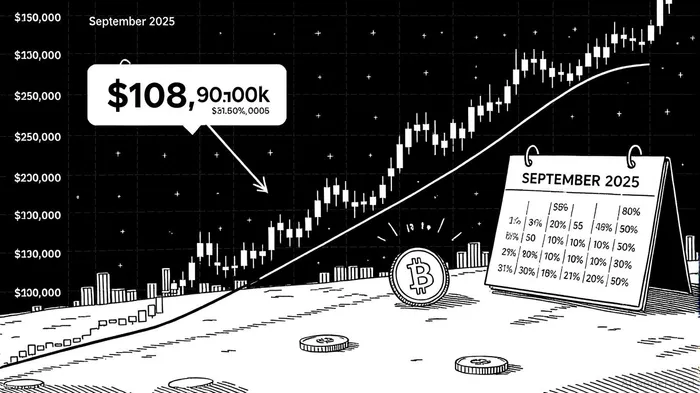
Bitcoin’s price has remained stubbornly range-bound near $112,000 in early September 2025, despite a 99.4% probability of a Federal Reserve rate cut at the September 17 meeting [3]. This divergence between macroeconomic expectations and on-chain behavior raises critical questions for institutional investors navigating a dovish macro environment. While lower interest rates typically boost liquidity and asset prices, Bitcoin’s technical indicators—such as its failure to retake the double top neckline—suggest a bearish bias, with some analysts warning of a potential 90% correction if macroeconomic conditions falter [1]. However, the same environment also presents strategic opportunities for institutions to position BitcoinBTC-- as a core portfolio asset, leveraging regulatory tailwinds, yield advantages, and structural supply dynamics.
The Dovish Macro Environment: A Tailwind for Institutional Bitcoin Allocation
The U.S. jobs report for August 2025, which added only 22,000 jobs (far below the 75,000 forecast), has intensified expectations of a 25-basis-point rate cut [1]. Lower interest rates reduce the opportunity cost of holding non-yielding assets like Bitcoin, making it more attractive in a low-yield world. Institutional investors are capitalizing on this shift, with firms like MicroStrategy and Japanese firm Metaplanet accumulating Bitcoin amid the $108,000–$116,000 consolidation phase [4].
The Federal Reserve’s dovish pivot is further amplified by global liquidity expansion and regulatory clarity. The approval of spot Bitcoin ETFs and the Trump administration’s executive order promoting a federal crypto framework have normalized Bitcoin’s inclusion in retirement portfolios and corporate treasuries [4]. For instance, Harvard University and TeslaRACE-- now hold Bitcoin as a strategic hedge against inflation and geopolitical risks [5]. These developments signal a transition from retail-driven speculation to institution-led capital flows, with projected institutional demand reaching $3 trillion over the next six years [1].
Strategic Positioning: Leveraging Dovish Conditions and Structural Advantages
Institutional investors are adopting multi-pronged strategies to capitalize on Bitcoin’s unique positioning in a dovish environment:
ETF-Driven Capital Inflows: The success of spot Bitcoin ETFs has created a structural supply shock, with minimal new mining supply unable to meet growing institutional demand [1]. This dynamic is reinforced by the anticipated redirection of $7.2 trillion from money market funds into riskier assets as the Fed cuts rates [3].
Yield Arbitrage and Treasury Accumulation: With traditional fixed-income yields collapsing, institutions are allocating to Bitcoin as a high-growth alternative. Firms like Galaxy DigitalGLXY-- and Tiger Research project Bitcoin could reach $190,000 by Q3 2025, driven by large-scale accumulation and yield-seeking capital [3].
Regulatory Tailwinds and Retirement Integration: The opening of 401(k) accounts to Bitcoin investment is unlocking access to a $10 trillion capital pool, reducing volatility and enhancing long-term demand [3]. This shift aligns with broader trends of institutional diversification, as Bitcoin’s 60% market dominance provides stability amid altcoin volatility [5].
Navigating Volatility: Key Risks and Technical Considerations
Despite these tailwinds, Bitcoin’s price remains fragile. On-chain metrics reveal short-term holder profitability at 60%, rebounding from earlier lows but still below levels confirming renewed momentum [2]. A break below $108,000 could trigger a correction toward $100,000, while a sustained move above $112,000 might signal a rally toward $150,000 [4]. Institutions must also contend with gold’s safe-haven appeal in a dovish environment, as the Fed’s caution about liquidity injections has favored gold over Bitcoin [5].
The upcoming August CPI data will be pivotal, as it could either validate or disrupt the current rate-cut narrative. Institutions are advised to employ hedging strategies, such as options or futures, to mitigate downside risks while maintaining exposure to Bitcoin’s long-term structural case.
Conclusion: A Calculated Bullish Case for Institutional Investors
Bitcoin’s current price stagnation near $112,000 reflects a tug-of-war between bearish technical signals and bullish macroeconomic catalysts. For institutional investors, the dovish environment offers a unique window to position Bitcoin as a core asset, leveraging regulatory clarity, yield advantages, and structural supply constraints. While volatility and macroeconomic uncertainty persist, the alignment of institutional adoption, ETF-driven inflows, and a Fed rate-cut cycle creates a compelling case for strategic accumulation. As the September 17 meeting approaches, the market will likely see a decisive move—either a breakdown into bearish territory or a breakout into a new bull phase. Institutions that act with discipline and foresight may find themselves well-positioned to capitalize on the latter.
Source:
[1] Institutional Forecasts Suggest Bitcoin Could Rise Above $125k Amid Dovish Signals [https://www.bitget.com/news/detail/12560604888297]
[2] Accumulating in the GapGAP-- [https://insights.glassnode.com/the-week-onchain-week-35-2025/]
[3] Bitcoin Price Gets Rejected at $113k Again Amid Rising Odds for Fed Rate Cuts [https://cryptorank.io/news/feed/f1148-bitcoin-price-gets-rejected-at-113k-again-amid-rising-odds-for-fed-rate-cuts]
[4] The Institutional Shift Redefining Portfolio Strategy in 2025 [https://www.bitget.com/news/detail/12560604939467]
[5] Crypto Market Q3 Macro Research Report: The signal of the alt [https://www.panewslab.com/en/articles/2uwu67k673n5]







Comentarios
Aún no hay comentarios