
Bitcoin's Price Stability Amid Rising Options Volumes: A Derivatives-Driven Analysis
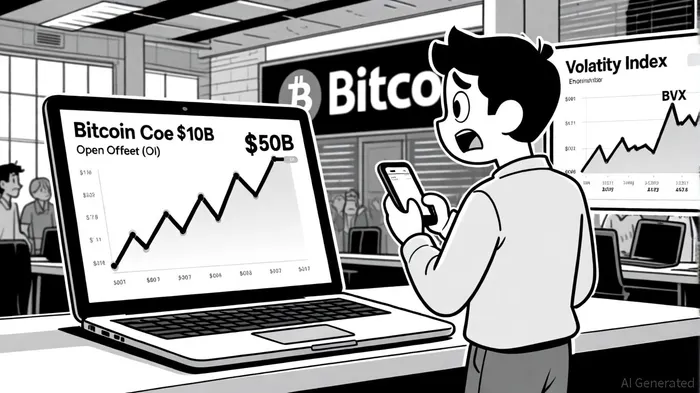
The BitcoinBTC-- derivatives market in 2025 has reached unprecedented scale, with notional open interest (OI) in Bitcoin options surging to $50 billion by mid-year[3]. This growth reflects a maturing ecosystem where institutional and retail participants increasingly use options to hedge, speculate, and manage risk. However, the interplay between rising options volumes and Bitcoin's price stability remains a contentious topic. While bullish positioning dominates—70% of open contracts are call options[3]—volatility dynamics, expiry events, and macroeconomic factors complicate the narrative of stability.
Speculative Positioning and Institutional Participation
Bitcoin's options market has become a barometer of speculative sentiment. As of Q2 2025, 55% of institutional crypto exposure is routed through derivatives[1], with Bitcoin and EthereumETH-- accounting for 68% of total derivatives activity[1]. The dominance of call options (70% of open contracts[3]) underscores a bullish bias, driven by factors like U.S. election-related capital inflows and the proliferation of structured products such as Cboe's MBTX options[2].
Institutional participation has further amplified this trend. Paradigm's institutional network alone contributes 33–36% of Deribit's monthly volume[1], while CME Group's regulated venue hosts $4 billion in notional OI[3]. This institutionalization has introduced sophisticated strategies, including volatility arbitrage and gamma hedging, which can stabilize prices during low-volatility periods but exacerbate swings during high-impact events.
Volatility Dynamics: Jumps, Smirks, and Models
Bitcoin's volatility is inherently tied to its options market structure. Short-maturity options exhibit "smiles" in their pricing, while long-maturity contracts show "smirks," reflecting asymmetric demand for downside protection[1]. Advanced models like ARJI-EGARCH[1]—which incorporate time-varying jumps and asymmetric volatility—have proven superior to traditional GARCH models in forecasting Bitcoin's price behavior. This is critical for managing risk in a market where "jump risk" (sudden, large price movements) accounts for 20% of spot volatility[4].
The CF Bitcoin Volatility Index (BVX), launched in April 2024, now serves as a real-time benchmark for implied volatility[5]. As of September 2025, BVX readings have spiked to 85% during major expiry events, underscoring the market's sensitivity to derivatives activity. For example, the $11.8 billion options expiry on September 19, 2025, triggered a 12% price swing as traders adjusted to new equilibrium levels[5].
Expiry Events and the "Max Pain" Theory
Bitcoin options expiries have become pivotal for short-term price stability. The "max pain" theory—which posits that prices gravitate toward strike prices with the highest financial loss for option holders—has shown 73% accuracy across 37 monthly expiries[6]. For instance, the September 2025 expiry had a max pain level at $114,000, pulling Bitcoin's price within 2.6% of that level[6].
Large expiries also amplify volatility. The $23 billion Bitcoin and Ethereum expiry in September 2025, 1.2 times the size of the entire crypto market, led to a 15% intraday swing as market makers rebalanced portfolios[6]. Such events highlight the dual role of derivatives: they provide liquidity but also create gravitational forces that can destabilize prices.
Macroeconomic Crosscurrents: USD Correlation and Liquidity
Bitcoin's inverse correlation with the U.S. Dollar Index (historical range: -0.3 to -0.6[4]) remains a key macro driver. As the dollar weakened in Q3 2025, Bitcoin surged to $117,600, reflecting its role as a hedge against fiat devaluation[6]. Additionally, global M2 money supply growth has shown a 10-week lead-lag relationship with Bitcoin prices[3], suggesting that liquidity trends influence derivatives activity and price stability.
Conclusion: Balancing Bullish Sentiment and Volatility Risks
While Bitcoin's derivatives market demonstrates robust institutional participation and bullish positioning, price stability remains contingent on managing volatility risks. The interplay of expiry events, jump dynamics, and macroeconomic factors ensures that Bitcoin's price trajectory will remain a tug-of-war between speculative optimism and structural volatility. For investors, the key lies in hedging against expiry-driven swings while leveraging the growing sophistication of volatility products like BVX and structured options.





Comentarios
Aún no hay comentarios