
Bitcoin's Price Response to Fed Rate Cuts and the Strategic Case for Digital Asset Allocation
The Fed's Easing Cycle and Bitcoin's Macroeconomic Role
The Federal Reserve's September 17, 2025, rate cut—marking the first in a projected easing cycle—has reignited debates about Bitcoin's role as a macro-hedging asset. With the Fed now targeting a 3.75%–4.00% range, markets are pricing in further cuts to combat slowing growth and inflationary pressures[1]. Historically, Bitcoin's response to rate cuts has been anything but linear. During the 2020 pandemic, BitcoinBTC-- plummeted to $3,800 amid zero-rate policy but later surged to $29,000, driven by liquidity injections and risk-on sentiment[4]. Similarly, a 50-basis-point cut in July 2024 catalyzed a $59,000-to-$62,000 rally[4]. These patterns underscore a critical insight: Bitcoin thrives in environments of monetary expansion, even if short-term volatility obscures long-term trends.
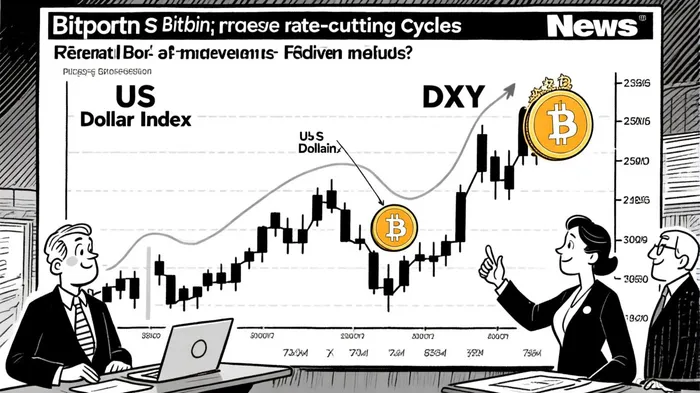
The Fed's easing cycle reduces the opportunity cost of holding non-yielding assets like Bitcoin, while a weaker U.S. dollar amplifies demand for dollar-denominated alternatives[5]. A 2020–2025 white paper notes that Bitcoin's correlation with equities (e.g., S&P 500) has strengthened during market stress, whereas its link to inflation metrics like CPI remains tenuous[5]. This positions Bitcoin as a high-beta technology asset, not a traditional inflation hedge. Yet, as the Fed normalizes policy, Bitcoin's inverse relationship with the dollar and its appeal to institutional investors—bolstered by ETF inflows and corporate reserve allocations—suggest a strategic shift in capital flows[4].
Strategic Implications for Digital AssetDAAQ-- Allocation
For investors, the Fed's easing cycle presents a dual opportunity: hedge against dollar depreciation while capitalizing on risk-on liquidity. Bitcoin's projected surge into Q4 2025 and potential $135,000 target by Q1 2026 hinges on sustained monetary easing and institutional adoption[4]. Meanwhile, Ethereum's proof-of-stake model offers a complementary strategy. With staking yields of 3–5%, EthereumETH-- bridges the gap between Bitcoin's macro-hedging role and yield-seeking alternatives[1]. Analysts project Ethereum could reach $5,200 by early 2026, driven by DeFi growth and regulatory clarity[4].
However, volatility remains a wildcard. Short-term pullbacks could emerge from stagflation fears or regulatory shifts, particularly as the Fed's political independence faces scrutiny[3]. Investors are advised to adopt a dual-asset approach: allocate Bitcoin as a macro hedge and Ethereum for yield and growth, while maintaining liquidity to navigate near-term turbulence[1].
The Case for Rebalancing Portfolios
As the Fed's easing cycle unfolds, traditional fixed-income assets face diminishing returns. The “belly” of the Treasury yield curve (3–7 years) offers a modest yield-income trade-off, but long-dated bonds remain vulnerable to a non-recessionary environment[2]. In contrast, Bitcoin's scarcity and decentralized nature position it as a durable store of value amid fiat erosion. For crypto-native investors, this is not speculative—it's a recalibration of risk.
Retail and institutional investors alike should prioritize Bitcoin exposure as a counterbalance to dollar weakness and a catalyst for capital appreciation. With the Fed signaling more cuts ahead, the window to position for a digital asset-driven recovery is narrowing[1].
Conclusion
The Fed's normalization of monetary policy is reshaping the investment landscape. Bitcoin's historical performance during rate cuts, coupled with its inverse correlation to the dollar, makes it a compelling macro-hedging asset. While volatility persists, the strategic case for Bitcoin—and its complementary role with Ethereum—has never been clearer. For investors seeking to future-proof their portfolios, the message is unequivocal: allocate to Bitcoin as a cornerstone of alternative investments in a Fed-driven easing cycle.






Comentarios
Aún no hay comentarios